
Kids Lunch Boxes and Water Bottles: School Tableware Buying Guide

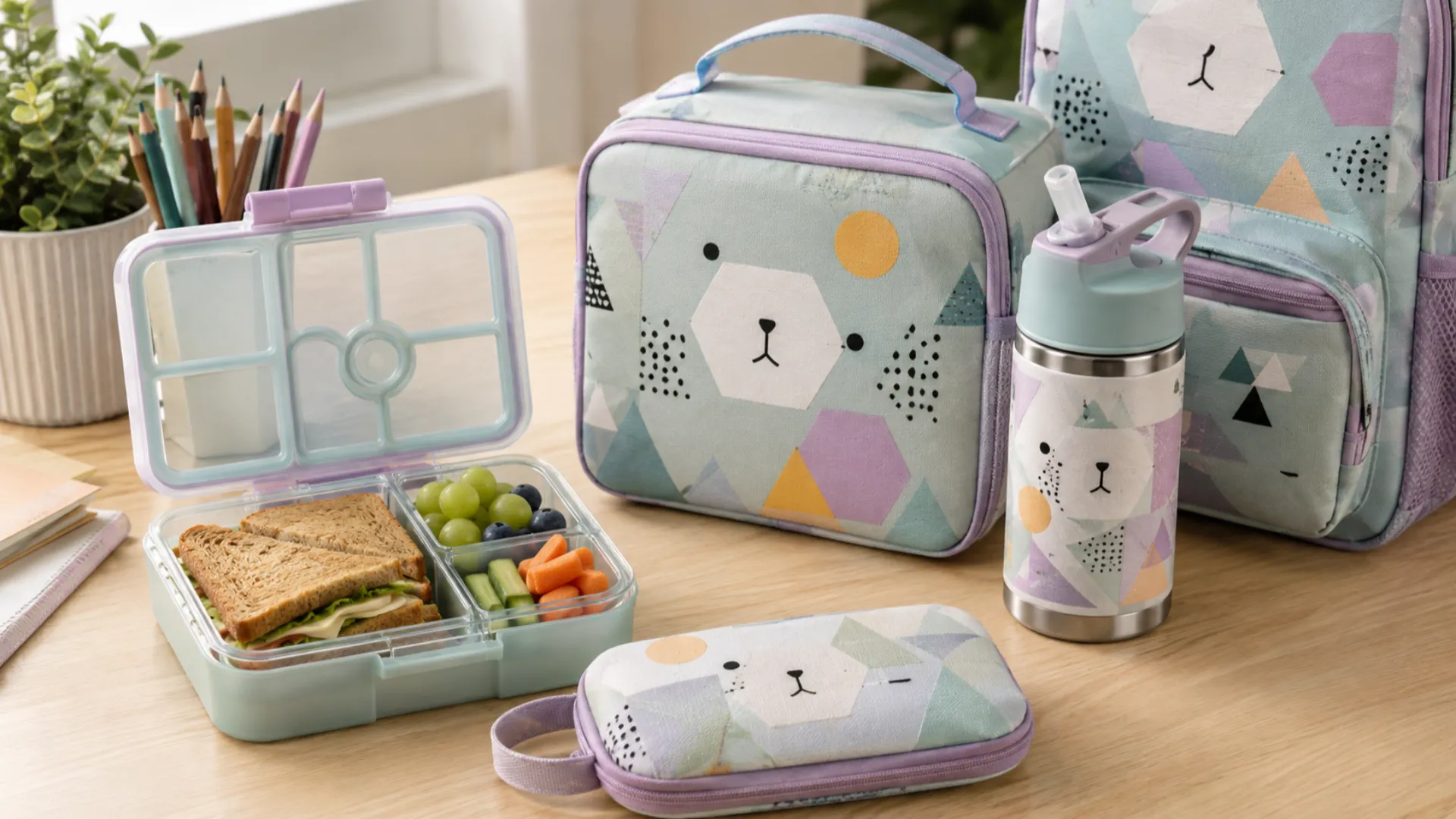
Choosing a kids lunch box involves more than choosing a color or counting compartments. The size, usable capacity, material, lid design, gasket, latch, cleaning access, and opening force all affect how the box performs during a normal school day.
Parents usually check whether the box holds the expected meal, fits inside a lunch bag, can be washed without food remaining in hidden grooves, and can be opened by the child without help. Children notice color, graphics, shape, and whether the lid or clips are easy to use. Retailers also need to consider price levels, packaging, returns, color assortments, matching products, and repeat orders.
For wholesale buyers, the evaluation goes further. Materials must be identified correctly, food-contact documentation should match the actual product, physical samples need to be filled and leak-tested, and production specifications should define the lid, gasket, clips, compartments, packaging, and carton quantities.
A complete school lunch setup often includes kids water bottles, an insulated lunch bag, a backpack, and other kids tableware. This guide therefore treats the lunch box as the main product and water bottles as an important supporting category. The aim is to help parents, retailers, importers, and distributors compare real product structures rather than rely on claims such as “large capacity,” “leakproof,” or “easy clean” without checking what those claims mean for the finished product.
Why Kids Lunch Boxes Matter in School Product Assortments
A school lunch box goes through the same cycle many times. Food is packed at home, the box is placed inside a lunch bag or backpack, it is carried to school, opened by a child, closed again, returned home, washed, dried, and used again.
Small design problems become obvious during this routine.
A latch may be secure but too stiff for a young child. A box may look large but lose considerable internal space to a thick lid and deep dividers. A silicone gasket may reduce leakage but sit inside a narrow groove that is difficult to clean. A bottle may hold enough water but be too wide for the side pocket of the intended backpack.
A practical kids lunch box must therefore work through the complete daily routine, not only look attractive when empty.
Daily School Use
A practical school lunch box should allow the user to:
- Pack the intended meal without forcing food against the lid.
- Separate foods where separation is useful.
- Fit the box inside the intended lunch bag.
- Open the box without excessive hand force.
- Close every latch or lid correctly.
- Carry it without accidental opening.
- Reach corners, seals, and removable parts during cleaning.
- Dry the product properly before the next use.
The same principle applies to kids water bottles. A bottle needs to fit the child, the school routine, and the backpack rather than simply provide the largest possible capacity.
Parent, Child, and Retail Buyer Priorities
Parents, children, and commercial buyers evaluate the same product from different perspectives.
| User | Main Priorities |
|---|---|
| Parents | Cleaning, meal capacity, materials, leakage, opening, product weight |
| Children | Colors, graphics, size, simple opening, easy carrying |
| Retail Buyers | Price point, packaging, returns, assortment, seasonal replenishment |
| Wholesale Buyers | Specifications, samples, documentation, MOQ, packaging, batch consistency |
A useful product range should satisfy these different needs without adding features that make the product heavier, harder to clean, or unnecessarily expensive.
Lunch Boxes as Part of a Back-to-School Range
Lunch boxes commonly sit beside:
- Backpacks
- Lunch bags
- Water bottles
- Pencil cases
- Notebooks
- Stationery sets
Retail buyers planning a complete seasonal assortment can use our back-to-school essentials checklist to compare the school, lunch, stationery, and carrying products commonly purchased together.
A coordinated range can also make store displays easier to understand. Customers can quickly identify which products share the same colors, graphics, or intended age group.
Lunch Box, Bento Box, Food Container, and Lunch Bag: What Is the Difference?
Clear terminology helps buyers compare the correct product structures.
Kids Lunch Box
A kids lunch box is the broad category term for a reusable container used to carry a child’s meal or snacks.
It may be:
- Single-compartment
- Multi-compartment
- Bento style
- Removable-tray
- Stackable
- Plastic
- Stainless steel
- Mixed-material
The product name alone does not explain how the box seals, how much usable space it provides, or how difficult it is to clean.
Kids Bento Box
A kids bento box usually divides one outer container into several sections.
Typical compartments may hold:
- A sandwich or other main food
- Fruit
- Vegetables
- Crackers
- A small side item
A bento layout provides visual separation, but it does not automatically make every compartment liquid-tight.
If the top of a divider does not contact the lid or gasket, liquids can move from one section to another even when nothing leaks outside the box.
That distinction is important when comparing bento boxes for kids.
Food Containers
Smaller food containers may include:
- Snack boxes
- Fruit containers
- Dip containers
- Small side containers
- Stackable containers
They can supplement a main lunch box and provide more flexibility for different meals.
Insulated Lunch Bags
A lunch bag is an outer carrying product.
It may:
- Hold the lunch box
- Carry a snack
- Carry a bottle
- Protect the containers during transport
- Provide thermal buffering depending on its construction
It does not replace the primary food container.
The lunch box and lunch bag should always be checked together for size compatibility.
Common Kids Lunch Box Formats
Retailers do not need many almost-identical products. A stronger assortment contains a limited number of clearly different structures for different meals, age groups, and price levels.
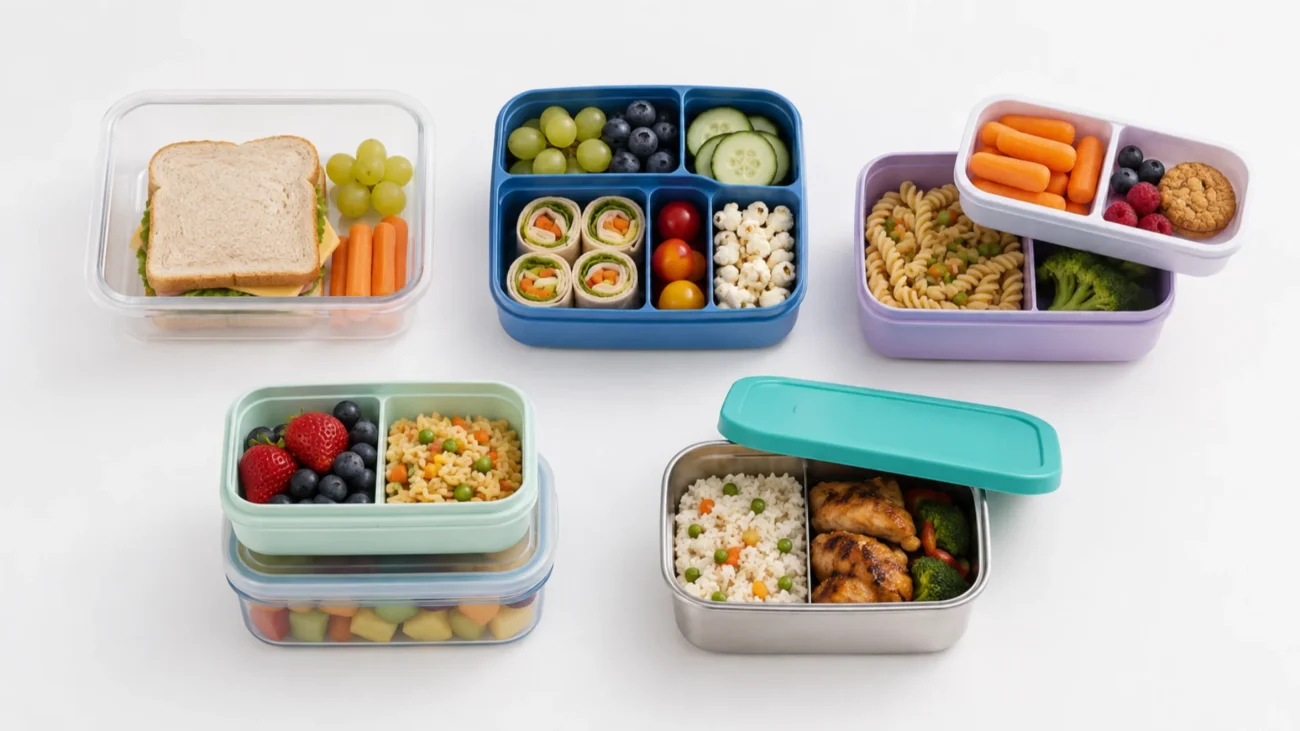
Single-Compartment Lunch Boxes
A single-compartment box provides one uninterrupted internal space.
Its advantages include:
- Flexible volume
- Fewer parts
- Easier washing
- Fewer pieces to lose
- Lower structural complexity
It works well for:
- Sandwiches
- Bread
- Whole fruit
- Large dry foods
- Simple packed meals
The main limitation is separation. Small or moist foods may need an additional container.
Bento Boxes for Kids
Bento boxes for kids provide several fixed or removable sections.
When evaluating one, check:
- Number of sections
- Actual size of each section
- Divider height
- Corner depth
- Lid alignment
- Gasket contact
- Food movement during transport
Five compartments are not necessarily better than three. If several sections are too small for normal food, they reduce useful capacity.
A practical sample should be loaded with real foods similar to those shown in the product listing.
Lunch Boxes with Removable Trays
A removable tray can make one outer box suitable for several meal layouts.
Check whether the tray:
- Sits flat inside the box.
- Can be removed without excessive force.
- Has smooth edges.
- Returns to the correct position.
- Does not interfere with the seal.
- Can be washed separately.
The tray should not shift when the lunch box is carried.
Stackable Food Containers
Stackable products place foods in separate vertical containers.
They can work well for:
- Fruit
- Snacks
- Dry foods
- Different meal times
However, they add:
- More lids
- More seals
- More cleaning steps
- More assembly
- Greater total height
The complete stack should be tested inside the intended lunch bag rather than evaluated one section at a time.
Stainless Steel Lunch Boxes for Kids
A stainless steel lunch box for kids may use:
- A full metal container
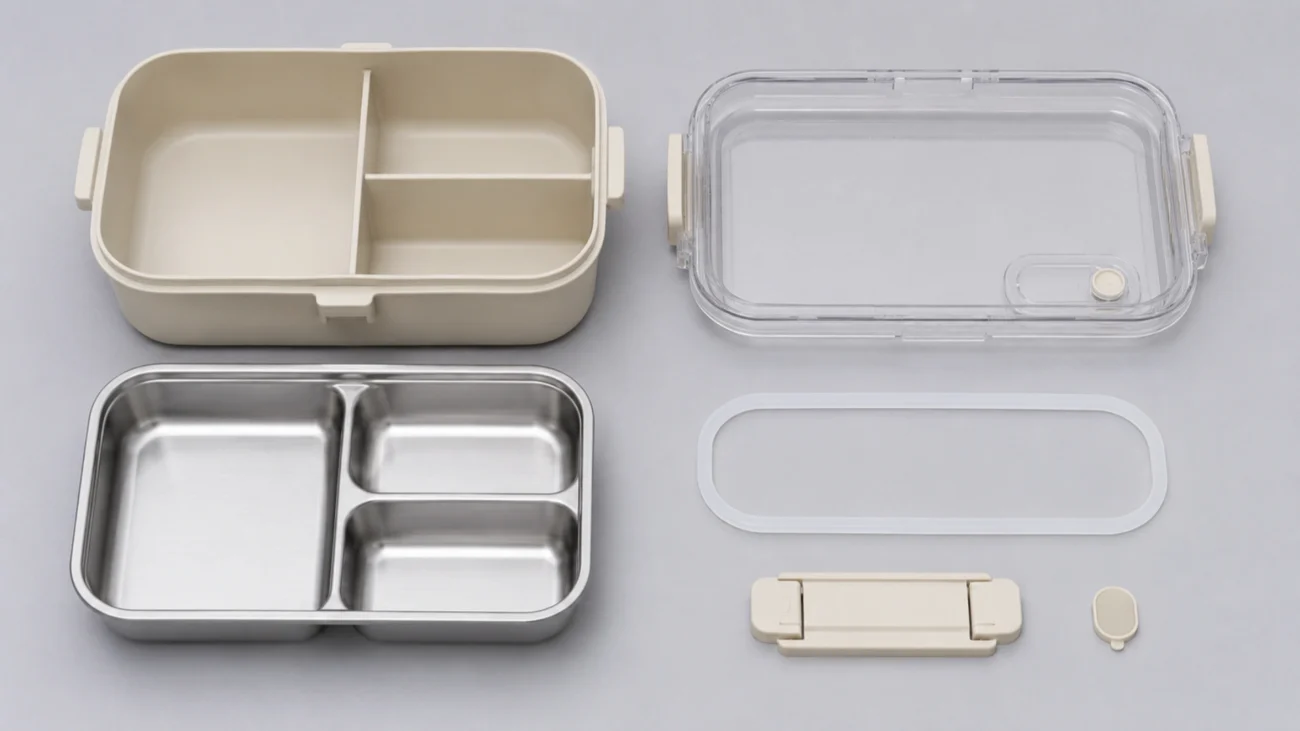
- A stainless steel inner tray
- A stainless steel food section inside a plastic shell
- Metal sections combined with silicone and plastic
Key checks include:
- Metal thickness
- Edge finishing
- Surface finish
- Dents
- Product weight
- Lid fit
- Gasket fit
- Compatibility with the intended use
Stainless steel is not automatically better than plastic. It changes the weight, price, surface characteristics, and appliance limitations of the product.
The correct choice depends on the intended user and complete product structure.
Insulated Food Jars
Food jars are a separate format for meals intended to be carried warm or cool.
Buyers should review:
- Internal material
- Lid threads
- Opening diameter
- Gasket
- Empty weight
- Cleaning access
- Tested temperature-retention information
A fixed statement such as “keeps food hot for six hours” should only be used when supported by data for the specific finished product.
Materials Used in Kids Lunch Boxes
Material selection affects weight, shape, cleaning, surface appearance, sealing, durability, and the documentation required for the intended market.
Polypropylene and Other Plastic Components
Polypropylene is commonly used for containers, lids, latches, dividers, and other molded parts.
When reviewing plastic lunch boxes for kids, check:
- Exact material identification
- Wall thickness
- Mold quality
- Surface texture
- Odor
- Hinge design
- Latch movement
- Color consistency
- Warping
- Finished product weight
Do not infer microwave, dishwasher, freezer, or hot-food suitability from the polymer name alone.
The completed product may also contain:
- Silicone
- Printing ink
- Adhesives
- Different lid plastics
- Decorative coatings
Those components can have different use limitations.
Transparent Plastics
Transparent components allow children and parents to see the contents without opening the box.
Check:
- Material identification
- Clarity
- Scratching
- Clouding
- Lid fit
- Mold marks
- Surface wear after repeated cleaning
A transparent component should not be described as a particular polymer unless the supplier documentation identifies it.
Stainless Steel
When evaluating stainless steel components, inspect:
- Material specification
- Thickness
- Rim finish
- Corners
- Surface polish
- Dents
- Connection to the lid
- Overall product weight
A stainless steel tray with a poorly fitting plastic lid can still perform poorly as a lunch box.
Silicone Components
Silicone is commonly used for:
- Gaskets
- Plugs
- Valves
- Flexible dividers
- Grip parts
Check:
- Odor
- Flexibility
- Shape recovery
- Surface quality
- Fit in the groove
- Removal
- Reinsertion
- Cleaning access
A seal that is easy to remove but easy to install incorrectly can create leakage complaints.
Mixed-Material Lunch Boxes
Many kids lunch boxes combine several materials.
Common examples include:
- Plastic shell with a stainless steel tray and silicone gasket
- Plastic box with a transparent lid and silicone seal
- Stainless steel container with plastic clips
- Plastic container with a removable silicone divider
Each material should be reviewed as part of the completed product rather than in isolation.
For products intended for the United States, buyers should review FDA information on food-contact substances and finished food-contact materials when checking the components used in a lunch box or bottle.
Lunch Box Material Comparison
| Material | Weight | Main Advantage | Main Buyer Check |
|---|---|---|---|
| Plastic | Usually light | Flexible shapes and colors | Material, molding, hinges, use conditions |
| Transparent plastic | Light to medium | Visible contents | Material identification, scratches, clarity |
| Stainless steel | Medium to heavy depending on design | Smooth, rigid food-contact surface | Edges, thickness, weight, lid fit |
| Silicone | Flexible | Sealing and flexible parts | Fit, odor, cleaning, recovery |
| Mixed materials | Varies | Combines several functions | Compatibility between all components |
Lunch Box Compartments, Lids, Seals, and Leak Resistance
This is one of the most important areas for reducing avoidable customer complaints.
Fixed vs. Removable Compartments
Fixed dividers:
- Cannot be lost.
- Require less assembly.
- Provide a stable layout.
- Limit meal-layout flexibility.
Removable dividers:
- Allow more configurations.
- Add cleaning steps.
- Can move during use.
- Can be installed incorrectly.
The right structure depends on the meal and the age of the user.
Lid-to-Compartment Contact
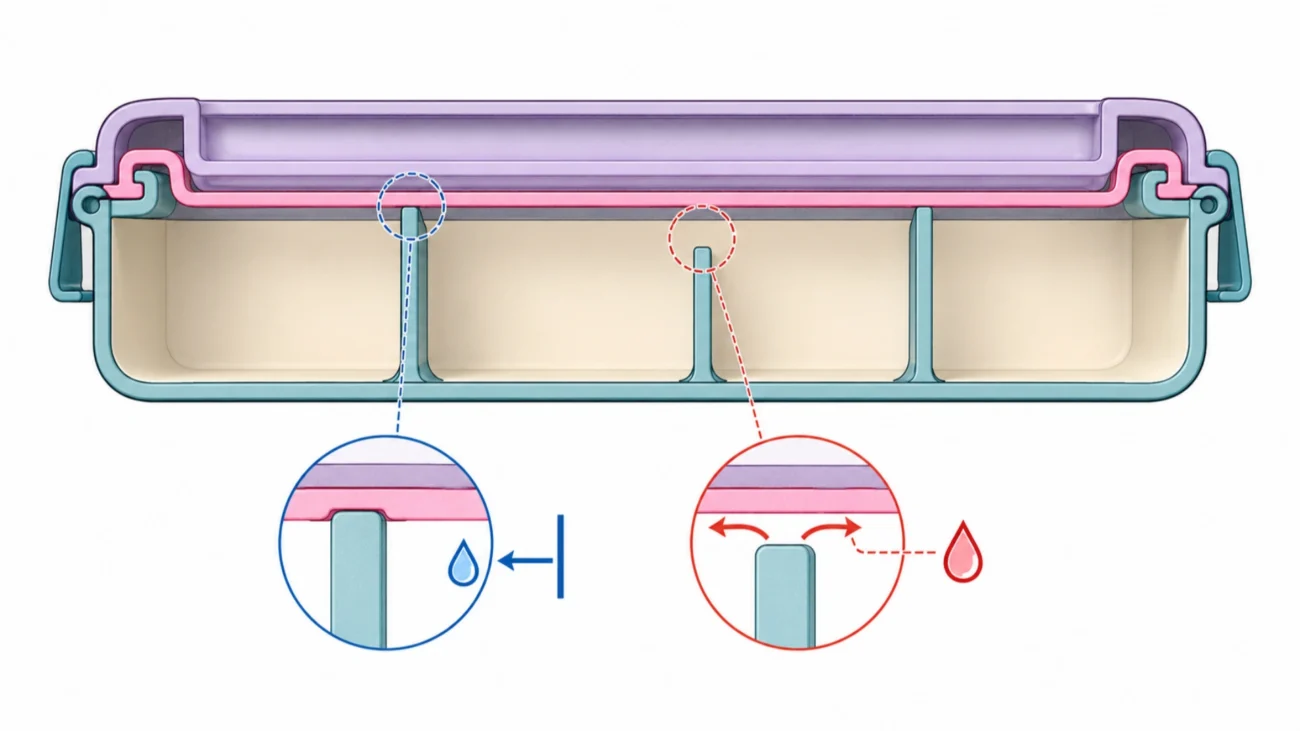
A divided lunch box has two different leakage questions:
- Does liquid leave the outer box?
- Does liquid move from one internal compartment to another?
These are not the same test.
For internal separation, inspect:
- Divider height
- Lid flatness
- Gasket shape
- Pressure on each divider
- Lid deformation
- Gaps around corners
A box may pass an external leak test but still allow food to mix internally.
Silicone Gaskets
Remove the gasket when reviewing a sample.
Check:
- Whether the seal is continuous
- Whether it sits flat
- Whether the corners lift
- Whether the groove traps water
- Whether the gasket stretches during removal
- Whether it returns to the correct position
Cleaning performance matters as much as the initial seal.
Hinges, Clips, and Latches
For latches and clips, inspect:
- Opening force
- Closing force
- Alignment
- Sharp mold lines
- Stress whitening
- Cracking
- Hinge flexibility
- Feedback when fully closed
A latch should be secure enough for transport but manageable for the intended age group.
Leak-Resistant vs. Leakproof Lunch Boxes
These claims should not be treated as synonyms.
Leak-resistant is a more limited claim. It indicates that the construction reduces leakage under specified normal conditions.
Leakproof is a stronger claim and should be tied to a repeatable test of the complete product.
Buyers should also define what is being tested:
- Water
- Thick sauce
- Yogurt
- Juice
- External leakage
- Internal compartment migration
A leakproof lunch box for kids should not be promoted for soup or other thin liquids unless the product has been tested for that use.
Practical Lunch Box Leak Test
Use a repeatable procedure rather than an informal visual inspection.
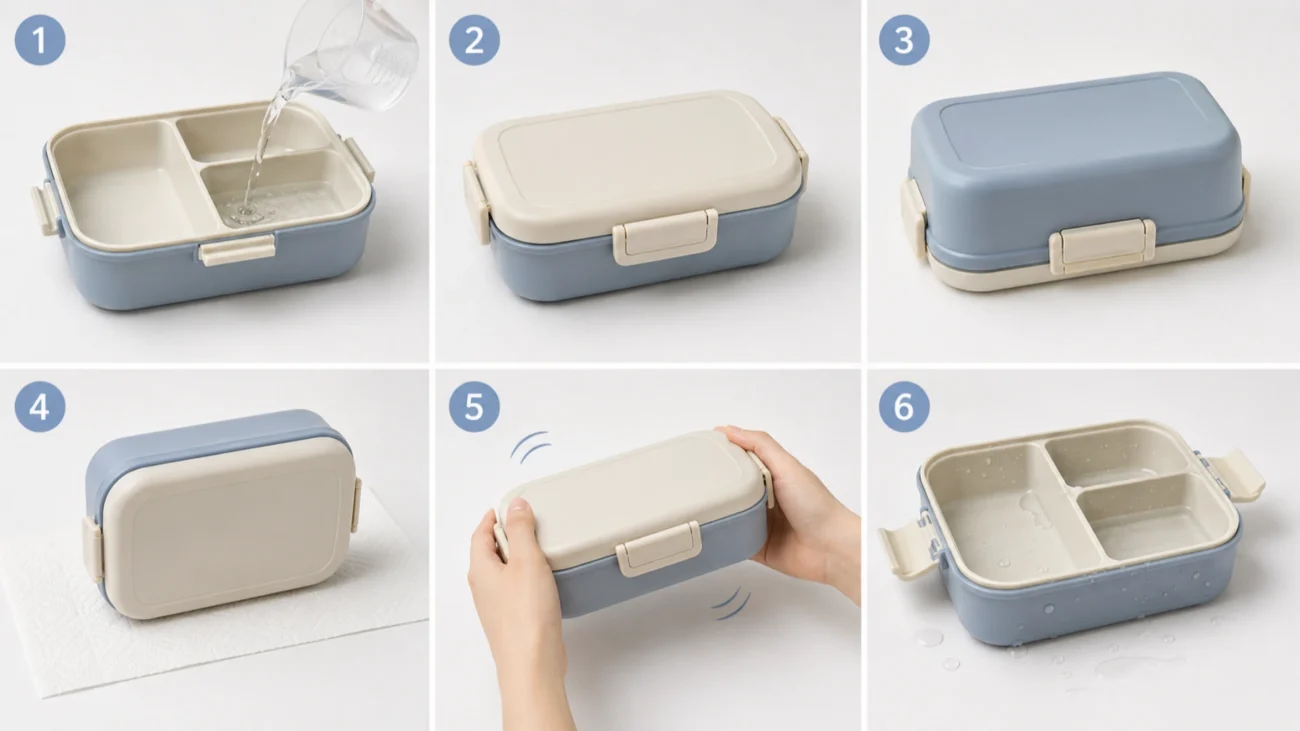
- Add a measured amount of water to the intended compartment.
- Close the lid exactly as instructed.
- Leave the box upright.
- Invert the box.
- Place it on one side.
- Place it on the opposite side.
- Shake it gently.
- Place it inside the intended lunch bag.
- Inspect the exterior.
- Open the box and inspect movement between compartments.
Record:
- Water quantity
- Test duration
- Orientation
- External leakage
- Internal leakage
- The compartment where leakage occurred
The same conditions can then be repeated on another sample or production batch.
How to Choose the Right Kids Lunch Box Size
There is no single lunch box capacity that suits every child.
Snack Boxes
Snack containers prioritize:
- Small size
- Low weight
- Fast opening
- Easy cleaning
They suit fruit, crackers, small sandwiches, and short activities.
Preschool Lunch Boxes
For preschool use, buyers should prioritize:
- Low empty weight
- Simple latches
- Manageable dimensions
- Smaller meal space
- Compatibility with compact lunch bags
A large box does not automatically provide better value for a young child.
School Lunch Boxes for Elementary Students
A typical school lunch box may need to hold:
- One main food
- Fruit
- A side food
- A snack
The exact layout depends on the local meal style and customer preferences.
A bento arrangement may work better for separated portions. A single compartment may work better for a sandwich combined with separate snack containers.
Buyers comparing lunch-box sizes by age can also review our school supplies list by grade to see how daily school and carrying needs change from preschool through middle school.
Larger Lunch Boxes
Larger products may serve older students or larger meals, but increasing size also increases:
- Filled weight
- Lunch-bag size
- Backpack space
- Cleaning area
The additional capacity should solve a real use case.
External Dimensions vs. Usable Capacity
External dimensions are reduced internally by:
- Thick lids
- Gaskets
- Raised dividers
- Stainless steel inserts
- Curved corners
- Latch housings
- Removable trays
For product specifications, record both external dimensions and internal usable space or measured capacity.
| Use | Typical Structure | Main Capacity Question |
|---|---|---|
| Snack | Small single or multi-compartment | Does it hold the intended snack without unnecessary size? |
| Preschool | Compact single or Bento | Can the child carry and open it easily? |
| Elementary | Standard Bento or single compartment | Does it hold the normal school meal? |
| Larger meal | Deep or stackable | Is the extra volume worth the additional weight and space? |
Kids Water Bottles as a Supporting School Tableware Category
Kids water bottles belong naturally in the same retail range, but their design decisions differ from lunch boxes.
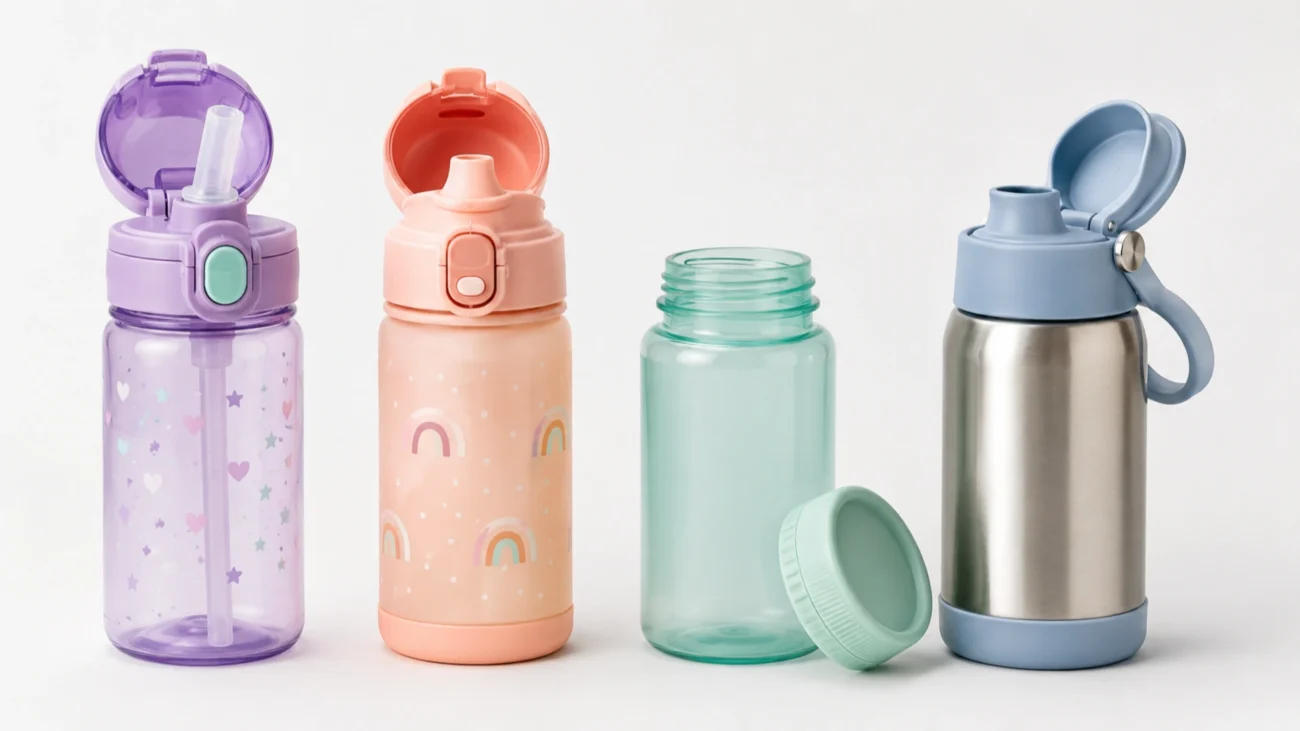
The main questions are:
- How does the child drink from the bottle?
- How many removable parts are inside the lid?
- Can those parts be cleaned?
- Does the bottle leak after repeated opening?
- What is its filled weight?
- Does it fit the backpack side pocket?
Straw Water Bottles for Kids
A straw bottle may include:
- Mouthpiece
- Protective cover
- Upper connector
- Internal straw
- Air vent
- Valve
- Gasket
The more parts the lid contains, the more important disassembly and cleaning become.
Check:
- Straw length
- Connection strength
- Water flow
- Ease of removal
- Cleaning access
- Replacement availability
Flip-Top School Water Bottles
A flip-top school water bottle may use:
- Push button
- Hinged cover
- Lock
- Drinking spout
- Gasket
Test whether the lid gives a clear indication that it has fully closed.
An easy-open button is useful only if it does not open accidentally inside a school bag.
Screw-Top Water Bottles
Screw-top bottles usually have fewer moving parts.
Possible benefits include:
- Wide opening
- Easier access for cleaning
- Fewer hinges
- Fewer valves
The main question is whether the child can tighten the lid correctly and consistently.
Stainless Steel Water Bottles for Kids
When evaluating a stainless steel bottle, check:
- Empty weight
- Body diameter
- Rim
- Interior finish
- Exterior coating
- Lid compatibility
- Filled weight
A bottle that feels light when empty may become much heavier after it is filled.
Insulated Water Bottles for Kids
An insulated water bottle for kids usually adds a second wall and therefore additional material and weight.
Buyers should verify:
- Capacity
- Empty weight
- Lid construction
- Gasket
- Opening size
- Temperature-retention claims
Do not apply the same retention time to different bottle structures unless the actual products support the claim.
Choosing Water Bottle Capacity, Lids, Straws, and Seals
Capacity and Filled Weight
Consider:
- Age
- Length of the school day
- Access to refilling
- Climate
- Empty bottle weight
- Filled bottle weight
- Backpack pocket size
A larger bottle is not useful if the child avoids carrying it because of the weight.
Buyers planning the complete school carrying system can use our kids backpack buying guide to compare bottle-pocket dimensions, backpack capacity, and loaded-use testing before selecting a bottle size.
Straw Connections and Valves
Check:
- How firmly the straw connects to the lid
- Whether it reaches the correct depth
- Whether the valve restricts flow
- Whether the valve can be removed
- Whether a cleaning brush can reach the internal channel
Lid Threads and Flip Mechanisms
For screw-top lids:
- Check thread alignment.
- Look for cross-threading.
- Repeat tightening.
- Inspect gasket compression.
For flip-top lids:
- Check button resistance.
- Check lock operation.
- Inspect hinge movement.
- Confirm full closure.
Practical Water Bottle Leak Test
- Fill the bottle with a defined amount of water.
- Close it correctly.
- Invert it.
- Leave it on its side.
- Shake it gently.
- Place it in a backpack side pocket.
- Open and close the lid repeatedly.
- Repeat the leak test.
Record where any water appears:
- Thread
- Spout
- Straw connection
- Air vent
- Gasket
- Button mechanism
Cleaning Kids Lunch Boxes and Water Bottles
Cleaning should be treated as part of product design rather than an afterthought.
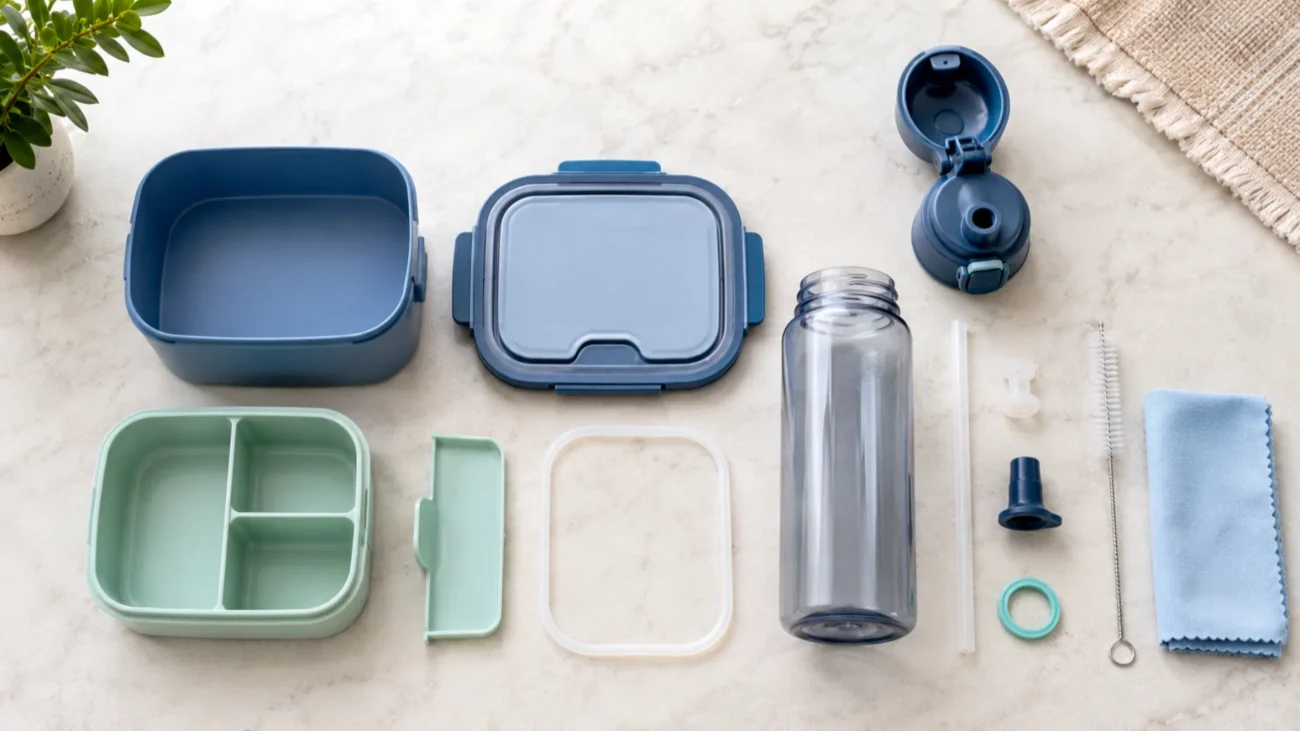
Count the Removable Parts
A lunch box or bottle may include:
- Lid
- Gasket
- Divider
- Tray
- Straw
- Valve
- Plug
- Mouthpiece
Each additional piece means another item to:
- Remove
- Wash
- Dry
- Reinstall
- Potentially lose
Hard-to-Reach Areas
Inspect:
- Gasket channels
- Narrow lid grooves
- Straw connectors
- Valve cavities
- Flip-top hinges
- Bento corners
- Divider joints
- Threaded bottle necks
A clean-looking exterior does not indicate that the internal structure is easy to wash.
Dishwasher-Safe Claims
Do not base a dishwasher-safe claim on the main plastic alone.
The finished product may include:
- Printed decoration
- Several polymers
- Silicone
- Metal
- Adhesive
- Coating
The actual finished product and stated washing conditions should support the claim.
Drying
Good product design should allow users to:
- Remove trapped water
- Open the lid fully
- Remove seals where appropriate
- Air-dry straws
- Dry internal grooves
Residual moisture in seals, channels, and valves can make routine cleaning more difficult.
Replacement Parts
For products at higher price points, retailers can consider offering:
- Replacement straws
- Replacement gaskets
- Replacement lids
- Cleaning brushes
These components can extend product use when a small part wears out or is lost.
Food-Contact Materials and Product Claims Buyers Should Verify
Food-contact requirements depend on the destination market, material, intended food, temperature, and conditions of use.
The complete product should therefore be reviewed rather than only the main container body.
Review the Complete Finished Product
Relevant components can include:
- Container
- Lid
- Gasket
- Straw
- Valve
- Divider
- Tray
- Ink
- Coating
- Adhesive
A document for the main plastic body does not automatically cover the entire finished lunch box or bottle.
BPA-Free and Similar Claims
Claims such as:
- BPA-free
- Food-grade
- Non-toxic
- Lead-free
- Phthalate-free
should be supported by documentation relevant to the actual materials and product.
Do not assume that a document for a similar container automatically covers:
- A different color
- A different polymer
- A new lid
- A new coating
- A new straw
- A different supplier
Temperature and Appliance Claims
Treat each statement as a separate claim:
- Microwave-safe
- Dishwasher-safe
- Freezer-safe
- Suitable for hot food
- Suitable for hot water
The main container and lid may have different limitations.
Buyers reviewing temperature or storage claims can use FDA food-contact conditions-of-use information to understand how different food and temperature conditions are categorized during material review.
European Union Food-Contact Materials
For products sold in the European Union, buyers should review the applicable food-contact requirements for the actual materials and finished product.
Buyers supplying the European market should review the European Commission’s food-contact-material guidance and identify the general and material-specific rules that apply to the finished lunch box or water bottle.
Documentation should correspond to the product that will actually be manufactured and sold.
Matching Lunch Box and Water Bottle Sets for Retail Programs
A matching lunch box and water bottle helps customers identify related products quickly.
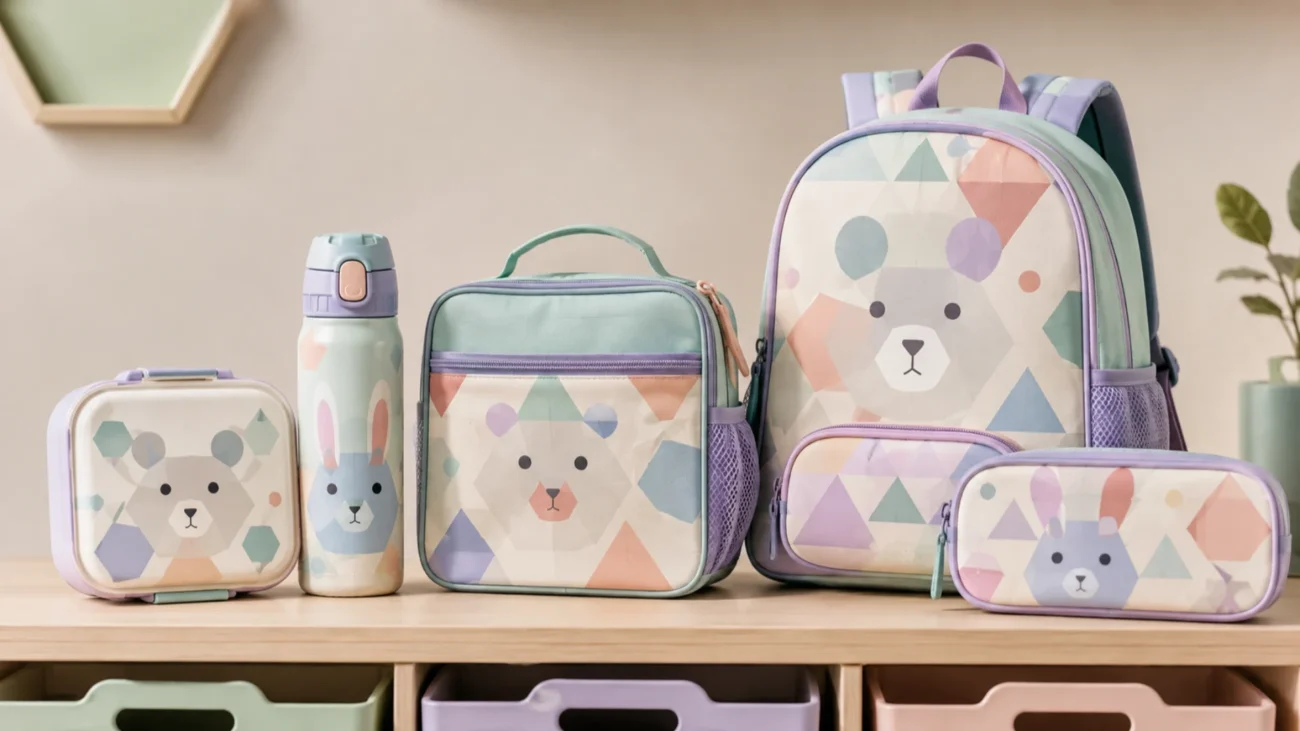
Matching Lunch Box and Water Bottle
The pair can share:
- Main colors
- Accent colors
- Original graphics
- Lid colors
- Packaging style
- Collection name
The two products do not need to be identical. They need enough consistent elements for customers to recognize them as one set.
Matching Backpacks and Lunch Bags
A broader collection can include:
- Backpack
- Lunch bag
- Lunch box
- Bottle
- Pencil case
Retailers building coordinated school collections can compare the lunch products with our kids pencil case buying guide when planning matching colors, graphics, and everyday school accessories.
Entry-Level Sets
A basic set might combine:
- Simple plastic lunch box
- Basic bottle
- Standard colors
- Simple paper sleeve or box
Mid-Range Sets
A mid-range set could combine:
- Bento lunch box
- Flip-top bottle
- Lunch bag
- Coordinated artwork
Higher-Feature Sets
A higher-feature set could combine:
- Stainless steel lunch container
- Insulated bottle
- Lunch bag
- Replacement components
- Display packaging
The price tier should be based on measurable differences rather than labels such as “premium.”
Color and Design Assortment
A controlled assortment might use:
- Two core colors
- One seasonal color
- One original printed design
This gives customers choice without multiplying the number of SKUs too quickly.
Retailers can also use our kids stationery set buying guide to plan coordinated school and gift collections around the same original artwork and color palette.
What Wholesale Buyers Should Check Before Ordering Kids Lunch Boxes
The wholesale purchasing process should convert product knowledge into measurable specifications.
Confirm a Complete Specification Sheet
For each lunch box, record:
- External dimensions
- Usable capacity
- Individual compartment capacity where relevant
- Unit weight
- Main material
- Lid material
- Gasket material
- Number of parts
- Latch structure
- Divider layout
- Use limitations
- Individual packaging
- Carton quantity
For bottles, also record:
- Nominal capacity
- Empty weight
- Diameter
- Height
- Lid type
- Straw details
- Gasket
- Packaging
Avoid specifications such as:
- High-quality plastic
- Large capacity
- Strong seal
- Premium material
These terms are not measurable.
Evaluate Physical Samples
For a lunch box:
- Load real food.
- Open and close each latch.
- Test leakage.
- Remove the gasket.
- Wash the product.
- Dry the product.
- Place it inside the intended lunch bag.
For a bottle:
- Fill it with water.
- Record filled weight.
- Test leakage.
- Test flow.
- Remove the straw.
- Wash the lid.
- Test the backpack side pocket.
Test Child-Friendly Opening
Do not judge opening force only with adult hands.
For the intended age, assess:
- Latch
- Button
- Flip top
- Screw lid
- Handle
The child needs to be able to open the product and also close it correctly.
Confirm MOQ and Mixed Colors
For wholesale lunch boxes, MOQ may differ by:
- Product structure
- Body color
- Lid color
- Printed design
- Gasket color
- Package artwork
- Individual SKU
Ask:
- Can several colors share one order quantity?
- Does each printed design have a separate minimum?
- Is custom tooling required?
- Do custom bottle lids have their own minimum?
- Can different colors be packed in one carton?
Review Customization Options
Depending on actual supplier capability, options may include:
- Molded colors
- Printed graphics
- Logo printing
- Embossing
- Lid colors
- Gasket colors
- Dividers
- Carry straps
- Paper sleeves
- Retail boxes
- Matching lunch bags
Confirm the production method before the artwork is finalized.
Check Batch Consistency
Compare bulk production against the approved sample.
Check:
- Color
- Dimensions
- Capacity
- Lid fit
- Gasket fit
- Latch force
- Straw length
- Printing
- Barcode
- Packaging contents
- Carton assortment
Review Documentation
The documentation should match:
- Current product
- Current materials
- Actual components
- Intended use
- Current supplier
- Destination market
Evaluate the Supplier
A suitable supplier should be able to provide:
- Measurable product specifications
- Sample records
- Material information
- Relevant food-contact documentation
- Packaging information
- Carton data
- Quality checks
- Repeat-order control
Before placing a larger school-product order, buyers can use our school-supplies supplier guide to evaluate communication, sample control, product consistency, export experience, and reorder support.
Retail Packaging and Carton Planning
Packaging should protect the product and present necessary information without adding unnecessary volume.
Paper Sleeves
A paper sleeve can carry:
- Product name
- Capacity
- Material information
- Barcode
- Care information
- Collection graphics
It also allows much of the lunch box to remain visible.
Individual Boxes
Boxes are more suitable for:
- Bottles
- Stainless steel products
- Product sets
- Products with loose components
Internal support should prevent unnecessary movement and surface scratching.
Protective Packaging
Protection may be useful for:
- Transparent lids
- Printed surfaces
- Loose straws
- Stainless steel surfaces
- Latches and clips
Packaging should protect the product without making unpacking unnecessarily complicated.
Retail Displays
Retail displays can organize:
- Mixed colors
- Seasonal products
- Matching sets
- Small snack boxes
- Water bottles
The color ratio should be planned rather than packed randomly.
Carton Packing
Record:
- Units per carton
- Product orientation
- Internal dividers
- Mixed-color ratio
- Net weight
- Gross weight
- Carton dimensions
- Compression risk
Heavy bottles should not be positioned in a way that crushes lighter lunch boxes during transport.
Common Mistakes When Choosing Kids Lunch Boxes and Water Bottles
- Checking only external dimensions. Thick lids and dividers may reduce useful internal space.
- Choosing too many small compartments. A complicated layout may prevent normal food from fitting.
- Assuming a bento box prevents liquid transfer. Divider height and lid contact must be checked.
- Treating leak-resistant and leakproof as the same claim. A stronger claim needs defined testing.
- Testing latches only with adults. The intended child must be able to open and close the product.
- Ignoring gasket and straw cleaning. Small channels and grooves can trap water or food residue.
- Checking only the main material. Lids, seals, valves, inks, coatings, and other components may also matter.
- Using BPA-free or food-grade claims without supporting documentation.
- Assuming one heat-resistant component makes the whole product microwave- or dishwasher-safe.
- Failing to check lunch-box, lunch-bag, and backpack compatibility.
- Starting custom artwork before confirming MOQ, tooling, and printing limits.
- Approving one sample without checking batch consistency and final packaging.
Frequently Asked Questions About Kids Lunch Boxes and Water Bottles
What Is the Best Kids Lunch Box for School?
The best kids lunch box is one that matches the child’s meal, lunch bag, age, and ability to operate the lid.
For simple dry meals, a single compartment may be enough. For several foods, a bento structure can make separation easier. The product should also be easy to clean and small enough to fit the intended carrying bag.
Are Bento Boxes for Kids Suitable for School Lunches?
Yes. Bento boxes for kids can work well when several foods need separate space.
Check the size of each compartment, divider height, lid contact, gasket design, and cleaning access. A bento structure does not automatically make every section leakproof.
What Should Buyers Check in a Leakproof Lunch Box for Kids?
For a product sold as a leakproof lunch box for kids, ask what was tested.
Check:
- External leakage
- Internal food migration
- Water or food type
- Product orientation
- Test duration
- Condition after repeated opening
The claim should match the intended use.
Are Stainless Steel Lunch Boxes for Kids Better Than Plastic Lunch Boxes?
Neither material is automatically better.
A stainless steel lunch box for kids changes product weight, surface characteristics, price, and appliance use. Plastic provides lighter structures and more molded shapes.
Compare finished products for:
- Weight
- Lid fit
- Cleaning
- Material documentation
- Intended use
- Price
What Size Kids Lunch Box Is Suitable for School?
There is no universal size.
Choose based on:
- Meal size
- Age
- Food type
- Lunch-bag size
- Backpack space
- Filled weight
A physical loading test is more useful than relying only on external dimensions.
What Size Water Bottle Is Suitable for Kids at School?
A kids water bottle should hold enough water for the school routine without becoming difficult to carry.
Consider:
- Refill access
- Empty weight
- Filled weight
- Diameter
- Height
- Backpack pocket dimensions
Are Insulated Water Bottles for Kids Worth Adding to a School Range?
An insulated water bottle for kids gives retailers another price and feature tier.
The decision depends on:
- Weight
- Cost
- Target market
- Capacity
- Tested temperature performance
Do not assume every insulated bottle provides the same retention time.
What Is the Difference Between Straw and Flip-Top Water Bottles for Kids?
A straw bottle uses an internal straw and usually includes more removable drinking components.
A flip-top bottle opens a protected drinking area using a hinged lid or button.
Straw bottles require close attention to straw and valve cleaning. Flip-top products require close attention to the button, hinge, lock, and closure.
Should Retailers Sell a Matching Lunch Box and Water Bottle?
A matching lunch box and water bottle can simplify customer selection and create a clearer back-to-school display.
The set can also be expanded with:
- Lunch bag
- Backpack
- Pencil case
- Stationery
What Should Wholesale Buyers Check Before Sourcing Kids Lunch Boxes?
Before ordering wholesale lunch boxes, buyers should check:
- Materials
- Dimensions
- Capacity
- Lid and gasket
- Opening force
- Leakage
- Cleaning
- Documentation
- MOQ
- Packaging
- Batch consistency
The written specification and approved physical sample should be used together.
Conclusion
Choosing a kids lunch box requires more than selecting a shape or printed design. Size, usable capacity, materials, compartments, lid contact, gaskets, latches, and cleaning access all affect normal school use.
Kids water bottles add a different group of checks, including capacity, empty and filled weight, lid design, straws, valves, leakage, and backpack-pocket fit.
For retailers, the strongest range is not necessarily the one with the most features. It is the one in which each structure serves a clear age group, meal type, and price level.
For wholesale buyers, product approval should include measurable specifications, physical sample testing, relevant food-contact documentation, MOQ confirmation, packaging checks, and production consistency.
Retailers and distributors can also contact the Wandefu team to discuss kids lunch boxes, school water bottles, matching products, packaging, and wholesale sourcing requirements.