
How to Choose the Right School Supplies Supplier for Wholesale Buyers

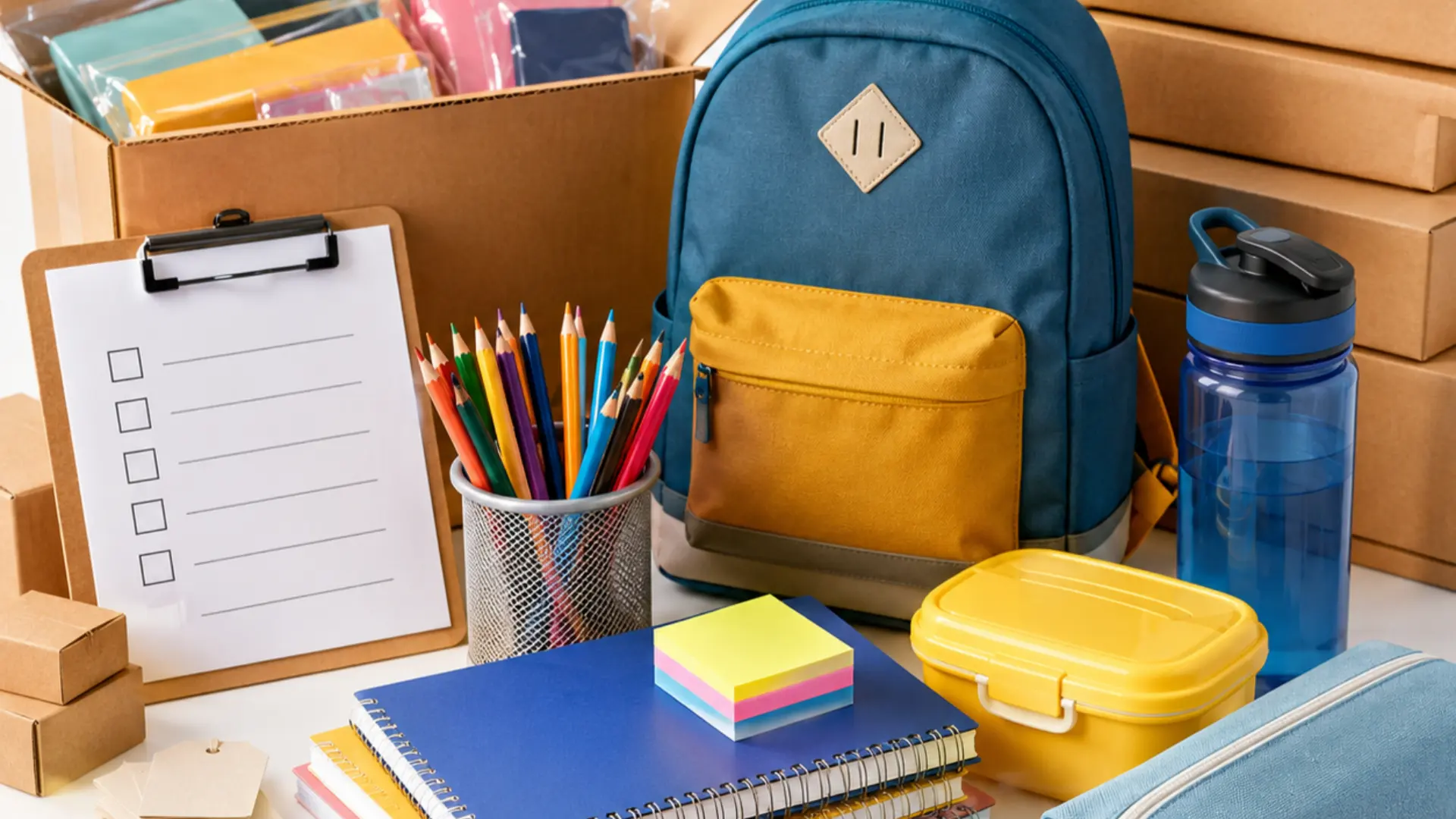
Introduction
Choosing the right school supplies supplier is a core decision for retailers, wholesalers, distributors, school procurement teams, and private-label brands. The supplier you choose affects product quality, order cost, delivery time, packaging quality, and customer reviews. A weak supplier can cause late shipments, poor printing, broken zippers, unclear invoices, and products that do not meet your market’s safety rules. A strong supplier can help you plan product lines, control MOQ, prepare samples, organize cartons, and build repeat orders.
School supplies now cover more than pencils and notebooks. A complete collection can include school stationery, pencil cases, notebooks, pens, coloring books, sticker books, backpacks, lunch bags, lunch boxes, water bottles, storage boxes, DIY craft kits, wallets, keychains, and other kids products. Many buyers also want cute themes, cartoon-style designs, private-label packaging, and ready-to-sell product sets.
This guide explains how to choose a reliable school supplies supplier for wholesale and custom orders. It covers product range, safety standards, bulk order capability, OEM and ODM options, lead time, pricing, export support, communication, and common mistakes. Use it as a practical checklist before you send a purchase order or confirm a new sourcing partner.
Browse Our School Supplies Collection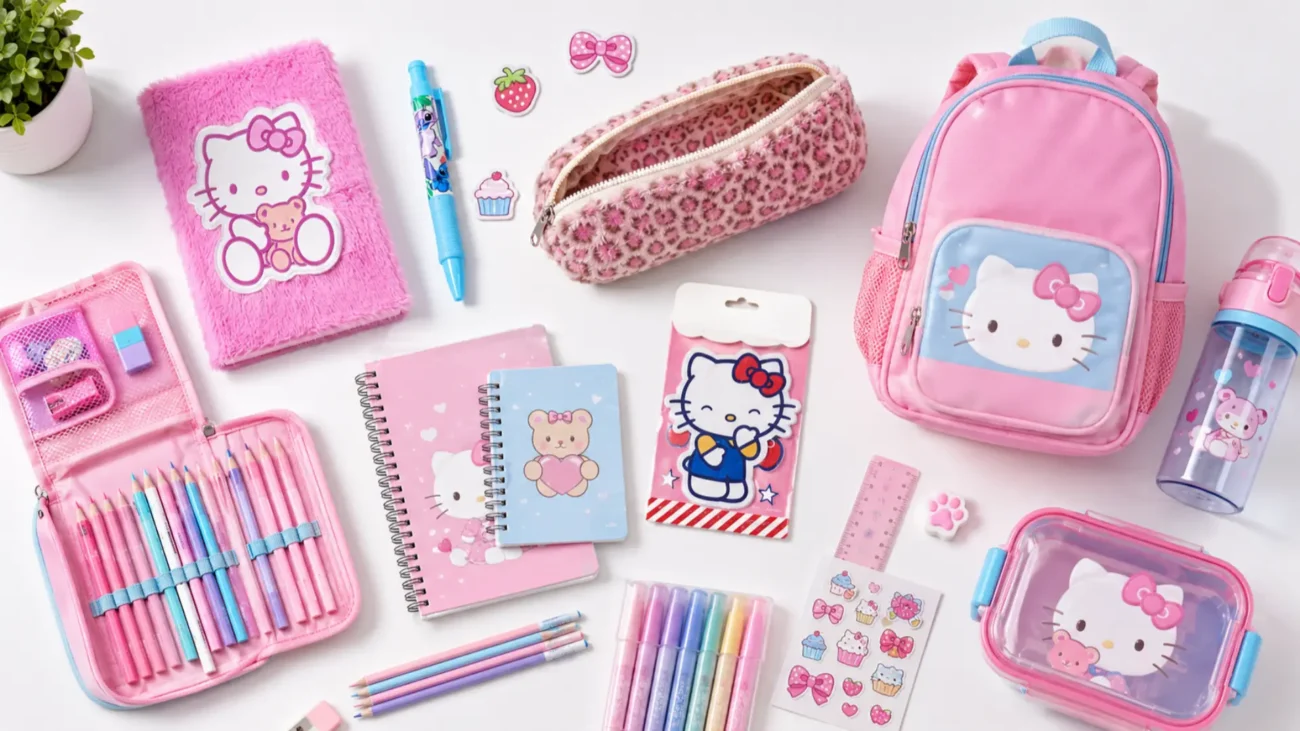
Why Choosing the Right School Supplies Supplier Matters
A school supplies supplier is not only a product source. For B2B buyers, the supplier becomes part of the supply chain. The wrong choice can affect your store shelves, online listings, promotion calendar, and after-sales workload.
Product quality affects customer trust
Children, parents, teachers, and students use school supplies every day. Small defects are easy to notice. A pencil case with a weak zipper, a notebook with loose paper, a pen that dries quickly, or a lunch box that does not close well can lead to returns and complaints.
Retailers also need products that look good in photos and on shelves. Blurry printing, uneven colors, scratched surfaces, and crushed retail boxes reduce the value of the product. If you sell through a marketplace or your own online store, these issues can also damage product ratings.
A reliable school supplies supplier should keep product quality stable from sample to bulk order. The approved sample should match the final shipment. This is more important than getting the lowest price for one order.
Stable supply protects seasonal sales
School supplies have clear selling periods. Back-to-school season, holiday gift periods, birthday gift promotions, classroom activities, and new semester campaigns all need early planning. If the supplier ships late, you may miss the sales window.
A dependable supplier helps you plan sample approval, packaging confirmation, production, inspection, carton packing, and shipment. This is especially important for wholesale stationery supplies, school bags, lunch boxes, and giftable kids stationery sets because these products often sell in seasonal collections.
Supplier mistakes can increase hidden costs
A cheap quote can become expensive if the supplier makes mistakes. Common hidden costs include:
- Replacing defective goods
- Reprinting wrong packaging
- Paying extra air freight because production was late
- Handling customer complaints
- Reworking labels or barcodes
- Losing a seasonal promotion window
When you compare suppliers, compare total risk and total landed cost, not only unit price.
Define Your Product Range Before Contacting Suppliers
Before asking for quotes, write a clear product list. This helps you choose the right school supplies supplier and avoid wasting time with suppliers that do not match your needs. Stationery supplies
Basic school stationery
Basic school stationery usually includes writing, drawing, paper, and storage products. These are common items for school supply stores, gift shops, supermarkets, online stores, and back-to-school promotions.
| Product Group | Examples |
|---|---|
| Writing tools | pencils, gel pens, ballpoint pens, markers |
| Paper products | notebooks, memo pads, folders, planners |
| School tools | erasers, rulers, sharpeners, scissors, glue |
| Storage items | pencil cases, pencil bags, file bags |
| Creative products | coloring books, sticker books, sketch books |
If your business focuses on stationery supplies, check whether the stationery supplier can offer different sizes, materials, colors, packaging options, and price levels. For example, a basic notebook for school use is different from a plush-cover journal for gift use.
Product sets and themed bundles
Product sets are useful for retail because they are easy to display and easy for customers to understand. A kids stationery set may include a pencil case, pencils, ruler, eraser, sharpener, notebook, stickers, and colored pencils. Some buyers also need back-to-school kits, birthday gift sets, holiday gift sets, or cartoon-themed stationery sets.
Ask the supplier whether they can assemble sets, add inserts, pack items into a box or tin, and apply barcode labels. If you sell through retail chains or online stores, set assembly and packaging accuracy are important.
Beyond stationery: school bags, crafts, tableware, and accessories
Many buyers need more than stationery. A broader school supplies collection may include:
- Backpacks and school bags
- Lunch bags and crossbody bags
- DIY craft kits and coloring sets
- Lunch boxes and water bottles
- Storage boxes and desk organizers
- Wallets, coin purses, keychains, and hair accessories
Working with one multi-category school supplies supplier can make product sourcing easier. It can also help you build one theme across several products, such as a matching pencil case, notebook, backpack, lunch bag, and water bottle.
DIY Craft KitsSchool BagsCheck Product Quality and Safety Standards
Quality and safety are critical for kids products. Buyers should not choose a school supplies supplier based only on product photos. You need to ask clear questions about materials, inspection, testing, and documentation.
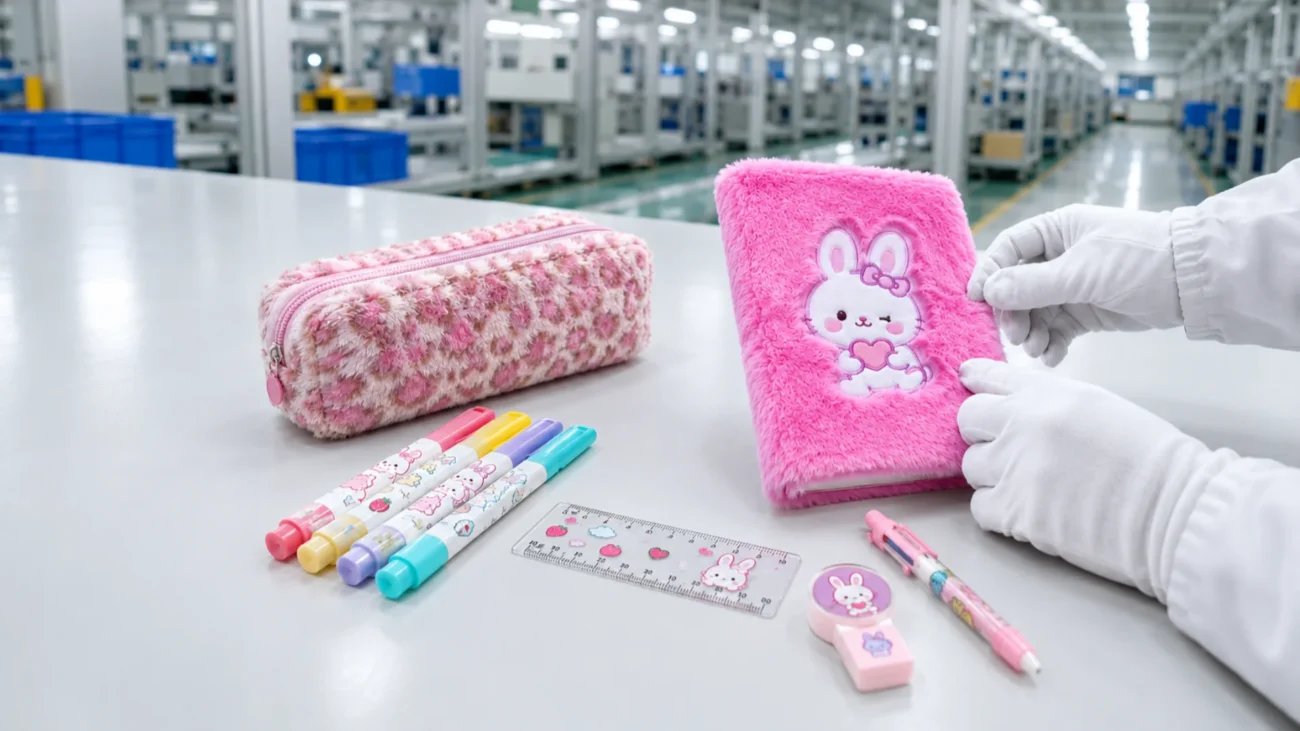
Material safety for children
Children’s products should use materials that are suitable for daily handling. Ask the supplier about:
- Non-toxic inks and paints
- BPA-free materials for lunch boxes and water bottles
- Smooth edges on plastic parts
- Strong zippers and closures
- Safe glue or adhesive
- Odor control for plastic and printed products
- Durable printing that does not peel during normal use
For products that touch food or drink, material selection is even more important. Lunch boxes, water bottles, bowls, and cups should be reviewed separately from paper and writing products.
lunch boxes and water bottlesTesting and compliance documents
Compliance needs depend on your market and product type. A buyer selling in the United States may need to consider CPSIA requirements for children’s products. The U.S. Consumer Product Safety Commission states that CPSIA addresses issues such as lead, phthalates, toy safety, third-party testing, certification, and imports. CPSIA requirements for children’s products. For products sold in the European market, REACH may be relevant for chemical substances. REACH chemical safety rules. Art materials may also need proper labeling, and the CPSC notes that art materials must undergo toxicological assessment and meet labeling requirements related to ASTM D-4236. ASTM D-4236 art material labeling guidance
Do not assume that every product needs the same report. A notebook, a pencil case, a marker set, and a lunch box can have different requirements. Ask the supplier what documents are available and whether third-party testing can be arranged for your order.
Bulk quality should match the sample
A good sample is only the first step. The real test is bulk production. Before confirming a school supplies supplier, ask how they control:
- Color consistency across batches
- Printing position and printing sharpness
- Product dimensions
- Stitching and zipper strength
- Packing quantity per carton
- Inner box and master carton quality
- Label and barcode placement
- Pre-shipment inspection
For printed products, such as cartoon notebooks, pencil cases, and bags, ask for clear photos or videos during production. For large orders, use a pre-shipment inspection before the balance payment.
Evaluate Wholesale and Bulk Order Capability
If you are buying for resale, the supplier must understand wholesale order needs. A supplier that works only with small retail orders may not be suitable for B2B sourcing.
MOQ and order flexibility
MOQ means minimum order quantity. It can be set by SKU, color, design, packaging type, or production method. Ready-made products usually have lower MOQ. Custom printing, private-label packaging, special materials, and new molds usually require higher MOQ.
Ask these questions early:
- What is the MOQ for each SKU?
- Is the MOQ per design or per total order?
- Can different colors be mixed?
- Can different patterns be packed in one carton?
- Is there a lower MOQ for stock products?
- What MOQ applies to custom packaging?
A suitable school supplies supplier should give direct answers. If the MOQ is unclear at the start, the final order may become hard to manage.
Bulk order management
Wholesale buyers often need many SKUs in one shipment. For example, one order may include stationery sets, notebooks, pencil cases, bags, craft kits, and lunch boxes. The supplier must be able to manage item codes, carton labels, packing lists, and mixed shipments.
For wholesale stationery supplies, ask whether the supplier can support:
- Mixed SKU orders
- Assorted designs
- Multi-color packing
- Retail display boxes
- Barcode labels
- Carton marks
- Repeat orders
- Reorder support for best sellers
This is important for retailers and distributors that need variety without overstocking one design.
Wholesale pricing structure
A clear quote should include more than a unit price. Ask for a quotation sheet with:
| Quote Item | Why It Matters |
|---|---|
| Product name and SKU | Prevents item confusion |
| Size and material | Helps compare products fairly |
| MOQ | Shows order requirement |
| Unit price | Shows product cost |
| Packaging | Affects retail use and shipping cost |
| Carton quantity and CBM | Helps estimate freight cost |
| Sample cost | Helps plan development budget |
| Lead time | Helps plan the sales calendar |
| Trade terms | Clarifies EXW, FOB, CIF, or other terms |
When comparing suppliers, check whether the price includes standard packaging, custom printing, labels, testing, or only the product itself.
Review OEM, ODM, and Private-Label Options
A strong school supplies supplier should offer different product development options. This is useful for retailers, distributors, and brands that want products with their own identity.
OEM school supplies
OEM works when you already have your own design, logo, artwork, or packaging files. The supplier makes the product according to your requirements.
OEM may include:
- Logo printing
- Custom artwork
- Custom colors
- Private-label packaging
- Custom barcode labels
- Product inserts
- Retail display packaging
OEM is useful if your company wants a unique product line or already has brand guidelines.
ODM school supplies
ODM works when the supplier provides existing product designs and you make changes. This can be faster than developing a product from zero.
ODM can help when you need:
- Ready-made product structures
- Existing designs with color changes
- Quick product launch
- Lower development cost
- Market-tested product styles
For example, a stationery supplier may already have a pencil case, notebook, or kids stationery set that can be adjusted with new colors, graphics, and packaging.
Custom packaging and private label
Packaging can decide whether a product looks ready for retail. For school supplies, common packaging options include:
- Poly bag
- Header card
- Blister card
- Display box
- Gift box
- Tin box
- Hang tag
- Color label
- Barcode sticker
- PDQ retail display
Ask for packaging photos and carton details. If you sell to retail chains, confirm barcode requirements and shelf display needs before production.
Check Experience with Licensed and Cartoon-Style Products
Many school supplies sell because of their visual design. Cute colors, cartoon-style artwork, game-inspired graphics, and character themes can make products more attractive to children and gift buyers. licensed and cartoon-style products
Design accuracy matters
Printed products need careful control. A small printing shift can make a notebook cover look cheap. Uneven colors can make a product set look inconsistent. A school supplies supplier with experience in cartoon-style products should understand printing position, color matching, product surface treatment, and packaging consistency.
This is important for:
- Character pencil cases
- Cartoon notebooks
- Themed stationery sets
- Printed backpacks
- Lunch boxes with graphics
- Sticker books and coloring books
Keep the same theme across many products
A good product theme can be extended across multiple categories. One cute school theme can be used on a notebook, pencil case, lunch bag, backpack, water bottle, and wallet. This makes it easier for retailers to build a complete collection.
When reviewing a supplier, ask whether they can create or manage matching designs across several products. A supplier with multi-category capability can reduce design mismatch and make the final collection look more planned.
Compare Lead Time, Capacity, and Delivery Reliability
Lead time is a major part of supplier selection. A product that arrives late may lose most of its value, especially before back-to-school season.
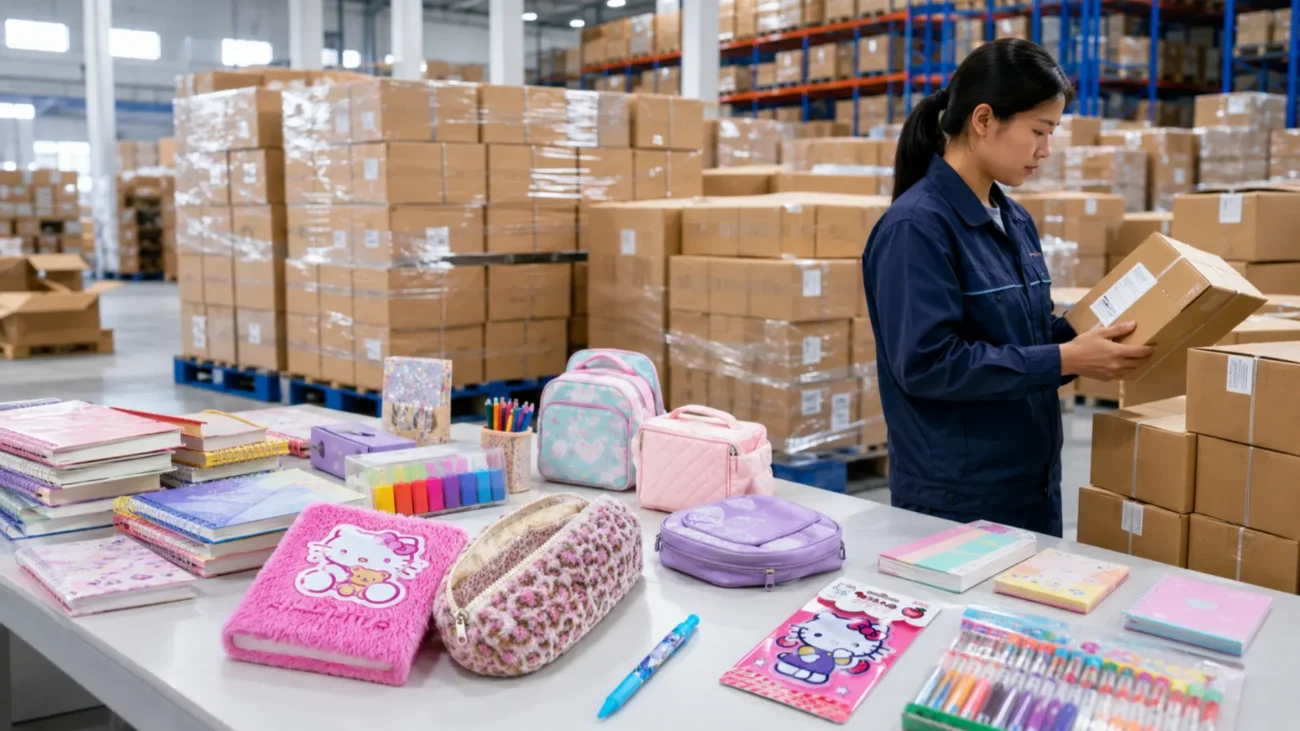
Sample lead time
Before mass production, you may need several types of samples:
- Stock sample
- Custom logo sample
- Color sample
- Packaging sample
- Pre-production sample
- Final approval sample
Ask how many days each step usually takes. Also ask whether sample cost can be refunded after a bulk order.
Mass production lead time
Production lead time depends on order quantity, material availability, printing method, packaging, and factory schedule. For seasonal products, plan backwards from your target delivery date.
For example:
- Back-to-school products should be planned several months before the selling season.
- Holiday gift sets need extra time for packaging and shipping.
- Custom products need more time than stock products.
- Sea freight requires more time than air freight.
A dependable school supplies supplier should give a realistic schedule instead of a promise that sounds too fast.
Shipping and export support
International buyers need more than production. They also need export support. Ask whether the supplier can provide:
- Packing list
- Commercial invoice
- Carton marks
- Export cartons
- Product labels
- HS code information
- Freight forwarder coordination
- Container loading support
If you source several categories from one supplier, ask whether they can consolidate products into one shipment.
Check Communication and Service Quality
Communication quality is a practical sign of supplier reliability. If the supplier cannot answer clearly before the order, problems may become worse during production.
Response speed and detail
A professional school supplies supplier should respond with useful details, not only short replies. Good responses include product size, material, MOQ, price, packaging, carton quantity, sample time, and production time.
Slow replies can delay product development. Unclear replies can create mistakes in artwork, labels, packaging, or shipment documents.
Clear quotation and product information
Ask for a formal quotation sheet. It should include SKU, product name, image, size, material, MOQ, unit price, packaging, carton details, lead time, and trade terms. A clear quote makes it easier to compare suppliers.
If a supplier only sends a price without details, ask for a complete sheet before you make a decision.
After-sales problem solving
Even careful orders can have problems. Ask how the supplier handles:
- Short shipment
- Defective products
- Wrong labels
- Damaged packaging
- Color difference
- Delayed shipment
- Missing accessories
A responsible supplier should have a clear solution, such as replacement, credit, remake, or a discount on the next order, depending on the issue.
Questions to Ask Before Choosing a School Supplies Supplier
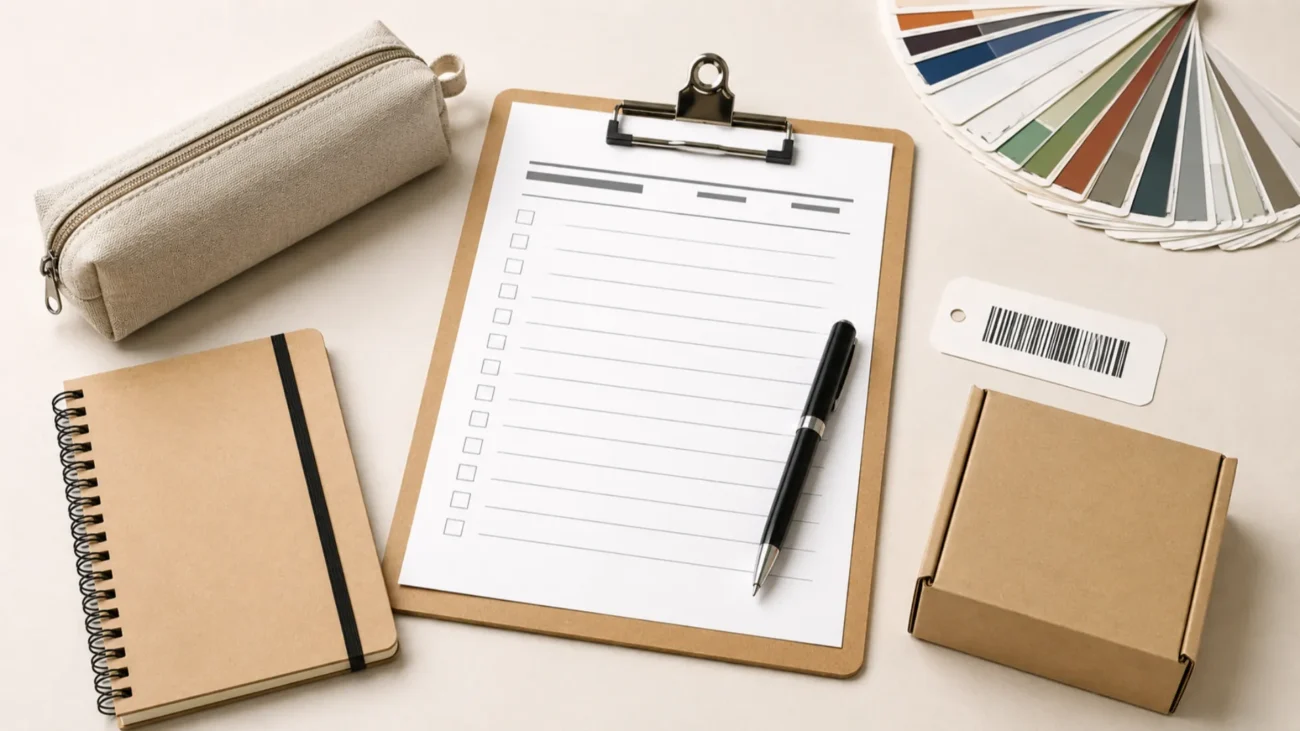
Use this checklist before you confirm a new partner.
| Question | Why It Matters |
|---|---|
| What product categories do you supply? | Confirms whether the supplier matches your full product range. |
| What is your MOQ by SKU and design? | Helps you plan budget and inventory. |
| Can you provide samples? | Lets you check real material, size, printing, and packaging. |
| Do you support OEM and ODM? | Shows whether the supplier can handle custom products. |
| Can you customize packaging? | Important for retail, private label, and gift products. |
| What safety documents can you provide? | Helps review market compliance needs. |
| What is your normal lead time? | Helps plan seasonal sales and shipment. |
| Can you handle mixed SKU orders? | Important for wholesale buyers that need variety. |
| Can you support carton marks and export documents? | Shows export experience. |
| How do you handle defects or short shipment? | Shows after-sales responsibility. |
Common Mistakes When Choosing a Supplier
Avoid these mistakes when selecting a school supplies supplier.
Choosing only by the lowest price
The lowest price often comes with weak materials, poor printing, thin packaging, or slow support. A low unit price can become expensive if you need to replace goods or miss a sales season.
Compare product quality, packaging, service, lead time, and order risk together.
Ignoring safety documents
Do not choose kids products only because they look cute. Ask about materials and documents. This is especially important for art materials, markers, lunch boxes, water bottles, and products for young children.
Not confirming MOQ early
Some buyers spend too much time discussing artwork before they confirm MOQ. If the MOQ is too high, the project may not fit the budget. Confirm MOQ before sample development.
Ordering too late for the season
Back-to-school orders need early planning. If you order too late, you may face limited material supply, rushed production, higher freight cost, or missed shelf time.
Not checking packaging details
Packaging affects product value, shelf display, and shipping safety. Confirm packaging type, barcode, carton quantity, and outer carton strength before production starts.
Why a Multi-Category Supplier Can Be More Efficient
For many B2B buyers, a multi-category school supplies supplier is more useful than several single-product factories.
Easier sourcing
If you buy stationery from one factory, bags from another, craft kits from another, and lunch boxes from another, you need to manage more quotes, samples, payment records, and shipment plans. One multi-category supplier can reduce this workload.
Better collection planning
A matching back-to-school collection can include a notebook, pencil case, backpack, lunch bag, lunch box, water bottle, and accessory. If one supplier manages several categories, it is easier to keep the same theme, color direction, and packaging style.
Better wholesale coordination
A multi-category supplier can help combine products in one shipment. This can reduce communication steps and make reorder planning easier. It also helps retailers and distributors test more product lines without managing too many supplier accounts.
Final Supplier Evaluation Checklist
Before you approve an order, review this final checklist:
- Product range matches your business needs.
- Sample quality meets your standard.
- MOQ fits your budget.
- Pricing sheet is clear.
- Packaging details are confirmed.
- Safety documents are discussed.
- Lead time fits your selling season.
- Export documents are available.
- Mixed SKU order rules are clear.
- After-sales solution is agreed.
If several suppliers offer similar products, choose the one that gives clear answers, stable samples, complete packaging details, and realistic lead times.
Frequently Asked Questions
What should I look for in a school supplies supplier?
Look for product range, sample quality, MOQ, wholesale pricing, safety documents, OEM and ODM ability, packaging support, lead time, export experience, and clear communication.
What is the difference between a stationery supplier and a school supplies supplier?
A stationery supplier usually focuses on pens, pencils, notebooks, rulers, erasers, pencil cases, and paper products. A school supplies supplier may also offer bags, lunch boxes, craft kits, storage products, and accessories.
Can I order wholesale stationery supplies in mixed styles?
Many suppliers can support mixed styles, but rules vary. Ask whether mixed colors, patterns, and SKUs are allowed and whether each style has its own MOQ.
What is the typical MOQ for school supplies?
MOQ depends on product type and customization. Stock products may have lower MOQ, while custom colors, custom artwork, private-label packaging, and new molds usually need higher quantities.
Can I customize school supplies with my own brand logo?
Yes. Many suppliers can add logos, custom colors, barcode labels, packaging inserts, and private-label boxes. Confirm MOQ, sample cost, and production time before starting.
How early should I order back-to-school products?
Plan several months before the sales season. Custom products, large orders, and sea freight need more time than stock products and air freight.
What safety standards should kids stationery meet?
The required standards depend on product type and market. Buyers may need to review CPSIA, ASTM, EN71, REACH, BPA-free material claims, non-toxic ink, or art material labeling requirements.
Can I source stationery, bags, and lunch boxes from one supplier?
Yes, if the supplier has multi-category capability. This can simplify sampling, quotation, packaging, shipment, and repeat orders.
Conclusion
Choosing the right school supplies supplier is not a price-only decision. A good supplier should provide stable quality, suitable MOQ, clear wholesale pricing, safe materials, reliable lead time, packaging support, export documents, and fast communication.
For retailers, wholesalers, distributors, and private-label brands, the best partner is the one that can support repeat orders and seasonal planning. Before you confirm a purchase order, check samples, ask about safety documents, review packaging, confirm MOQ, and compare the full cost of the order.
If you need wholesale stationery supplies, school stationery, kids stationery set options, bags, crafts, tableware, storage products, or accessories, a multi-category supplier can help you build stronger product collections and prepare for sales seasons with less sourcing work.
Contact Us for Wholesale Inquiry