
Kids Pencil Case Buying Guide: Size, Materials, Compartments, and Wholesale Tips

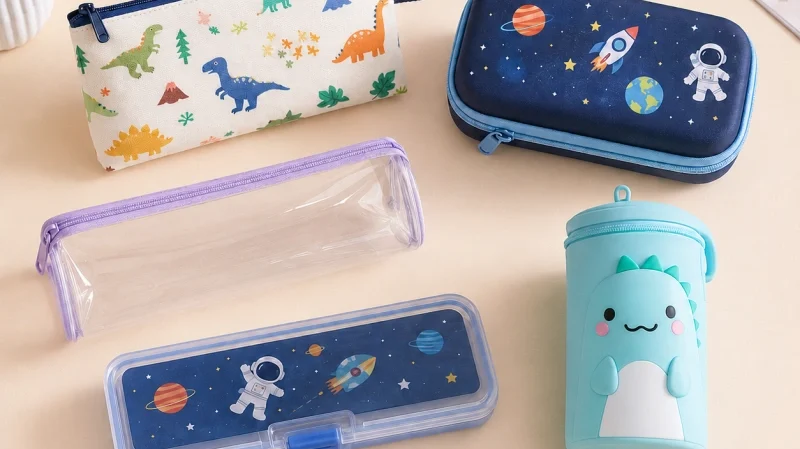
Choosing the right kids pencil case looks simple until you compare the products side by side. Two cases may have similar outer dimensions, yet one can hold a ruler, highlighters, and a sharpener while the other becomes difficult to close after only a few pencils. Materials, shell thickness, zipper construction, compartments, lining, and opening style all affect how the product works in daily use.
Parents usually want a case that is durable, easy to clean, and simple for a child to manage. Children notice the color, pattern, shape, and whether the design matches their other school supplies. Retailers must also consider shelf presentation, price points, color assortments, and whether the product can be sold as part of a coordinated collection. Wholesale buyers need an even more detailed review that covers real internal capacity, material specifications, stitching, hardware, printing, packaging, minimum order quantities, and batch consistency.
This guide explains how to choose a kids pencil case for daily school use, art supplies, examinations, gifts, and retail displays. It also provides a practical framework for testing samples and sourcing wholesale pencil cases without relying on vague descriptions such as “premium quality” or “large capacity.”
What Is a Kids Pencil Case?
A kids pencil case is a portable container designed to organize pencils, pens, erasers, sharpeners, rulers, highlighters, colored pencils, and other small school tools. It can be a soft fabric pouch, a molded hard-shell case, a silicone container, a transparent bag, or a rigid plastic box.
The basic purpose is organization, but a well-designed case also protects the contents and the school bag around them. It keeps small items from spreading through a backpack, reduces friction between sharp tools and other belongings, and helps contain ordinary pencil dust or an uncapped pen. For younger children, one clear storage location also makes it easier to learn how to put supplies away after class.
A pencil case can be sold as a standalone item or used as the main storage component in a coordinated stationery set. Retailers often match it with notebooks, pencils, erasers, backpacks, lunch bags, stickers, or water bottles to create a more complete school collection. Retailers planning a bundled offer can compare this storage role with our complete guide to building kids stationery sets for school, gifts, and retail displays.
Pencil Case, Pencil Pouch, Pencil Box, and Pen Case
Product names often reflect the structure:
- Pencil case is the broadest term. It can describe soft, semi-rigid, or rigid products.
- Pencil pouch usually means a flexible zippered product made from fabric or film.
- Pencil box generally describes a rigid plastic, metal, or molded container with a lid.
- Pen case is often used for slim products aimed at teenagers, university students, or office users.
Clear naming matters in product pages and wholesale specifications. A buyer searching for a lightweight pencil pouch may not want a bulky molded shell, while a customer looking for a protective box may be disappointed by a thin fabric bag.
Why the Right Pencil Case Matters
The best kids pencil case is not always the largest or the most complicated. It is the one that fits the child’s actual tools, school bag, age, and daily routine.
A suitable case can:
- Keep small supplies easy to find
- Reduce lost erasers, sharpeners, and pen caps
- Protect pencils and markers during transport
- Prevent tools from moving loosely inside a backpack
- Make packing and unpacking faster
- Support a coordinated retail collection
- Give retailers a clear entry-level, mid-range, or premium product
A poor design creates the opposite result. A small case may place constant pressure on the zipper. A large case may occupy too much desk or backpack space. Too many dividers can reduce usable volume, while an unlined pouch can show wear quickly at the corners.
Common Kids Pencil Case Materials
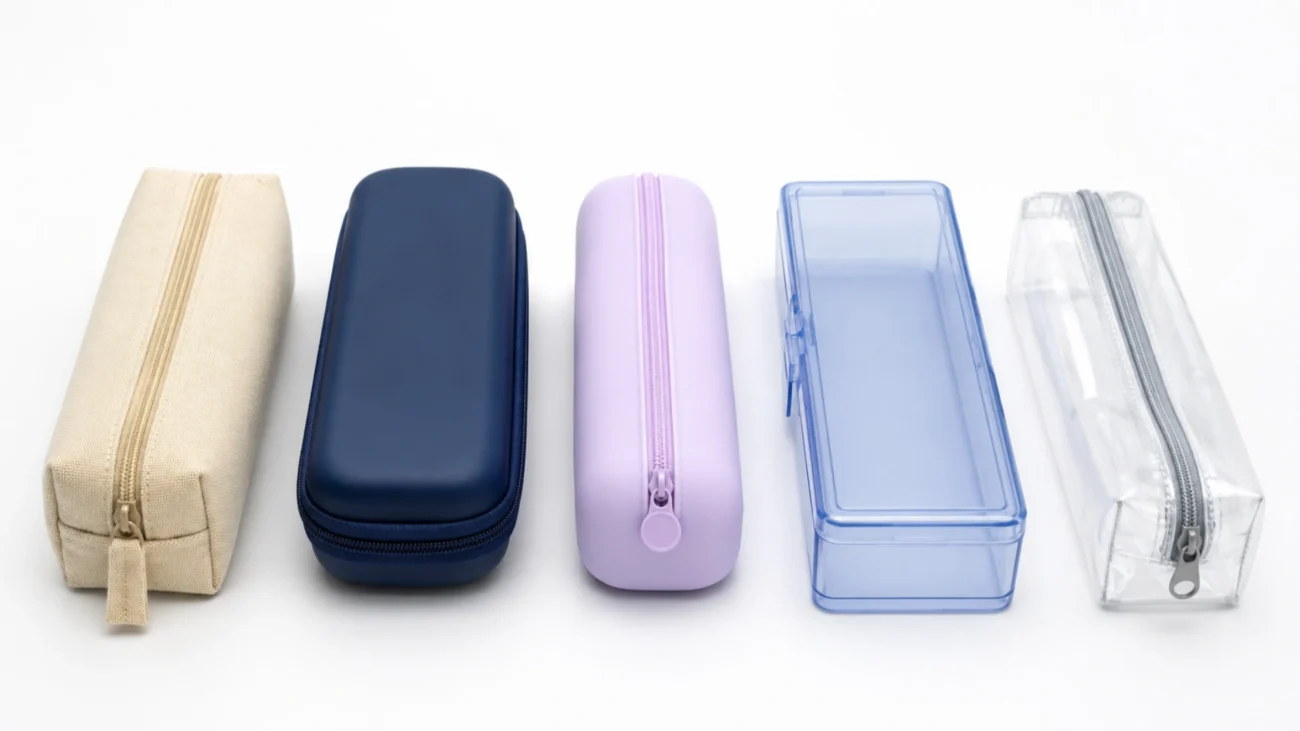
Material selection affects the weight, protection, printing, cleaning, cost, and internal structure of a kids pencil case. Wholesale buyers should review the complete construction rather than judging the outer surface alone.
Fabric and Canvas Pencil Cases
Soft fabric cases are widely used for school because they are lightweight, flexible, and easy to customize.
Common materials include:
- Cotton canvas
- Polyester
- Oxford fabric
- Nylon
- Blended woven fabrics
- Corduroy or other textured fabrics for fashion-led collections
Canvas usually provides a firm hand feel and a suitable surface for printing, embroidery, woven labels, or patches. Polyester and Oxford fabrics are often lighter and can be treated for better resistance to light moisture and stains. Fabric structures can range from a simple single-compartment pencil pouch to a multi-layer organizer with pockets, elastic loops, and a carry handle.
When evaluating a fabric case, check:
- Fabric composition and weight
- Weave density
- Lining material
- Padding, if used
- Coating or water-repellent treatment
- Print method and colorfastness
- Seam construction
- Binding around internal raw edges
- Reinforcement at handles and zipper ends
A product description should not state that a fabric case is machine washable unless the complete finished product has been tested for washing. Zippers, printed coatings, foam layers, labels, and internal boards may react differently from the outer fabric. For many products, “wipe clean” or “hand clean according to the care label” is safer and more accurate.
Fabric cases work well for daily school use, matching backpack collections, promotional products, and entry-to-mid-price ranges.
EVA Hard-Shell Pencil Cases
EVA hard-shell cases use a molded foam structure that gives the product a firm or semi-rigid shape. The shell can help protect the contents when the case is pressed between books or carried in a crowded school bag.
Common features include:
- Molded front and back shells
- Fabric-covered or printed surfaces
- Elastic pen loops
- Mesh pockets
- Central dividers
- Wide book-style openings
- Carry handles
An EVA case often looks larger than its usable interior because the shell, lining, curved edges, and internal panels take up space. Buyers should therefore record both external and internal measurements.
Important inspection points include:
- Shell thickness and consistency
- Shape symmetry
- Recovery after compression
- Surface lamination or printed cover adhesion
- Smoothness of molded edges
- Zipper alignment around corners
- Lining attachment
- Interior panel stiffness
- Odor after sealed packaging
A strong shell is useful, but “crushproof” is usually too absolute for a consumer description unless the claim is supported by a defined test. “Structured,” “semi-rigid,” or “designed to help protect contents from everyday pressure” is more precise.
EVA cases suit large capacity pencil case designs, gift products, art tools, and mid-to-premium retail ranges.
Silicone Pencil Cases
Silicone cases are popular in novelty and gift collections because the material supports rounded shapes, bright colors, molded details, and stand-up designs.
Possible structures include:
- Simple zip pouches
- Animal- or food-inspired shapes
- Pop-down cases that become desk cups
- One-piece molded bodies with a flexible opening
- Cases with embossed or debossed decoration
The smooth surface is generally easy to wipe, but the material can attract dust or lint. Decorative walls may also reduce the interior volume. A case that looks large externally may hold only a few pens.
Check:
- Material flexibility
- Shape recovery
- Surface feel
- Odor
- Opening force
- Tear resistance around the zipper or closure
- Security of attached decorations
- Color consistency
- Stability when used as a standing container
Silicone is often heavier than fabric and may require a higher retail price. It works best when the shape or desk function provides a clear reason for the customer to choose it.
Plastic Pencil Boxes
Rigid plastic boxes are easy to wipe clean and keep their shape on a desk or shelf. They are often used for younger students, basic school lists, classroom storage, and low-to-mid-price products.
Common formats include:
- Hinged-lid boxes
- Sliding-lid boxes
- Double-sided boxes
- Boxes with removable trays
- Transparent or translucent structures
- Compartmented art-supply boxes
Key inspection points include:
- Material thickness
- Hinge design
- Lid alignment
- Snap or latch force
- Rounded edges
- Surface scratches
- Drop resistance
- Internal tray fit
The closure should be secure but not so tight that a child needs excessive force to open it. The box should also be reviewed after a basic drop test because cracks at hinges and corners can create sharp edges.
Transparent Pencil Pouches
Transparent pouches make it easy to see the contents. They are useful for basic school kits, promotional products, travel stationery, and situations where an institution asks students to use a clear container.
Common film materials include PVC, TPU, and transparent EVA. Material choice affects flexibility, clarity, cost, odor, and long-term appearance.
Wholesale buyers should check:
- Film thickness
- Clarity
- Flexibility at low and normal temperatures
- Seam strength
- Zipper-to-film attachment
- Printed trim adhesion
- Surface scratches
- Yellowing resistance
- Odor after storage
Retailers should avoid claiming that a transparent pouch is accepted by every school or examination center. Rules differ, so product copy should advise users to confirm local requirements.
Material Comparison Table
| Material | Protection | Weight | Cleaning | Customization | Typical Price Level | Best Use |
|---|---|---|---|---|---|---|
| Canvas or woven fabric | Low to medium | Light | Wipe or follow care label | Printing, embroidery, patches | Entry to mid | Daily school use and matching collections |
| Polyester or Oxford fabric | Medium | Light | Usually easy to wipe | Full-surface print, color blocking, labels | Entry to mid | School, promotional, and retail ranges |
| EVA hard shell | Medium to high | Medium | Wipe clean | Printed covers, embossing, molded shape | Mid to premium | Organized, gift, and art cases |
| Silicone | Medium | Medium to heavy | Easy to wipe | Molded colors and shapes | Mid to premium | Novelty, gift, and standing designs |
| Rigid plastic | Medium to high | Medium | Easy to wipe | Mold colors, labels, inserts, printing | Entry to mid | Younger children and classroom use |
| Transparent film | Low to medium | Light | Easy to wipe | Printed trim or simple graphics | Entry | Basic kits, travel, and clear-storage needs |
How to Choose the Right Pencil Case Size
The size printed on a kids pencil case specification is only a starting point. Real capacity depends on internal dimensions, corner shape, shell thickness, opening length, compartments, and the diameter of the tools placed inside.
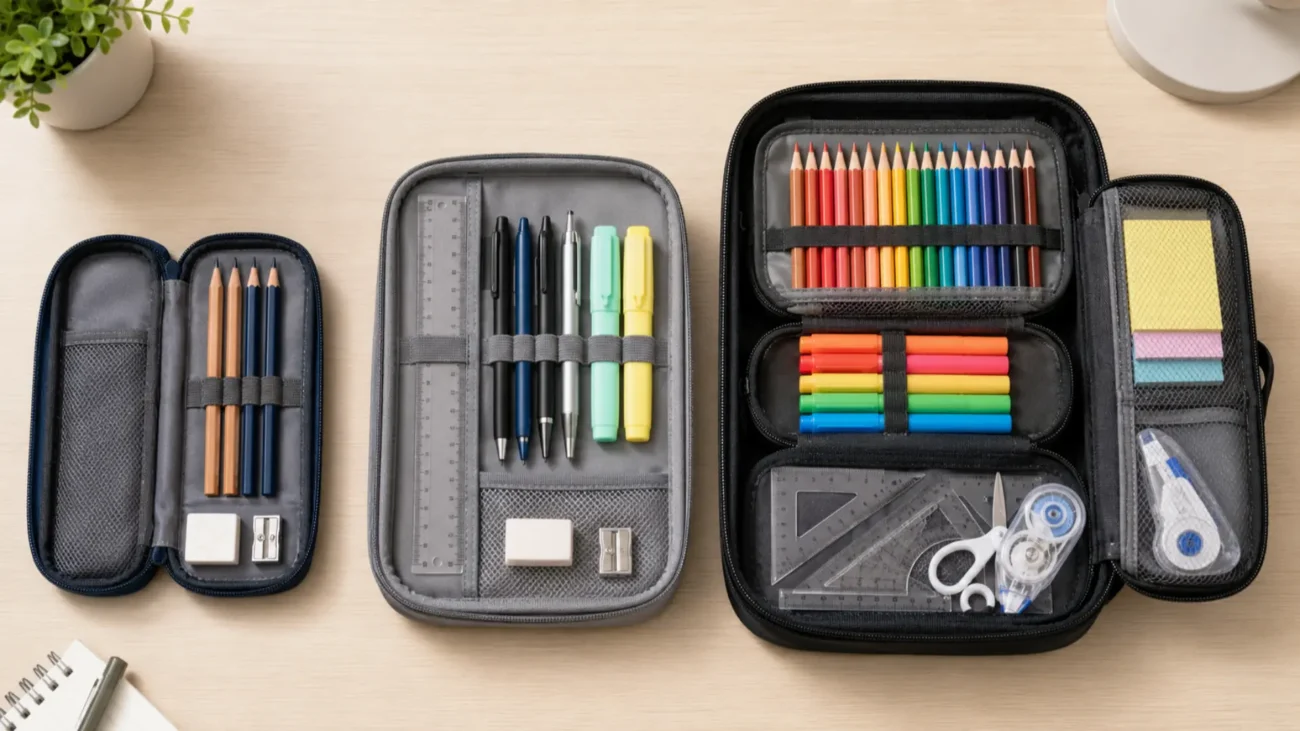
Compact Pencil Cases
Compact cases hold only the essentials, such as:
- Two to four pens or pencils
- One eraser
- One small sharpener
- One short ruler
- A few page markers
They are useful for younger children, minimal carry, examinations, short lessons, or gift sets that include only a few premium writing tools.
The advantage is low weight and easy storage. The limitation is that a standard ruler, safety scissors, thick markers, or a glue stick may not fit.
Standard School Pencil Cases
A standard school pencil case should cover daily classroom needs without becoming difficult to carry. It usually holds:
- Six to ten writing tools
- One eraser
- One sharpener
- One 15 cm ruler
- One or two highlighters
- A small accessory such as correction tape
This school pencil case structure suits many elementary and middle-school students. It provides enough capacity for daily work without becoming a large portable organizer.
A single main compartment with a small pocket may be enough. A simple double-layer structure can separate pens from small accessories without adding excessive weight.
Large-Capacity Pencil Cases
A large capacity pencil case is designed for students who carry art supplies, several pen types, geometry tools, highlighters, sticky notes, or a small calculator. The most useful large capacity pencil case combines flexible open space with only the dividers needed for those tools.
Common features include:
- Expanding side panels
- Two or three zippered sections
- Elastic pen loops
- Mesh pockets
- Removable dividers
- Carry handles
- Wide flat openings
Capacity should be described with real examples rather than a vague claim, especially when a retailer markets a large capacity pencil case online. “Fits 30 pens” can be misleading because thirty slim ballpoint pens occupy far less space than thirty thick markers. A better product page shows the internal dimensions and a representative load.
Check Internal Dimensions, Not Only External Size
External dimensions can be reduced internally by:
- EVA or foam shells
- Padding
- Curved corners
- Thick seams
- Double lining
- Rigid panels
- Elastic loop boards
- Mesh dividers
Wholesale buyers should test the sample with actual products. A practical loading set might include:
- Standard wooden pencils
- One 15 cm ruler
- Two highlighters
- One eraser
- One sharpener
- One glue stick
- A pair of small scissors
- Several thick markers if the case is promoted for art use
The filled case should close without forcing the zipper or distorting the shape. It should also fit inside the target backpack compartment.
Size Reference Table
Gift-oriented ranges can also use tactile materials and character styling, as shown by this plush Hello Kitty pencil case designed for stationery storage and gift presentation.
| User | Suggested Structure | Typical Contents | Main Priority |
|---|---|---|---|
| Ages 3–5 | Compact soft pouch or rounded box | Thick pencils or crayons, large eraser | Low weight and easy opening |
| Ages 6–8 | Standard single or simple double layer | Pencils, ruler, eraser, sharpener, colored pencils | Daily school capacity |
| Ages 9–12 | Medium or large organized case | Pens, highlighters, ruler, geometry tools, notes | Capacity with clear separation |
| Teen students | Slim pouch or flat organized case | Pens, mechanical pencils, highlighters, correction tools | Compact and mature design |
| Art use | Large book-style or wide-opening case | Markers, colored pencils, scissors, glue, tools | Visibility and separation |
| Gift use | EVA, silicone, or premium fabric case | Coordinated pens and accessories | Presentation and perceived value |
Compartments and Internal Organization
An organized kids pencil case should make the contents easier to use. It should not add layers and pockets simply to create a more impressive product photograph.
Single-Compartment Pencil Cases
A single compartment offers the largest flexible storage space for the lowest structural complexity.
Advantages include:
- Low weight
- Lower production cost
- Wide opening
- Easy cleaning
- Flexible capacity
- Simple use for younger children
The disadvantage is that small items fall to the bottom and different tools rub together. This structure works best when the user carries only a limited number of supplies. For buyers comparing a soft pouch format, our My Melody pencil case provides a practical example of a simple character-led storage option for everyday stationery.
Double-Layer and Multi-Layer Pencil Cases
Two or more sections allow students to separate:
- Pens from pencils
- Writing tools from art supplies
- Frequently used items from spare items
- Long tools from erasers and sharpeners
- Geometry tools from softer supplies
A multi-layer case can be useful for older students, but every layer adds material, zippers, weight, and potential failure points. The fully opened case should not cover too much of a classroom desk.
Buyers should also examine whether the layers remain useful when the case is loaded. A narrow middle panel may look organized when empty but become difficult to close once both sides are full.
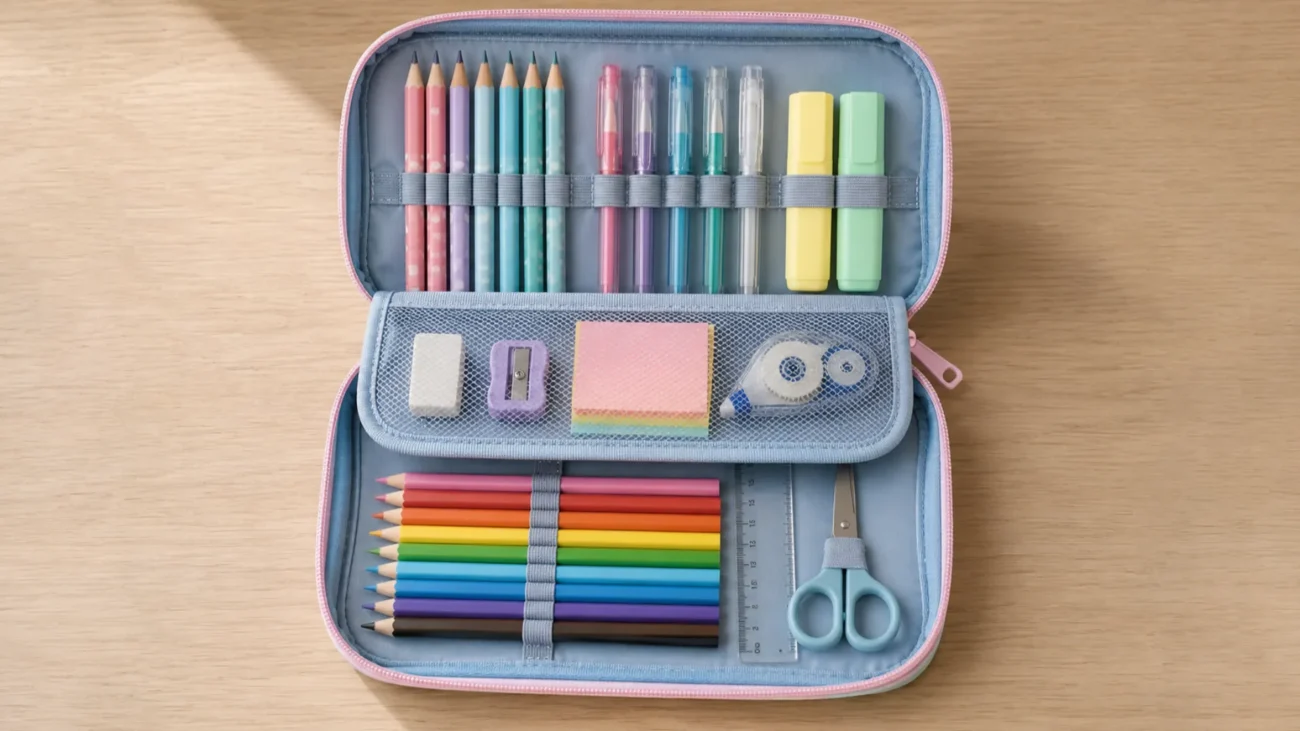
Elastic Pen Loops
Elastic loops keep individual tools visible and reduce movement during transport. They are particularly useful in EVA and book-style cases.
Check:
- Loop width
- Elastic recovery
- Stitching at both ends
- Spacing between loops
- Fit with standard pencils
- Fit with thicker highlighters or markers
- Ease of removal for a child
Loops that are too tight are frustrating. Loops that are too loose become decorative rather than functional.
Mesh Pockets and Zipper Pockets
Mesh pockets are suitable for:
- Erasers
- Sharpeners
- Sticky notes
- Small rulers
- Sticker sheets
- Paper clips
- Correction tape
The mesh should not sag when loaded. Its openings should be small enough to prevent narrow tools from catching. If an internal zipper is used, the pull should be easy to hold and positioned so it does not scratch other products.
Wide-Opening and Standing Designs
A 180-degree book-style case provides a clear view of the contents and can work well for art supplies or home study. A standing case converts into a pen cup and keeps tools upright on a desk.
The best kids pencil case structure depends on the setting. A standing case is useful on a home desk but may tip over in a crowded classroom. A wide flat case provides better visibility but may occupy more desk space. Buyers should test the product in the environment in which it will actually be used.
Choosing a Kids Pencil Case by Age
Age affects hand strength, opening ability, tool size, school requirements, and design preference.
Ages 3–5
Preschool children generally need:
- A lightweight case
- A large opening
- A large zipper pull or simple closure
- Rounded edges
- Space for a few thick pencils or crayons
- Minimal internal parts
Avoid small detachable decorations, complicated locks, and narrow elastic loops. The child should be able to open, close, and repack the case without assistance.
Ages 6–8
Children in early elementary school usually carry standard pencils, an eraser, a sharpener, a ruler, and a few coloring tools.
A suitable product may include:
- One main compartment
- One small mesh pocket
- A standard internal length
- A durable zipper
- A simple fabric or structured shell
- Bright colors or clear themes
At this age, a themed design can make school supplies easier to identify, but function should remain the priority.
Ages 9–12
Older elementary students often need more tools, including:
- Pens and mechanical pencils
- Highlighters
- Geometry tools
- Correction tape
- Sticky notes
- Colored pens
- Small scissors
A medium or large organized case can help separate these products. The case should still fit into a backpack already filled with books and folders. To match the case with the correct tools for each learning stage, review our school supplies list for preschool, kindergarten, elementary school, and middle school students.
Teens and Older Students
Teenagers often prefer:
- Slim or low-profile shapes
- Neutral or muted colors
- Minimal graphics
- Smooth zippers
- Efficient internal organization
- Space for pens, highlighters, mechanical pencils, and correction tools
A simple fabric pencil pouch may be more suitable than a large character case. Older students usually value compact storage and writing performance over elaborate decoration.
Choosing a Pencil Case for Different Uses
A kids pencil case should be designed around its intended use rather than one general idea of capacity.
Daily School Use
A daily-use kids pencil case should be light, durable, easy to open, and sized for the child’s normal school list.
Priorities include:
- Abrasion-resistant outer material
- Reliable zipper or closure
- Standard internal length
- Easy cleaning
- Simple organization
- Compatibility with the backpack
- Replaceable, standard-size contents
The case should withstand repeated movement between home and school without becoming difficult to close or losing its shape. Parents and retail buyers can also use our broader guide to choosing practical kids stationery for everyday school use to confirm which writing and classroom tools the case should hold.
Art and Coloring Supplies
Art cases need more space and better separation because thick markers, colored pencils, brushes, scissors, and glue can damage one another when packed loosely.
Useful features include:
- Wide opening
- Elastic loops in different sizes
- Wipeable lining
- Mesh pockets
- Dividers
- A handle
- A shell or padding that limits movement
The product should be tested with the exact marker and pencil sizes shown in the product images.
Examinations and Minimal Carry
A small transparent pouch may suit users who need only a few visible tools. It can also make it easier to check that the required pens, pencil, eraser, and sharpener are present.
However, requirements differ between schools and examination centers. Retailers should describe the product as suitable for clear, minimal storage and advise customers to verify local rules rather than promising universal acceptance.
Gifts and Matching Collections
A kids pencil case can become the main item in a gift or coordinated stationery range.
It may match:
- A notebook
- A stationery set
- A backpack
- A lunch bag
- Stickers
- A water bottle
- Small desk accessories
For gift products, visual consistency matters from the outer case to the zipper, lining, labels, and packaging. The product should still provide useful storage after the initial gift presentation.
Durability, Cleaning, and Quality Checks
Zipper Quality
The zipper is usually the most frequently used mechanical part.
During sample screening:
- Open and close the zipper repeatedly
- Test it while the case is empty and fully loaded
- Check movement around curves
- Pull gently on the slider and decorative pull
- Check whether the teeth separate under normal side pressure
- Inspect stitching or adhesion along the zipper tape
- Make sure the lining does not catch
A buyer may choose an internal screening target such as 30–50 opening cycles, but this is a purchasing check rather than a universal certification standard.
Stitching and Seam Strength
Inspect:
- Stitch consistency
- Loose or skipped stitches
- Zipper ends
- Corners
- Handle attachments
- Divider seams
- Mesh-pocket edges
- Binding over raw internal edges
- Label and patch attachment
Rather than using one universal stitch count for every fabric, agree on the sewing specification with the supplier and compare bulk production with the approved sample. Different fabrics, thread sizes, and seam constructions require different settings.
Shell and Material Durability
Use material-specific checks.
For fabric:
- Rub printed areas
- Pull gently at seams
- Inspect corner wear
- Check color transfer
- Review lining attachment
For EVA:
- Compress and release the shell
- Check for lasting dents
- Inspect lamination
- Review edge symmetry
- Test zipper corners
For plastic:
- Open the hinge repeatedly
- Test the latch
- Perform a basic drop check
- Inspect for cracks and sharp edges
For silicone:
- Bend the body
- Stretch the opening within normal use
- Check shape recovery
- Inspect attached decorations
For transparent film:
- Flex the seams
- Inspect clarity
- Pull gently at zipper connections
- Check for whitening, cracks, or early separation
Easy-to-Clean Interiors
Pencil cases collect graphite dust, ink marks, shavings, glue residue, and ordinary school-bag dirt.
Practical design choices include:
- Smooth lining
- Darker internal colors
- Wide openings
- Removable inserts
- Wipeable surfaces
- Corners that can be reached with a cloth
Care instructions should match the finished product. Do not advertise machine washing, waterproofing, or stain resistance unless those claims are supported for the exact construction.
Small Parts and Decorative Accessories
Common decorative parts include zipper charms, pom-poms, rubber patches, metal tags, badges, beads, and molded figures. For products sold in the United States, manufacturers and importers should identify the rules that apply to the finished item and review the CPSC’s official guidance for children’s products, testing, and certification before finalizing the compliance plan. Where a design includes detachable zipper charms, beads, badges, or molded figures, buyers should also review the CPSC’s guidance on small parts and choking-hazard labeling for children’s products.
Buyers should check:
- Attachment method
- Pull resistance
- Sharp points or edges
- Whether parts can detach during normal use
- Suitability for the intended age group
- Applicable rules in the destination market
Compliance should be based on the complete product, packaging, age grading, intended use, and target market. A decorative pencil case is not automatically treated in the same way as a toy, and one test report should not be assumed to cover every material or component. For products sold in the European Union, suppliers and importers should use the European Commission’s toy-safety guidance to determine whether a play-oriented or novelty pencil case falls within applicable toy requirements.
Cute Pencil Case Designs and Retail Planning
Popular Design Directions
Common design directions include:
- Pastel colors
- Animals
- Food illustrations
- Space and planets
- Dinosaurs
- Sports
- Floral patterns
- Stars and clouds
- Geometric graphics
- Corduroy or textile-led styles
- Kawaii-inspired rounded graphics
- Minimal line art for older students
Retailers should use original or properly licensed artwork. Generic animals, food, nature, and geometric themes can create strong collections without relying on unauthorized entertainment characters.
Matching Stationery Collections
A kids pencil case becomes easier to merchandise when it belongs to a wider product family.
Retailers can repeat the same color palette or artwork across:
- Notebooks
- Pens and erasers
- Stationery sets
- Backpacks
- Lunch bags
- Stickers
- Water bottles
- Desk organizers
This allows customers to choose coordinated products and makes the display easier to understand. The products do not need to be identical; they need a recognizable visual relationship.
Color Assortments for Retailers
One structure can be offered in three or four colorways:
- Two reliable core colors
- One current seasonal or pastel color
- One printed theme
This approach gives customers choice without creating too many different constructions, package sizes, and price points. Buyers should confirm whether colors and prints can be mixed under one MOQ.
What Wholesale Buyers Should Check Before Ordering Pencil Cases
Sourcing wholesale pencil cases requires measurable specifications, physical testing, clear commercial terms, and a production reference that both buyer and supplier understand.
Confirm Detailed Product Specifications
A specification sheet should include:
- External dimensions
- Internal usable dimensions
- Product weight
- Outer material and construction
- Fabric weight or material thickness
- Lining
- Padding
- Shell type
- Zipper type and size
- Puller material and color
- Number of compartments
- Pocket dimensions
- Elastic loop count and width
- Handle construction
- Print or logo method
- Color references
- Label position
- Packaging method
- Units per inner carton and master carton
Avoid descriptions such as “high-quality Oxford,” “strong zipper,” or “large capacity” without measurable details.
Use photographs or diagrams to show the internal layout, print position, logo size, and packing method.
Evaluate Physical Samples
A sample should be used, loaded, and handled.
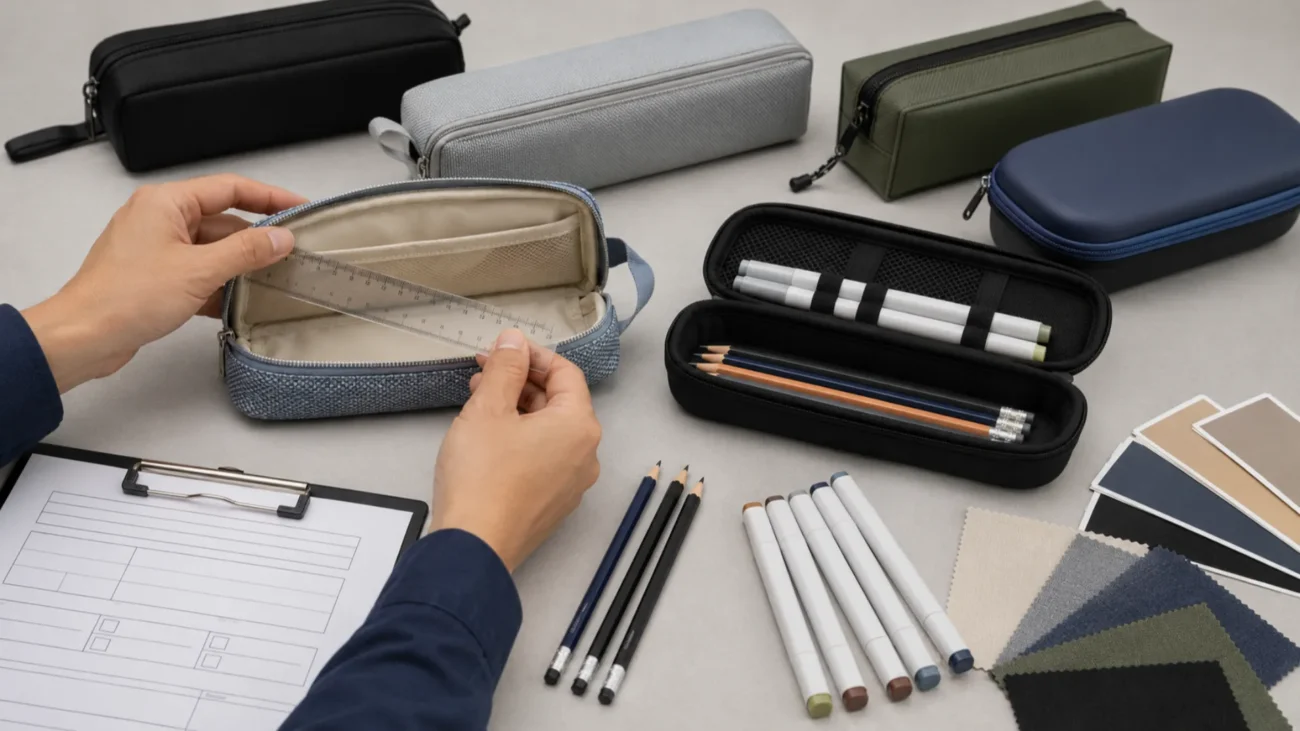
A practical review includes:
- Measure external and internal dimensions.
- Load the products that the customer is expected to carry.
- Close the case without forcing the zipper.
- Test the zipper repeatedly under load.
- Inspect all seams and reinforcement points.
- Pull the handle within normal use.
- Rub the printed surface and labels.
- Check odor after opening the package.
- Compress the case as it might be compressed in a backpack.
- Check whether the case recovers its shape.
- Review the final retail package.
- Compare the sample with the written specification.
Keep one approved sample as the production reference. For custom products, the final pre-production sample should reflect the approved material, color, graphics, accessories, and packaging. Before approving a larger purchase, buyers can follow our wholesale stationery buying guide covering physical samples, MOQ, packaging, pricing, quality control, and supplier checks.
Test Real Capacity
Ask the supplier to provide:
- Internal dimensions
- A representative loading list
- Loading photographs
- Maximum recommended tool length
- Suggested number of standard pens
- Compatibility with thick markers
- Elastic-loop dimensions
- Pocket dimensions
Retail product pages should use realistic capacity language. A statement such as “shown with 12 standard pencils, two highlighters, a 15 cm ruler, an eraser, and a sharpener” is more useful than “extra-large.”
Confirm MOQ and Mixed-Design Rules
MOQ may apply by:
- Structure
- Material
- Color
- Logo
- Zipper pull
- Packaging design
- Individual SKU
- Total purchase order
Ask whether multiple colors or prints can share one production quantity when the structure, fabric, zipper, lining, and packaging remain the same.
Custom molded parts, special zipper pulls, dyed-to-order materials, and unique packaging may have separate minimums. These should be confirmed before design work begins.
Review Customization Options
Possible options include:
- Screen printing
- Heat transfer
- Sublimation
- Embroidery
- Woven labels
- Rubber or silicone patches
- Embossing or debossing
- Custom zipper pulls
- Custom lining
- Custom color combinations
- Hangtags
- Header cards
- Barcode labels
- Window boxes
- Counter display boxes
- Matching stationery items
Ask which methods are suitable for the chosen material. Detailed artwork may work well with heat transfer but not with a small embroidered area. A molded zipper pull may create stronger differentiation but require tooling and a higher quantity.
Check Batch Consistency
The order should be inspected against the approved sample and specification.
Review:
- Finished dimensions
- Shape
- Fabric and lining color
- Print color and position
- Pattern direction
- Zipper color and movement
- Pocket dimensions
- Elastic-loop count
- Stitching
- Logo placement
- Labels and barcodes
- Individual packaging
- Carton quantity
Agree on tolerances before production. Do not wait until final inspection to discuss how much size variation or print movement is acceptable.
Plan Production and Seasonal Timing
Back-to-school products must arrive before retailers begin their seasonal promotion.
The schedule may include:
- Product selection
- Quotation
- Sample development
- Sample revisions
- Material and color approval
- Compliance review
- Packaging artwork
- Pre-production sample
- Material purchasing
- Mass production
- Inspection
- Packing
- Freight
- Customs
- Warehouse receiving
- Store or distributor delivery
The actual lead time depends on the design, quantity, material availability, packaging, shipping method, and supplier capacity. Confirm the timeline for each order and include a buffer for revisions and transportation delays.
Evaluate the Supplier, Not Only the Product
A good sample does not guarantee stable repeat production.
Check whether the supplier can provide:
- Clear specifications
- Material traceability
- In-process quality checks
- Packaging engineering
- Accurate carton data
- Export documents
- Artwork records
- Reorder support
- Consistent communication
- Corrective action when a problem is found
For a collection containing pencil cases, stationery sets, notebooks, and bags, a supplier with category coordination can also make color and artwork matching easier. For a wider review of production capability, communication, export experience, and reorder support, use our guide to choosing a reliable school supplies supplier for wholesale orders.
Retail Packaging and Display Options
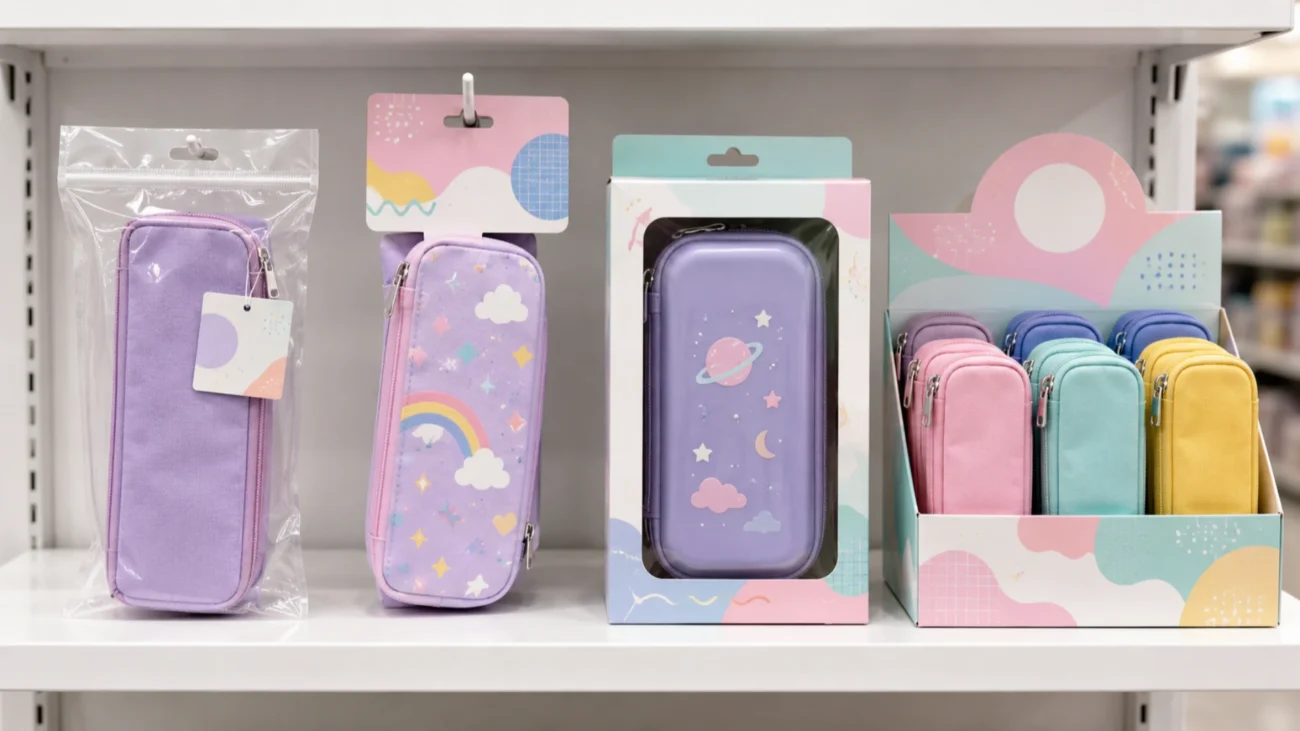
Individual Polybags with Hangtags
This is a simple and cost-effective format for fabric and basic cases.
The package can include:
- A clear protective bag
- A hangtag
- A barcode
- Material and care information
- SKU or color identification
The bag should fit the product rather than leaving excessive empty space.
Header Cards and Hanging Packaging
A printed header card improves shelf visibility and provides a reinforced hanging point.
It works well for compact or medium pencil pouch products. Check that the card, hole, adhesive, or fastener supports the product weight during display.
Window Boxes
Window boxes suit:
- EVA cases
- Gift products
- Silicone designs
- Cases sold with matching stationery
- Premium retail collections
The window should show the main product clearly. Internal support should prevent movement and compression. Buyers should also compare the visual benefit with the additional carton volume and shipping cost.
Counter Display Boxes
Counter display units are useful for compact cases, small silicone pouches, and mixed-color impulse products.
A display may hold 12, 18, or 24 units depending on the case size. The assortment should be balanced so that one slow color does not remain after the popular colors sell.
Common Mistakes When Choosing or Sourcing Pencil Cases
- Checking only external dimensions. Thick shells and dividers can reduce usable space.
- Using “large capacity” without a loading standard. Show real contents and internal measurements.
- Adding too many compartments. Extra layers can reduce flexible space and increase weight.
- Ignoring zipper corners. Curved sections often reveal alignment problems.
- Ignoring handle and divider stress points. These areas need reinforcement and testing.
- Choosing an impractical lining. Pale absorbent fabric may show ordinary pencil and ink marks quickly.
- Approving only an empty sample. Load the case and test the zipper under normal pressure.
- Mixing inconsistent colors across a collection. Use approved color references and physical samples.
- Confirming artwork before checking MOQ. Custom parts may change the minimum quantity and cost.
- Reviewing the product but not the package. Poor packing can deform the case before it reaches retail.
Frequently Asked Questions About Kids Pencil Cases
What size kids pencil case is best for school?
The best size depends on the student’s grade, school list, and backpack space. For many students, a standard case that holds six to ten writing tools, a 15 cm ruler, an eraser, a sharpener, and one or two highlighters is practical.
Measure the internal space and test the case with real products. A large outer size does not guarantee useful capacity.
Which material is best for a kids pencil case?
There is no universal best material.
Fabric is lightweight and highly customizable. EVA provides a more structured shell. Silicone supports creative shapes and is easy to wipe. Plastic boxes keep their shape and are simple to clean. Transparent pouches make the contents visible.
Choose according to protection, weight, cleaning, design, price, and the intended age group.
Are hard-shell cases better than soft pencil pouches?
Hard-shell cases provide more structure and may protect contents better from everyday pressure. Soft pouches are lighter, flexible, and easier to fit into a full backpack.
The better option depends on what the student carries and how much backpack space is available.
How many compartments should a school pencil case have?
A single compartment is often enough for basic supplies. Two sections can help separate writing tools from erasers, sharpeners, or coloring products. Multi-layer cases suit larger collections but can become heavy and bulky.
Use the fewest compartments needed to keep the normal contents organized.
How can retailers test pencil case capacity?
Load the sample with a defined set of standard school tools. Record the internal dimensions, the products used, and whether the case closes smoothly without distorting.
Photograph the loaded sample so the product page and sales team can use an honest capacity reference.
Can wholesale pencil cases be customized?
Yes. Depending on the material, supplier, and order quantity, customization may include colors, artwork, logos, labels, embroidery, patches, zipper pulls, lining, compartments, hangtags, barcodes, and retail packaging.
Confirm tooling, setup costs, sample fees, and MOQ before finalizing the design.
What should buyers inspect before placing a bulk order of wholesale pencil cases?
Before ordering wholesale pencil cases, inspect the material, dimensions, real capacity, zipper movement, stitching, lining, compartments, print position, color consistency, smell, individual packaging, and carton protection.
The approved sample and written specification should be used together during production and inspection.
Are transparent pencil pouches suitable for exams?
They can be useful when visible contents are requested, but rules vary. Customers should confirm the requirements of the relevant school or examination center.
How should retailers plan a pencil case assortment?
A balanced range can include:
- One basic fabric pouch
- One standard school case
- One organized large-capacity case
- One themed or cute design
- One premium gift option
Retailers can then offer several colors within the same structure to create choice without making inventory too complex.
Conclusion
A successful kids pencil case balances real internal capacity, material, weight, organization, durability, cleaning, and visual design. The right product changes with the user. Younger children need simple openings and a manageable size. Older students may need more sections for highlighters and geometry tools. Art users need wide access and space for thicker supplies. Gift buyers expect coordinated design and stronger presentation.
Retailers should build a structured assortment rather than asking one model to serve every customer. Buyers sourcing wholesale pencil cases should approve measurable specifications, load and test physical samples, confirm MOQ by color and design, and compare bulk production with a retained reference sample. Buyers can browse Wandefu’s wholesale stationery collection to compare pencil cases and matching school products before planning a coordinated retail range.
Wandefu supplies stationery and coordinated children’s products for retailers and distributors. Buyers can explore our stationery range or contact our team to discuss custom pencil case structures, graphics, packaging, and matching school product collections. Retailers and distributors can contact the Wandefu team to discuss custom pencil case structures, artwork, packaging, and wholesale order requirements.