
Wholesale Kids Backpacks: A Retail Buyer’s Guide to Size, Materials, Comfort, and Quality

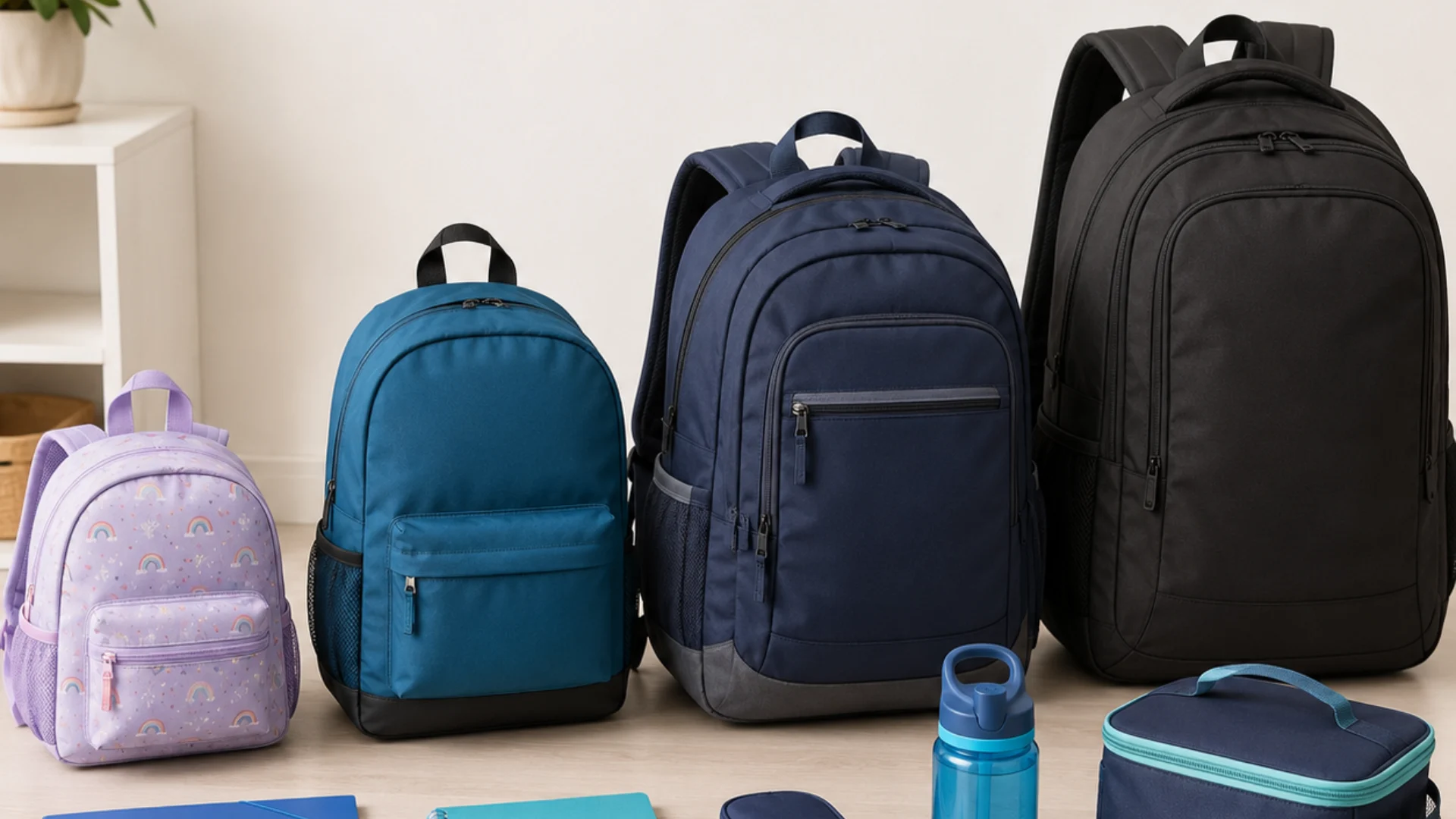
Sourcing wholesale kids backpacks requires more than choosing an attractive print and comparing unit prices. A backpack can look suitable in a catalog but still fail in normal use. It may be too heavy for a preschool child, too narrow for an A4 folder, difficult to open when fully loaded, or fitted with shoulder straps that become uncomfortable after a short walk. Retailers sourcing wholesale school backpacks must compare more than appearance because internal space, empty weight, strap construction, and material quality directly affect daily use and product returns.
Parents usually check whether a bag is comfortable, durable, easy to clean, and large enough for normal school supplies. Children pay more attention to colors, graphics, shapes, and matching accessories. Retail buyers must consider both groups while also managing retail prices, color assortments, product returns, packaging, and seasonal replenishment.
Importers and distributors have additional work to complete. They need to confirm internal and external dimensions, empty product weight, fabric construction, strap adjustment, zipper performance, load-bearing seams, packaging methods, minimum order quantities, and production consistency.
A large backpack is not automatically a useful backpack. Thick foam, curved top panels, EVA molded fronts, and unnecessary dividers can reduce internal space. A padded strap is not automatically comfortable if it is too narrow, poorly positioned, or attached to a weak seam. A coated fabric does not make the completed backpack waterproof if water can still enter through zippers and stitching.
This guide explains how to select and source wholesale kids backpacks for different ages, uses, price levels, and retail channels. It covers product types, size, materials, comfort, compartments, construction quality, sample testing, MOQ, customization, packaging, labeling, and supplier evaluation.
What Retail Buyers Should Define Before Sourcing Kids Backpacks
Before reviewing product catalogs, buyers should define the customer, use, retail price, and sales channel. These decisions determine which backpack structure is appropriate and help suppliers provide more accurate quotations.
Target Age Group
A preschool child and an older elementary student do not need the same backpack.
The intended age group affects:
- External height and width
- Internal capacity
- Empty backpack weight
- Shoulder strap length
- Strap adjustment range
- Zipper-pull size
- Number of compartments
- Graphic style
- Placement of name labels
- Suitability of decorative accessories
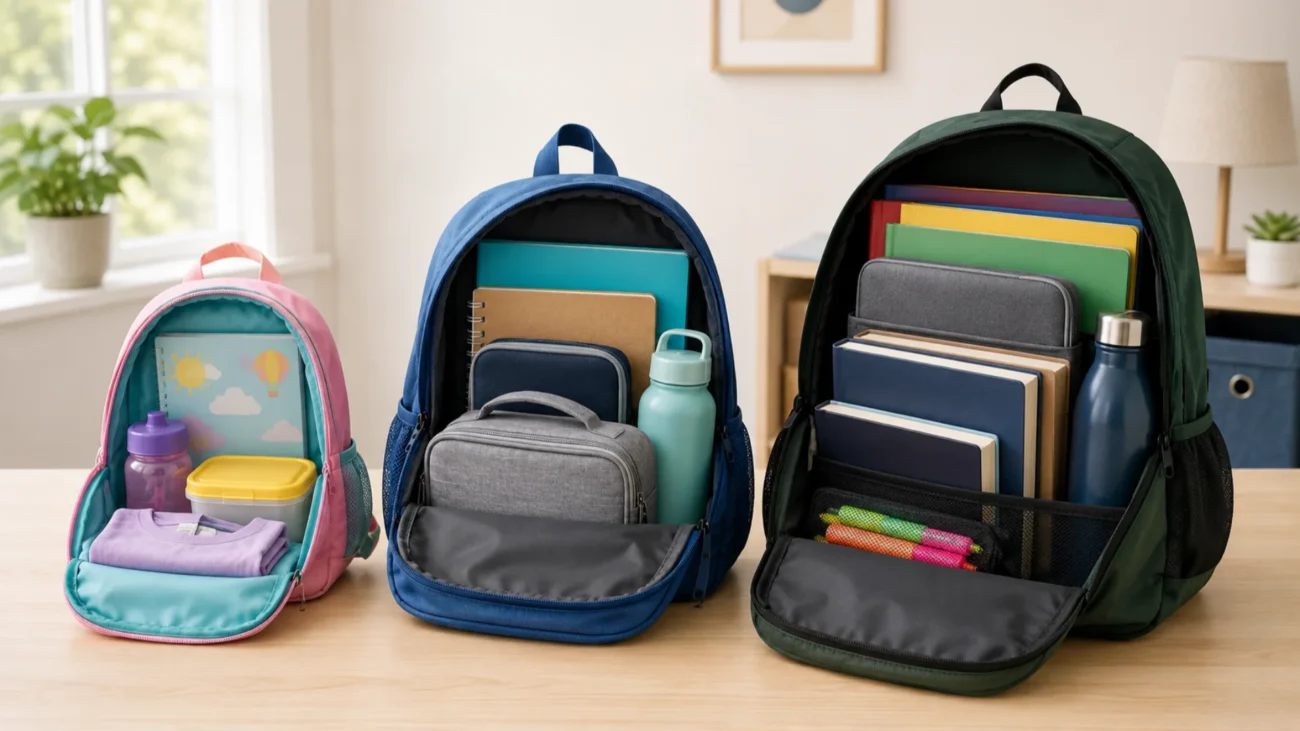
A small preschool backpack may only need to hold a snack container, a child-size water bottle, spare clothing, and a thin activity book. An elementary school backpack may need space for A4 worksheets, folders, notebooks, a pencil case, lunch products, and a water bottle. Older students may need several subject folders and a padded device sleeve.
Retailers should not use one structure for every age simply because the same artwork can be printed in different colors.
To compare the items children commonly carry at each learning stage, buyers can review our school supplies list for preschool, kindergarten, elementary school, and middle school students.
Primary Use
The intended use should be defined before the number of pockets or material is selected.
Common uses include:
- Preschool and daycare
- Daily elementary school
- Middle-school organization
- Art classes
- Sports and extracurricular activities
- Short trips
- Gift collections
- Promotional programs
- Matching back-to-school sets
A daily school backpack requires stable folder storage, practical bottle pockets, and durable shoulder-strap connections. An activity backpack may need a wider opening and an easy-clean compartment. A gift backpack may use a molded front panel or special packaging, but it must remain useful after the gift is opened.
Target Retail Price
Buyers should plan the required retail price before approving materials and accessories.
An entry-level backpack may use:
- Lightweight polyester
- One main compartment
- One front pocket
- Standard webbing
- Basic zippers
- Simple polybag packaging
A mid-range product may add:
- Full lining
- Padded shoulder straps
- Side bottle pockets
- Front organization
- Better printing
- Reinforced handle connections
A premium product may include:
- A structured back panel
- Molded EVA details
- Custom zipper pulls
- Printed lining
- Embroidery or rubber patches
- Matching lunch bags or pencil cases
- Gift or display packaging
Retail prices should be compared against a complete specification. Two backpacks that look similar in a front photograph may use different lining, foam, zipper, stitching, and packaging.
Sales Channel
Each retail channel has different requirements.
Supermarkets often need consistent package dimensions, clear barcodes, fast shelf replenishment, and compact carton packing.
School supply stores usually focus on practical age-based products, daily capacity, and reliable reorders.
Gift shops may prefer original themes, molded details, matching accessories, and stronger presentation.
E-commerce sellers need accurate dimensions, clear capacity photographs, realistic product descriptions, and packaging that limits deformation during delivery.
Department stores may require clear price tiers and consistent merchandising across several backpack designs.
Retail buyers planning a broader seasonal assortment can use our back-to-school essentials checklist to identify the stationery, lunch products, and storage items commonly purchased with children’s backpacks. The best assortment of kids school bags should therefore reflect the needs of the sales channel instead of using the same structure, packaging, and price level for every retailer.
Common Types of Kids Backpacks
A balanced product range should contain backpack types for specific ages and uses rather than several products with different graphics but the same unclear purpose.
Preschool Mini Backpacks
Preschool backpacks are smaller and lighter than standard school bags.
A typical design includes:
- One main compartment
- One small front pocket
- Two adjustable shoulder straps
- One top handle
- An internal name label
- Large, easy-to-hold zipper pulls
- An optional side bottle pocket
Common contents include:
- A small snack box
- A child-size water bottle
- Tissues
- Spare clothing
- A thin activity book
- A small comfort item
The main compartment should not be excessively deep. Young children may struggle to see or reach items at the bottom of a tall, narrow bag.
Retailers should not promote preschool mini backpacks as suitable for full-size folders or several textbooks unless the actual product has been tested with those items.
Standard School Backpacks
A standard school backpack is designed for daily elementary use.
A practical structure may include:
- One main compartment
- One front pocket
- Two padded shoulder straps
- One or two bottle pockets
- An internal document sleeve
- A lined interior
- A reinforced top handle
The main compartment should accept the expected folders and notebooks without bending their corners. The front pocket should hold a pencil case or small accessories without taking too much space from the main compartment.
A standard backpack should balance capacity and empty weight. Extra pockets should only be added when they serve a clear function.
Multi-Compartment School Backpacks
Multi-compartment backpacks are suitable for students who carry several subject folders or want to separate books, stationery, and smaller items.
Possible features include:
- Two main zippered compartments
- An internal folder sleeve
- A padded tablet compartment
- Front organizer pockets
- Pen slots
- Side bottle pockets
- A key clip
- A small quick-access pocket
More compartments do not always provide more usable space. Every divider, zipper, and padded section adds material and reduces flexible storage.
Retail buyers should confirm that the largest compartment still accepts the required folders and books after all internal panels have been installed.
Large-Capacity School Backpacks
A large-capacity backpack may suit older students, art activities, travel, or school-plus-sports use.
A useful large product should have:
- A wide main opening
- A clear primary storage area
- Strong strap connections
- Suitable back-panel structure
- A reinforced bottom
- Organized but flexible compartments
- A manageable empty weight
“Large capacity” should be supported by real measurements and loading examples.
A product page could state that the sample was shown with:
- One A4 folder
- Two books
- One pencil case
- One lunch bag
- One water bottle
- One light jacket
This gives the customer more useful information than an unsupported claim such as “extra-large school bag.”
Backpack and Lunch Bag Sets
Matching backpack and lunch bag sets can support back-to-school promotions and gift collections.
They can provide:
- Coordinated artwork
- Easier product selection
- Higher perceived value
- Better display impact
- Bundle-pricing opportunities
The lunch bag should still be treated as a separate product for material, cleaning, insulation, and food-related requirements.
Retailers developing a full seasonal range can compare the backpack with our complete back-to-school essentials checklist for children and retail buyers.
Gift and Character-Style Backpacks
Gift-oriented backpacks may include:
- Molded EVA front panels
- Embroidered graphics
- Rubber patches
- Three-dimensional ears
- Decorative zipper pulls
- Plush details
- Printed lining
- Gift packaging
These products often depend on visual design, but attachment strength, age suitability, cleaning, and carton deformation must still be checked.
Buyers should use original artwork or properly licensed designs. A supplier should not be assumed to hold character rights without supporting documentation.
How to Choose Backpack Size and Capacity by Age
There is no universal backpack dimension for every child within an age group. Size selection should consider the child’s body proportions, expected contents, school requirements, and empty bag weight.
Preschool Backpacks
A preschool backpack normally needs space for:
- A small water bottle
- A snack container
- Spare clothing
- Tissues
- A thin folder
- One small activity item
Important features include:
- Shorter body height
- Low empty weight
- Simple opening
- Large zipper pulls
- Easy strap adjustment
- Rounded corners
- Limited internal complexity
The product should not encourage excessive loading. A very deep compartment may be difficult for a small child to manage.
Early Elementary Backpacks
Early elementary students may carry:
- A4 worksheets or folders
- Notebooks
- A pencil case
- A water bottle
- A lunch bag
- One or two books
- Small personal items
The opening must be wide enough for folders to slide in without being forced through a narrow curved top.
Side pockets should be tested with actual child-size bottles. Empty product photographs cannot show whether the pocket is deep or elastic enough.
Upper Elementary Backpacks
Older elementary students may need space for:
- Several notebooks
- Subject folders
- Books
- A pencil case
- A planner
- A water bottle
- Lunch products
- Art tools
- A learning device where required
A more organized structure can be useful, but internal divisions should not make the main compartment too narrow.
The backpack bottom, shoulder straps, handle, and main seams should be tested with a realistic load.
Teen and Older-Student Backpacks
Older students often prefer:
- Cleaner graphics
- Muted or neutral colors
- Larger document storage
- A padded device sleeve
- Flat organizer pockets
- Stronger bottom construction
- Smooth double zippers
Device sleeves should state actual internal dimensions or a supported device size. “Fits most laptops” is too vague for a reliable product specification.
External Size vs. Internal Usable Space
External dimensions can be misleading.
Usable space may be reduced by:
- Thick back padding
- Molded EVA fronts
- Curved top panels
- Device sleeves
- Foam layers
- Multiple dividers
- Reinforced seams
- Decorative structures
A backpack may be 42 cm high externally but still fail to accept an A4 folder because the zipper opening is narrow or the upper corners curve inward.
Buyers should record:
- External height, width, and depth
- Internal usable height and width
- Zipper-opening width
- Largest flat item that fits
- Side-pocket opening and depth
- Empty backpack weight
- Example loading contents
Size and Use Reference Table
| User or Use | Suggested Structure | Typical Contents | Main Priority |
|---|---|---|---|
| Preschool | Small, lightweight, simple compartment | Snack, bottle, clothing, thin folder | Easy access and low weight |
| Early elementary | Standard main compartment and front pocket | A4 folder, notebook, pencil case, lunch item | Practical daily storage |
| Upper elementary | Two compartments and organizer sections | Books, folders, stationery, bottle, planner | Capacity and separation |
| Teen student | Larger document bag with device sleeve | Subject folders, books, device, stationery | Durability and mature design |
| Art or activity | Wide-opening, easy-clean structure | Art supplies, clothing, accessories | Flexible storage |
| Gift collection | Themed or molded design | School basics and matching products | Presentation and collection value |
Materials Used in Wholesale School Backpacks
Material selection is one of the main pricing and quality decisions when developing wholesale school backpacks for supermarkets, school-supply stores, gift shops, or online sellers. A material name does not prove the quality of a completed backpack. Buyers must also consider yarn, weave, fabric weight, coating, lining, printing, stitching, and product structure.
Polyester Backpacks
Polyester is widely used because it offers several weights, colors, surface finishes, and printing options.
Potential advantages include:
- Low-to-moderate weight
- Broad price range
- Good color availability
- Compatibility with all-over printing
- Efficient mass production
- Options for coatings and laminations
Check:
- Fabric specification
- Weave density
- Back coating
- Surface hand feel
- Abrasion behavior
- Print adhesion
- Color transfer
- Odor
- Final product weight
A higher denier number does not automatically mean that the finished backpack is better. Fabric quality, weave, coating, seam construction, and overall design must be assessed together.
Oxford Fabric Backpacks
Oxford fabric has a visible woven texture and is often used for structured school bags.
It may provide:
- A firmer appearance
- Suitable daily abrasion resistance
- Options across several fabric weights
- Compatibility with solid colors and selected prints
- Good support for everyday structures
Specifications such as 420D or 600D describe one part of the fabric construction. They should not be used as a complete quality claim.
Buyers should also check:
- Weave density
- Tear behavior
- Coating adhesion
- Surface wear
- Stitch performance
- Final empty weight
Nylon Backpacks
Nylon can be suitable for light, flexible, sports, or lifestyle designs.
Possible advantages include:
- Low weight in suitable specifications
- Flexible hand feel
- Smooth appearance
- Good performance in specific constructions
Points to confirm include:
- Exact fabric grade
- Weight
- Coating
- Abrasion performance
- Printing limitations
- Color consistency
- Cleaning method
- Cost
Do not assume that a product described only as “nylon” is ripstop, high-tenacity, or suitable for heavy use unless those properties are confirmed.
Canvas Backpacks
Canvas provides a natural appearance that suits gift shops and lifestyle collections.
It works well with:
- Embroidery
- Woven labels
- Screen printing
- Contrast webbing
- Minimal graphics
Possible disadvantages include:
- Higher empty weight
- Greater moisture absorption
- More visible dirt
- Longer drying time
- Possible color transfer
- Need for additional lining or support
Canvas can work well for older students and gift ranges, but it may not be the best choice for a lightweight preschool backpack.
EVA Molded Panels
EVA panels can create:
- Three-dimensional front shapes
- Embossed graphics
- Stronger visual presentation
- A structured front area
- Additional protection for front contents
Check:
- Mold consistency
- Surface recovery after pressure
- Bonding or stitching
- Edge finish
- Graphic alignment
- Zipper clearance
- Shape after carton packing
A large molded front can reduce flexible capacity and increase carton volume.
Lining and Internal Coatings
The lining affects appearance, cleaning, and construction.
Buyers should review:
- Lining fabric
- Tear resistance
- Color
- Coating
- Stitching
- Pocket attachment
- Odor
- Ease of cleaning
Dark or patterned linings usually hide ordinary pencil and food marks better than pale fabric.
A coated outer fabric may resist light moisture, but it does not make the complete bag waterproof. Standard stitching and zippers may still allow water to enter.
Material Comparison
| Material | Weight | Everyday Wear | Cleaning | Decoration Options | Typical Position |
|---|---|---|---|---|---|
| Polyester | Light to medium | Depends on specification | Usually easy to wipe | Wide printing and color options | Entry to mid range |
| Oxford fabric | Medium | Suitable for structured daily bags | Wipe according to coating | Solid colors and prints | Entry to mid range |
| Nylon | Light to medium | Depends on grade | Usually easy to maintain | Solid colors and selected prints | Mid to premium |
| Canvas | Medium to heavy | Durable but may show stains | More care required | Embroidery and lifestyle graphics | Mid range |
| EVA molded panel | Adds weight and structure | Protects front area | Wipe clean | Embossed and molded graphics | Mid to premium |
Comfort, Fit, and Weight Distribution
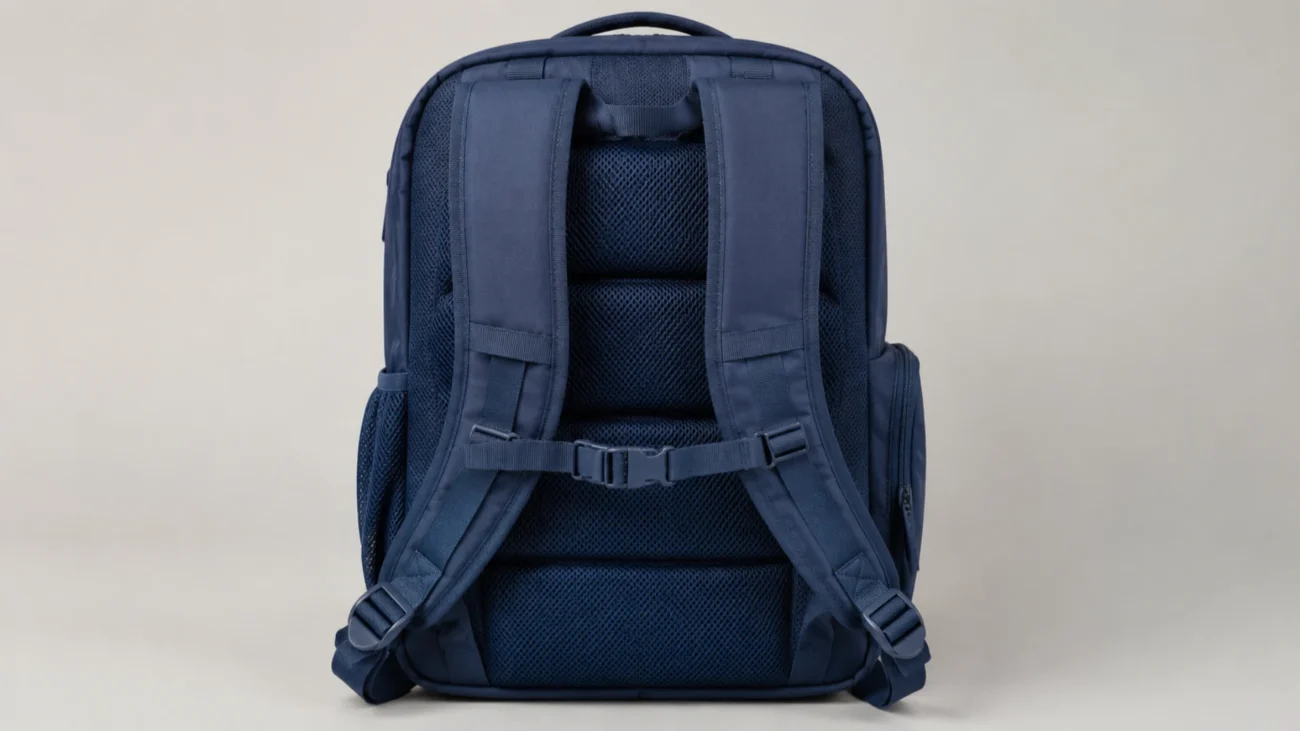
Comfort depends on strap width, adjustment, backpack position, load distribution, back-panel structure, and total loaded weight.
Shoulder Strap Width and Padding
Check:
- Strap width
- Padding thickness
- Padding consistency
- Edge construction
- Strap angle
- Adjustment range
- Left-right symmetry
- Webbing quality
- Upper attachment
- Lower attachment
A narrow strap concentrates pressure on a smaller area. Padding should remain stable and should not create a hard edge.
The American Academy of Pediatrics recommends choosing a backpack that fits the child’s size, using two broad padded adjustable straps, carrying the bag on both shoulders, and keeping the loaded backpack at no more than about 15% of the child’s body weight.
Parents and retail buyers can review the American Academy of Pediatrics’ practical guidance on backpack size, shoulder straps, packing, and loaded weight.
Back Panel Design
Common back-panel designs include:
- Basic foam padding
- Segmented foam sections
- Mesh-covered padding
- Air-channel shapes
- Internal stiffening boards
- Simple lined panels
A mesh surface alone does not prove that the bag provides strong ventilation. The foam shape, contact area, fabric, load, and fit all affect comfort.
Avoid unsupported descriptions such as:
- Orthopedic
- Medical-grade
- Spine-correcting
- Posture-improving
Accurate alternatives include:
- Padded back panel
- Mesh-covered back panel
- Segmented foam padding
- Structured back panel
Chest Straps
Chest straps may help hold shoulder straps in position on larger or activity-oriented backpacks.
Check:
- Buckle operation
- Strap width
- Height adjustment
- Stitching
- Webbing ends
- Ease of opening
- Stability under normal movement
A small preschool backpack may not need this additional hardware.
Top Handle and Hanging Loop
The top handle is commonly used to lift, hang, and move the backpack.
Check whether:
- It is attached to a reinforced area
- The bag distorts when lifted
- Stitching opens under normal load
- The handle is comfortable to hold
- A separate hanging loop is required
A decorative handle attached only to a thin top panel may fail after repeated use.
Empty Backpack Weight
The empty weight should be recorded in the product specification.
Weight increases with:
- Heavy fabric
- Thick foam
- Molded panels
- Metal accessories
- Multiple zippers
- Rigid boards
- Additional compartments
- Decorative hardware
Retailers should present capacity together with age positioning and empty weight instead of promoting storage space alone.
Compartments and Functional Design
Compartments should make products easier to store and remove. They should not be added only to make the backpack look more complex.
Main Compartment
Check:
- Opening width
- Internal height
- Internal width
- Internal depth
- Access to the bottom
- Folder compatibility
- Zipper movement when loaded
- Loose lining
- Internal obstructions
A wide compartment is not useful if the zipper opening is too small for the intended folder.
Front Organizer Pocket
A front pocket may hold:
- A pencil case
- Small notebook
- Tissues
- Keys
- Sticky notes
- Student card
- Small accessories
Keep the organization simple. Many narrow pen slots are often difficult for children to use and may reduce space for normal products.
Side Bottle Pockets
Bottle pockets are common failure points.
Test:
- Opening width
- Pocket depth
- Elastic recovery
- Mesh strength
- Bottom construction
- Seam attachment
- Common bottle diameter
- Bottle stability when the bag tilts
A product photograph should use a bottle size that represents normal customer use.
Document and Device Sleeves
Older students may need a folder, tablet, or laptop sleeve.
Confirm:
- Internal sleeve width and height
- Padding
- Closure
- Distance from the bottom
- Maximum supported device dimensions
- Ease of removal
Avoid using “fits most devices.” State the tested internal size instead.
Lunch and Wet-Item Compartments
Some backpacks include separate sections for lunch products, damp clothing, or activity equipment.
Check:
- Internal surface
- Seam construction
- Separation from books
- Cleaning method
- Opening
- Ventilation where relevant
Do not claim that a compartment is leakproof unless the finished section has been tested for that claim.
Name Labels
An internal label can provide space for:
- Student name
- Class
- Contact number
- School information where appropriate
Personal information should not be displayed openly on the outside of the backpack.
Reflective Details
Reflective piping or tape may improve visibility, but a silver-colored print is not automatically a tested reflective material.
Confirm:
- Material specification
- Placement
- Attachment
- Abrasion resistance
- Any claimed reflective performance
Without supporting test data, describe it as a reflective-style design detail rather than a certified safety feature.
Zippers, Stitching, Webbing, and Hardware
Small construction components often determine whether the backpack continues working after daily use.
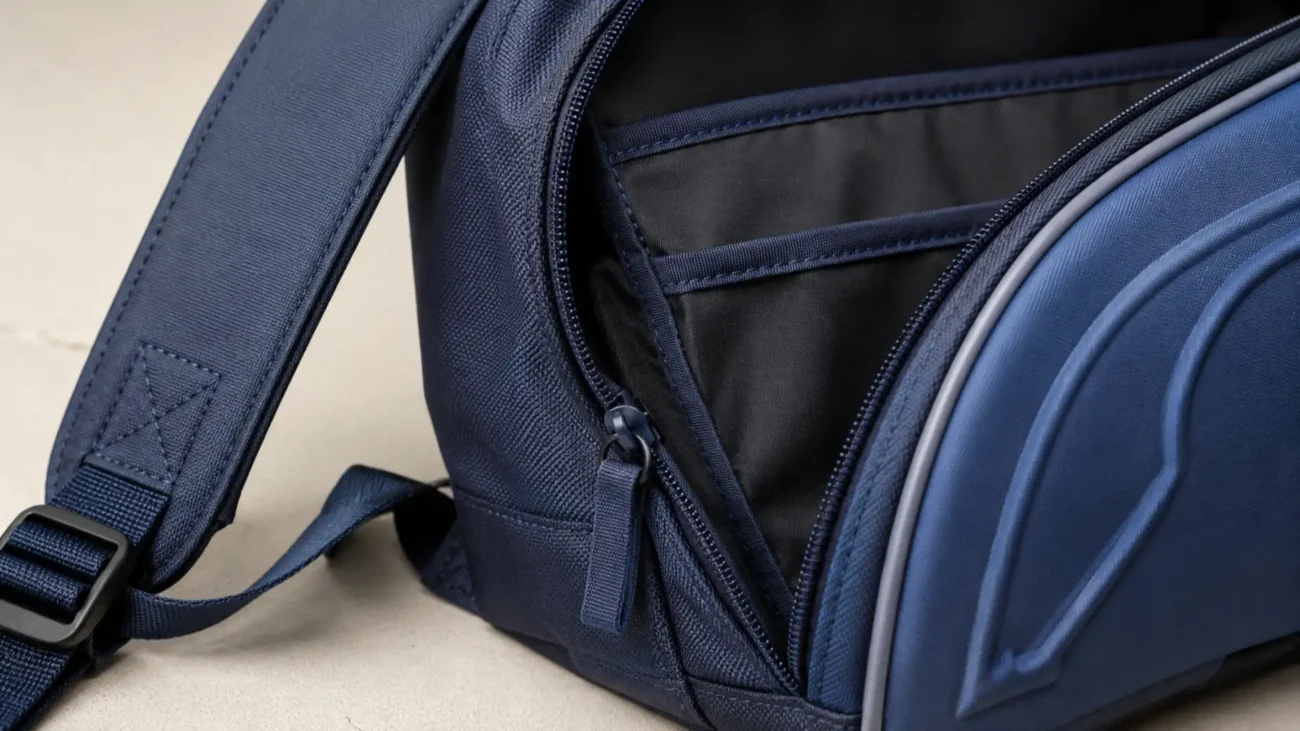
Zipper Performance
Test every zipper:
- While empty
- While partly loaded
- While fully loaded
- Around curved sections
- With both sliders
- After repeated opening and closing
Check:
- Tooth alignment
- Slider movement
- Pull attachment
- Zipper tape
- End stops
- Stitching
- Lining clearance
- Separation under normal pressure
The correct zipper size should be selected according to the compartment, product design, expected load, and supplier specification. A fixed zipper number should not be treated as a universal requirement for every backpack.
Load-Bearing Seams
Important stress points include:
- Upper shoulder-strap connections
- Lower strap connections
- Top handle
- Backpack bottom
- Main-compartment corners
- Side bottle pockets
- Chest-strap attachments
- Device-sleeve connections
Inspect these areas after the bag has been loaded, lifted, and carried.
Bartacks and Reinforcement
Bartack or box-style reinforcement can strengthen concentrated load points.
The sewing method should match:
- Fabric
- Webbing
- Seam allowance
- Product size
- Expected use
- Factory equipment
Do not impose one universal stitch count on every material. The sewing specification should be agreed with the supplier and checked against the approved sample.
Buckles and Adjusters
Check:
- Smooth edges
- Secure closing
- Easy release
- Strap adjustment
- Resistance to slipping
- Alignment
- Cracks
- Color consistency
The webbing should remain in the adjuster after normal use and should not loosen each time the child moves.
Decorative Accessories
Accessories may include:
- Zipper charms
- Rubber patches
- Metal badges
- Pom-poms
- Molded figures
- Three-dimensional ears
- Detachable keychains
- Beads
Check attachment, sharp edges, small-part risks, material claims, age suitability, packaging damage, and artwork rights.
Durability, Water Resistance, and Cleaning
Abrasion and Surface Wear
High-contact areas include:
- Bottom corners
- Lower back panel
- Shoulder straps
- Side pockets
- Zipper edges
- Printed surfaces
- Handles
- Decorative panels
Inspect these sections after rubbing, handling, loading, and basic use simulation.
Practical Load Testing
There is no single load test that suits every children’s backpack. Buyers should create a test based on the target age and intended use.
An elementary-school sample load may contain:
- One A4 folder
- Two notebooks or books
- One filled pencil case
- One water bottle
- One lunch bag
- One light jacket
After loading:
- Lift the bag by the top handle.
- Adjust the shoulder straps.
- Carry it on both shoulders.
- Open and close every zipper.
- Place it upright and on its back.
- Inspect the bottom and seams.
- Check the bottle pockets.
- Confirm the bag retains its shape.
Record the total loaded weight and all products used. This creates a repeatable internal test and more accurate product photographs.
Water-Resistance Claims
Use accurate language:
- Water-resistant fabric: the material resists some moisture.
- Water-repellent finish: water tends to bead on the surface.
- Coated fabric: a backing layer reduces penetration through the textile.
- Waterproof backpack: the complete construction prevents water entry under a defined test.
Most standard school backpacks have stitched seams and ordinary zippers. A coated fabric alone does not make the complete bag waterproof.
Cleaning and Care
Cleaning instructions should reflect:
- Outer material
- Coating
- Printing
- Foam
- Lining
- Molded panels
- Metal accessories
- Internal boards
- Decorative parts
Some products may be wipe-clean only. Others may support gentle hand washing.
Do not describe a backpack as machine washable unless the complete finished product has been tested for washing.
Choosing Kids Backpacks for Different Ages and Uses
Preschool and Daycare
Prioritize:
- Low empty weight
- Large zipper pulls
- Simple opening
- Shorter body size
- Internal name label
- Rounded structure
- Few compartments
- Secure decorative details
Daily Elementary School
A practical elementary backpack may include:
- A4 document space
- One main compartment
- One front pocket
- A working bottle pocket
- Padded shoulder straps
- Basic back padding
- Space for a pencil case
- Lunch-item storage
Retailers can compare the required storage space with our guide to choosing kids pencil cases by size, material, capacity, and compartments.
Older Students
Older students may need:
- More document storage
- Subject organization
- A measured device sleeve
- Stronger fabric
- A mature appearance
- A durable bottom
- Larger bottle storage
Art, Sports, and Activities
Activity backpacks may benefit from:
- A wide opening
- Flexible main storage
- Easy-clean lining
- Separate clothing or tool sections
- A strong handle
- A structured bottom
The product structure should be selected after defining the actual equipment that will be carried.
Gifts and Matching Collections
Matching products may include:
- Backpack and pencil case
- Backpack and lunch bag
- Backpack and stationery set
- Backpack and water bottle
- Backpack and notebook
Retailers can use our kids stationery set buying guide to plan coordinated school, gift, and retail bundles around the backpack design.
Design Planning for Kids School Bags
Core Design Directions
Suitable original themes include:
- Animals
- Dinosaurs
- Space
- Sports
- Floral patterns
- Fruit and food
- Pastel color blocking
- Geometric graphics
- Stars and clouds
- Original kawaii-inspired designs
- Minimal patterns for older students
Avoid using protected entertainment characters without commercial authorization.
Color Assortments
A practical assortment may use one structure in:
- Two core colors
- One seasonal or trend color
- One printed theme
This creates customer choice without introducing too many different constructions and package sizes.
Retail Price Tiers
Entry-Level
- Simple polyester structure
- One main compartment
- Basic straps
- Individual polybag
- Limited decoration
Mid-Range
- Better lining
- Padded straps
- Bottle pockets
- Front organization
- Coordinated graphics
- Matching pencil case option
Premium
- Structured back panel
- Molded EVA front
- Custom hardware
- Printed lining
- Matching lunch bag or pencil case
- Gift or display packaging
Buyers developing custom kids backpacks should confirm how the chosen artwork will be applied across fabric panels, molded parts, zipper pulls, lining, labels, and matching accessories.
Matching Collections
The same original artwork can be used across:
- Backpack
- Pencil case
- Lunch bag
- Notebook
- Stationery set
- Water bottle
- Storage pouch
- Small accessories
A coordinated range makes the retail display easier to understand and allows customers to purchase matching products.
What Wholesale Buyers Should Check Before Ordering Kids Backpacks
Sourcing wholesale kids backpacks requires clear specifications, physical samples, realistic testing, and written commercial terms.
Confirm a Complete Specification Sheet
The specification should include:
- External height, width, and depth
- Internal usable dimensions
- Empty product weight
- Main fabric
- Fabric construction or weight
- Coating
- Lining
- Foam and padding
- Back-panel construction
- Shoulder-strap width
- Strap-adjustment range
- Webbing
- Zipper type
- Puller type
- Number of compartments
- Internal sleeves
- Side-pocket dimensions
- Handle construction
- Decorative parts
- Printing method
- Logo method
- Individual packaging
- Carton quantity
- Carton dimensions
- Gross and net weight
Descriptions such as “high-quality polyester,” “comfortable straps,” or “large capacity” are not measurable specifications. A reliable kids backpack supplier should be able to convert the buyer’s product brief into a measurable specification sheet instead of relying on catalog photographs and general descriptions.
Evaluate Physical Samples
A sample should be measured, loaded, carried, compressed, and inspected.
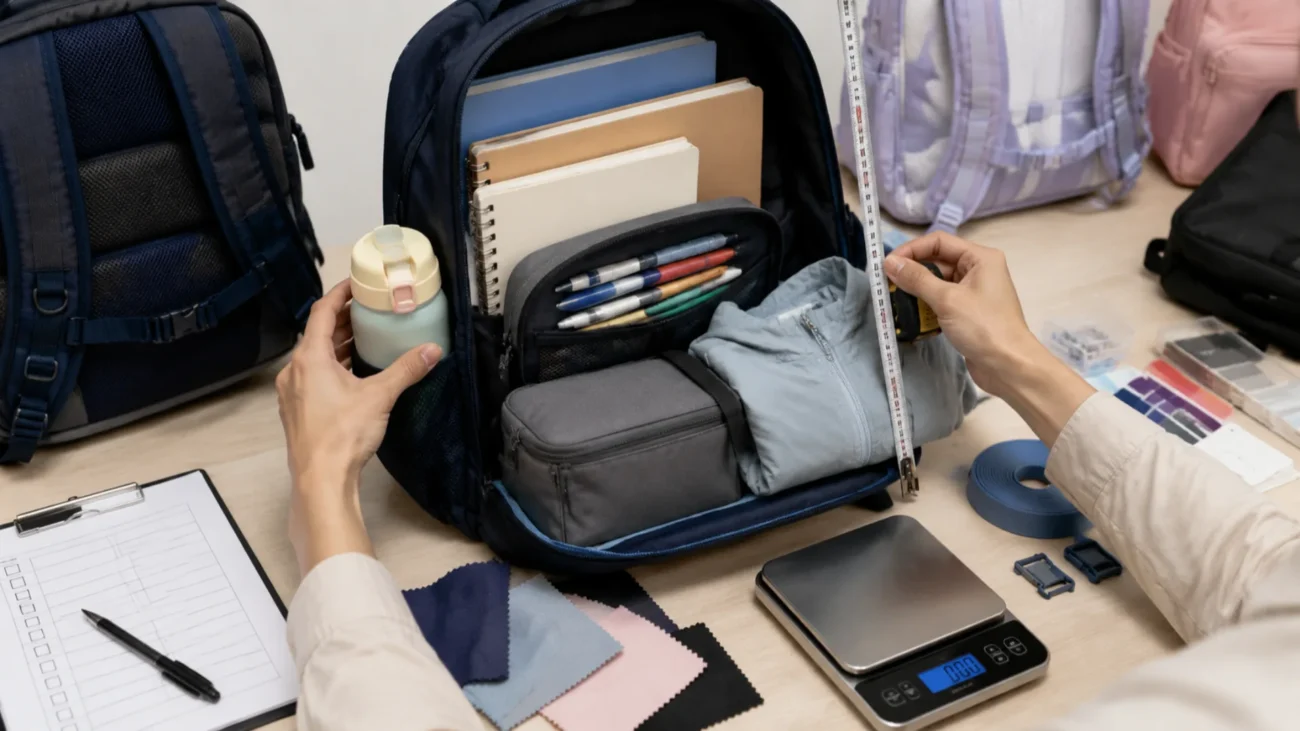
A practical review includes:
- Measure all external dimensions.
- Measure internal dimensions.
- Record empty weight.
- Test A4 folder compatibility.
- Add realistic school products.
- Close the bag under normal load.
- Test all zippers.
- Test both bottle pockets.
- Adjust both shoulder straps.
- Lift the bag by the handle.
- Inspect load-bearing seams.
- Check the lining and pockets.
- Review printing and colors.
- Check odor.
- Review individual packaging.
- Simulate carton compression.
- Reinspect the shape and hardware.
Before placing a larger order, buyers can use our school-supplies supplier guide to evaluate communication, manufacturing capability, quality control, export experience, and reorder support.
Conduct a Real-Load Test
Create a loading list for each target age group.
An elementary-school test may use:
- One A4 folder
- Two books
- One pencil case
- One lunch bag
- One full water bottle
- One light jacket
Record:
- Total loaded weight
- Ease of closing
- Backpack shape
- Strap position
- Bottom stability
- Handle performance
- Bottle-pocket performance
- Access to compartments
Photograph the loaded product so sales teams can use an honest capacity reference.
Confirm MOQ and Mixed Colors
MOQ may apply to:
- Backpack structure
- Fabric
- Fabric color
- Printed design
- Logo
- Zipper
- Webbing
- Molded panel
- Packaging
- Individual SKU
- Total purchase order
Ask whether several colors can share one total quantity when the structure, fabric, lining, zippers, and packaging remain the same.
Custom prints, dyed materials, molded parts, special zipper pulls, and individual packaging artwork may have separate minimums. For custom kids backpacks, buyers should confirm whether fabric colors, printed designs, molded panels, zipper pulls, and packaging each have separate minimum quantities.
Custom Kids Backpacks: Printing, Labels, and Accessories
Possible custom options include:
- All-over printing
- Screen printing
- Heat transfer
- Sublimation
- Embroidery
- Woven labels
- Rubber or silicone patches
- Molded EVA panels
- Custom zipper pulls
- Custom webbing
- Printed lining
- Internal name labels
- Hangtags
- Barcode labels
- Matching pencil cases
- Matching lunch bags
The method must suit the material and artwork. Fine illustrations may not reproduce well as small embroidery. Molded parts may require tooling and higher order quantities.
Check Batch Consistency
Inspect production for:
- Finished dimensions
- Empty weight
- Fabric color
- Printing position
- Pattern direction
- Shoulder-strap symmetry
- Adjustment range
- Zipper color
- Zipper performance
- Lining
- Side pockets
- Logo placement
- Molded-panel shape
- Accessories
- Hangtags
- Barcodes
- Polybags
- Carton assortment
Agree on acceptable tolerances before production.
Plan Seasonal Production
Work backward from the required warehouse date.
The schedule may include:
- Product selection
- Quotation
- Sample development
- Sample revision
- Material approval
- Compliance review
- Packaging artwork
- Pre-production sample
- Material purchasing
- Production
- Inspection
- Packing
- Freight
- Customs
- Warehouse receiving
- Retail distribution
Avoid presenting one fixed four-month or five-month timeline as suitable for every order. Lead time depends on design complexity, materials, quantities, freight method, and supplier capacity.
How to Evaluate a Kids Backpack Supplier
A capable kids backpack supplier should understand bag pattern development, load-bearing seams, material sourcing, printing, hardware, packaging, and repeat production:
- Bag-specific pattern development
- Fabric sourcing
- Printing
- Molded panels
- Cutting and sewing
- Reinforcement
- Hardware sourcing
- Quality control
- Packaging
- Mixed-color orders
- Export documents
- Repeat production
- Corrective action
Buyers should evaluate finished bags and the supplier’s process rather than relying only on factory photographs or general certifications.
Product Safety, Labeling, and Market Requirements
This section provides purchasing guidance and does not replace legal advice for a specific product or country.
Determine the Intended Age and Product Classification
For products sold in the United States, businesses must determine whether the finished backpack is a children’s product and which rules apply. CPSC explains that classification affects the applicable standards, testing, and certification obligations; applicable children’s products require third-party testing and a Children’s Product Certificate.
Buyers can review the CPSC’s official guidance on identifying, testing, and certifying children’s products before approving a U.S. compliance plan.
The finished product, intended age, graphics, packaging, accessories, and marketing should be considered together.
Small Parts and Decorative Attachments
CPSC states that children’s products intended for children under three are prohibited when small parts create choking, aspiration, or ingestion hazards. Some products containing small parts may also require warning labels, depending on the applicable category and age.
Where a backpack includes detachable zipper charms, beads, badges, or molded accessories, buyers should review the CPSC’s guidance on small parts and choking-hazard labeling for children’s products.
Chemical and Material Claims
Do not use unsupported claims such as:
- Non-toxic
- Lead-free
- Phthalate-free
- Chemical-free
- Eco-friendly
- Sustainable
- Recycled
- Biodegradable
Each claim should be supported by documents that apply to the actual material, color, coating, accessory, and production version.
A report for another fabric or an older product does not automatically support the final backpack.
EU General Product Safety and Traceability
Regulation (EU) 2023/988 applies from December 13, 2024 and replaced the previous General Product Safety Directive framework. It establishes general product-safety duties for relevant economic operators and other actors in the EU market.
Buyers selling in the EU should review the European Commission’s current product-safety guidance and the applicable GPSR responsibilities for manufacturers, importers, distributors, and online sales.
Depending on the product and sales model, buyers may need to confirm product identification, traceability, responsible economic-operator information, safety information, warnings, and target-market language requirements.
Packaging and Product Information
Confirm the applicable requirements for:
- Product identifier
- Model or SKU
- Manufacturer information
- Importer or responsible-person information
- Country of origin
- Intended age
- Warnings
- Barcode
- Materials
- Care instructions
- Traceability code
- Required languages
Do not assume the same label format applies to every destination country.
Retail Packaging and Carton Planning
Individual Polybags
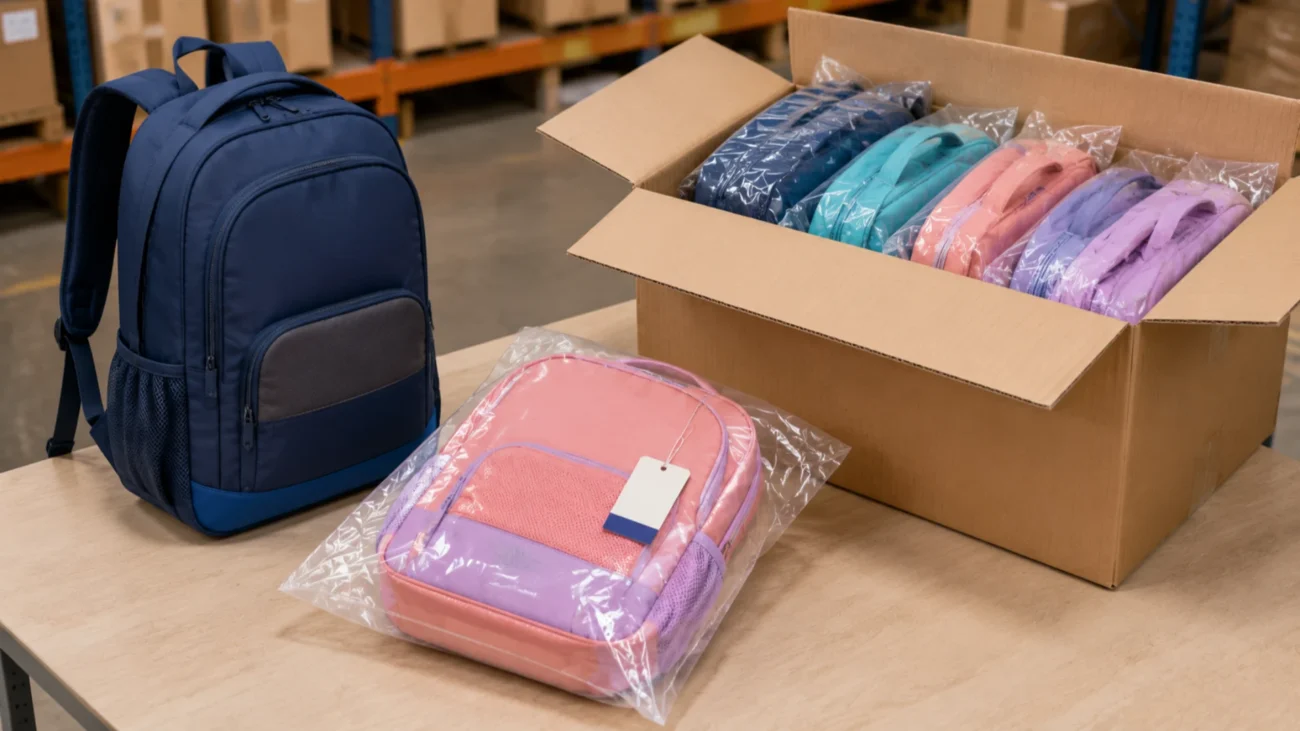
Individual bags protect the product from dust and handling.
Check:
- Polybag size
- Closure
- Warning requirements
- Ventilation holes where required
- Barcode visibility
- Fit around the backpack
- Tear resistance
The bag should fit the product without excessive empty material.
Hangtags
Hangtags may contain:
- Brand
- Product name
- SKU
- Barcode
- Materials
- Care information
- Main features
- Collection name
- Required warnings
The tag should not damage the fabric or cover the main design.
Gift and Display Packaging
Gift boxes may suit:
- Preschool mini backpacks
- EVA molded styles
- Backpack-and-accessory sets
- Premium collections
The package increases retail presentation but also increases carton volume and freight cost.
Carton Packing
Confirm:
- Units per carton
- Flat or shaped packing
- Compression method
- Mixed-color ratio
- Inner packaging
- Carton dimensions
- Net and gross weight
- Shipping marks
- Carton barcode
- Moisture protection
- Deformation risk
A tightly compressed carton may permanently deform foam, piping, or molded panels.
Common Mistakes When Sourcing Wholesale Kids Backpacks
- Checking external dimensions but not usable internal space.
- Failing to record empty backpack weight.
- Using “large capacity” without a real loading list.
- Checking strap padding but ignoring width and adjustment.
- Ignoring upper and lower shoulder-strap connections.
- Calling coated fabric a waterproof backpack.
- Approving an empty sample without a loaded test.
- Failing to test actual bottle-pocket dimensions.
- Starting custom artwork before confirming MOQ.
- Using one structure for preschool and older students.
- Checking the product but not the packaging.
- Failing to define production tolerances before mass production.
Frequently Asked Questions About Wholesale Kids Backpacks
What size backpack is suitable for preschool children?
A preschool backpack should match the child’s body size and normal contents. It usually needs space for a snack, small water bottle, thin folder, and spare clothing rather than several full-size books.
Prioritize low empty weight, simple access, a shorter body, and easy strap adjustment.
What material is best for kids school bags?
There is no single best material.
Polyester provides broad print and price options. Oxford fabric can create a firmer structure. Nylon may suit light or sports-style bags. Canvas creates a natural look but may be heavier and harder to clean. EVA panels add shape but increase weight and reduce flexible space.
The material should match the age, price, use, cleaning method, and appearance.
How should retailers test backpack capacity?
Use a defined set of real products.
Load the backpack with an A4 folder, notebooks, pencil case, lunch product, water bottle, and other items expected for the age group. Record the contents, loaded weight, ease of closing, and final shape.
What shoulder-strap features should buyers check?
Check:
- Width
- Padding
- Edge construction
- Adjustment range
- Left-right consistency
- Webbing
- Adjusters
- Upper attachment
- Lower attachment
- Performance under load
Is a water-resistant backpack waterproof?
No.
Water-resistant normally describes a material or limited finished-product performance. A waterproof claim requires the completed bag, including seams and zippers, to meet a defined test.
Can wholesale kids backpacks be customized?
Yes. Custom kids backpacks can usually be developed with selected colors, original artwork, printed fabric, embroidery, woven labels, rubber patches, molded EVA fronts, zipper pulls, lining, hangtags, and matching accessories.:
- Colors
- Printing
- Embroidery
- Labels
- Rubber patches
- EVA panels
- Zipper pulls
- Lining
- Webbing
- Hangtags
- Barcodes
- Packaging
- Matching accessories
Can buyers mix colors under one MOQ?
Sometimes.
A supplier may allow several colors when the structure, fabric, lining, zipper, and packaging remain unchanged. Custom prints, dyed fabrics, molded parts, and special hardware may have separate minimum quantities.
What should buyers inspect before mass production?
Approve:
- Dimensions
- Weight
- Fabric
- Lining
- Padding
- Straps
- Zippers
- Compartments
- Bottle pockets
- Handle
- Printing
- Colors
- Accessories
- Capacity
- Packaging
- Labels
- Carton plan
- Applicable compliance documents
Keep an approved pre-production sample for comparison.
How early should retailers order for back-to-school sales?
Work backward from the warehouse arrival date.
Include time for sampling, revisions, material sourcing, compliance review, packaging, production, inspection, freight, customs, and distribution.
The exact schedule depends on product complexity, quantities, destination, shipping method, and supplier capacity.
How do I choose a kids backpack supplier?
Choose a kids backpack supplier that can provide clear specifications, physical samples, material information, realistic loading tests, production quality checks, packaging data, and export documents. The supplier should also be able to explain which customization options affect MOQ, cost, and lead time.
Conclusion
Purchasing wholesale kids backpacks requires a clear balance of size, usable capacity, empty weight, materials, comfort, organization, durability, and visual design.
Preschool children need small and simple bags. Elementary students need practical document, pencil-case, bottle, and lunch storage. Older students may need stronger materials, organized compartments, and device sleeves.
Retailers purchasing wholesale school backpacks should approve measurable specifications, conduct real-load tests, inspect straps and seams, and confirm packaging before mass production. Buyers developing custom kids backpacks should also settle artwork methods, component MOQs, color standards, and production tolerances before approving the final sample.
Buyers can browse Wandefu’s bags collection to compare backpacks and matching children’s carrying products for future retail ranges. Retailers and distributors can also contact the Wandefu team to discuss wholesale kids backpacks, original graphics, matching pencil cases, packaging, and private-label sourcing requirements.