
Kids Craft Kits Buying Guide for Retailers

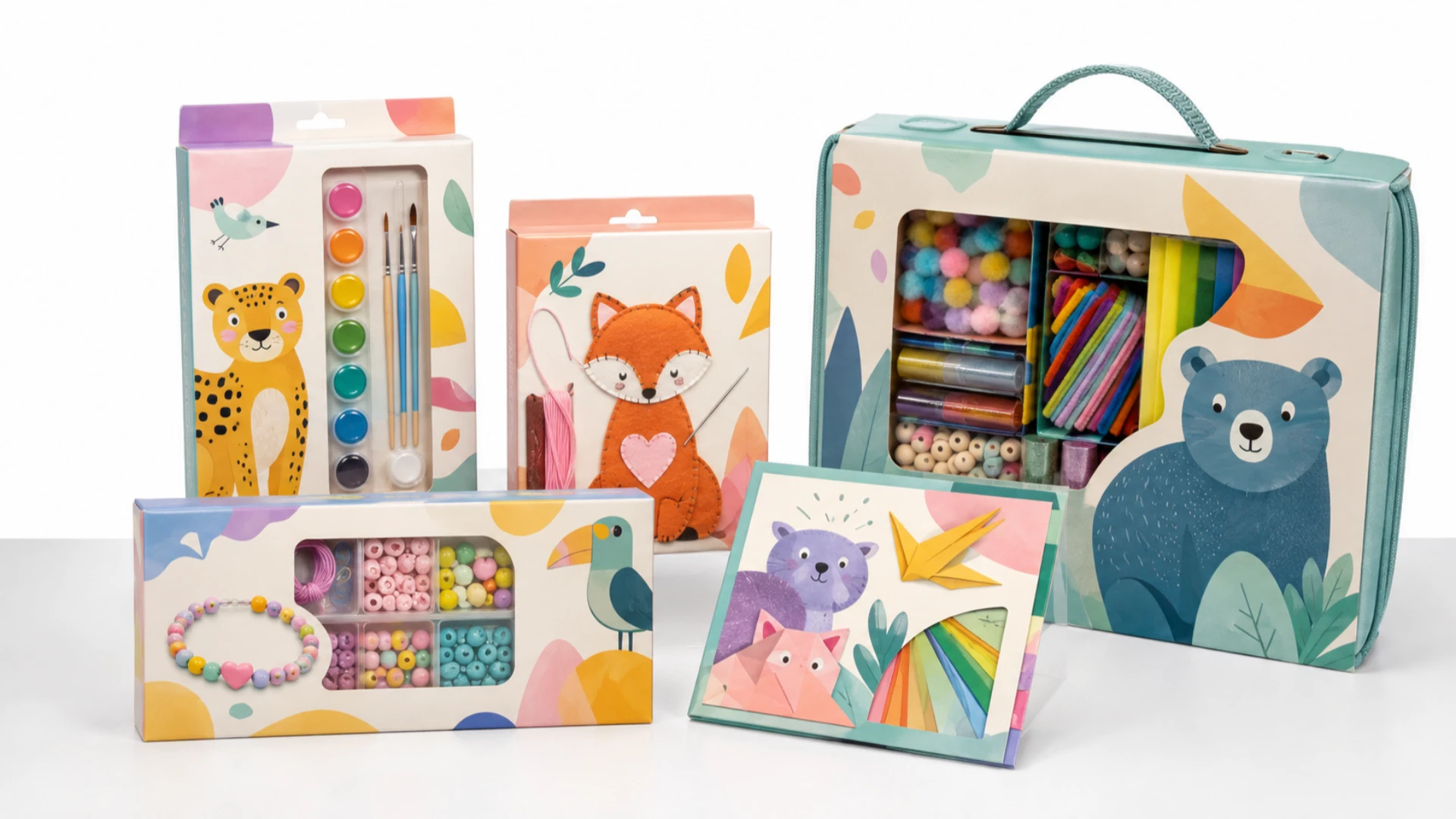
When a retailer looks at a shelf full of children’s creative products, it is easy to judge a box by its cover. Bright colors, a large component count, and an attractive finished-project image can all suggest a strong product. But when selecting kids craft kits for a retail assortment, the more important question is whether the kit actually works.
Can the child complete the project using the materials in the box? Are the instructions clear enough for the intended age group? Do the tools work with the supplied materials? Is there enough paint, thread, cord, glue, or other consumable material to finish the activity? Does the packaging keep small components organized from the factory to the customer?
For retailers, importers, and distributors, these questions affect more than user experience. An incomplete kids craft kit can result in returns, negative reviews, damaged brand perception, and problems when the same defect appears across an entire production batch.
Wholesale buyers also need to consider product classification, materials, safety documentation, packaging, component counts, MOQ, customization, seasonal lead times, and production consistency.
This guide explains how to evaluate craft kits for kids as complete activity systems rather than collections of colorful parts. It covers product types, age and difficulty positioning, instructions, materials, sample testing, packaging, seasonal programs, retail assortment planning, and wholesale quality control.
What Are Kids Craft Kits?
Kids craft kits are packaged activity products that combine materials, tools, components, and instructions around one or more creative projects.
The key word is project.
A box of markers, paper, beads, or glue can be useful, but loose craft supplies normally leave the customer to decide what to make and what other materials are needed. A craft kit provides more structure.
A well-designed kit should make several things clear:
- What the user is going to make
- Which materials are included
- Which tools are included
- Whether any household items are still required
- How the activity progresses from the first step to the finished result
For a retailer, that structure makes a kids craft kit easier to explain, merchandise, and compare.
Craft Kits vs. Loose Craft Supplies
Loose craft supplies can include:
- Paper
- Markers
- Paint
- Brushes
- Glue
- Yarn
- Beads
- Stickers
- Foam sheets
- Decorative materials
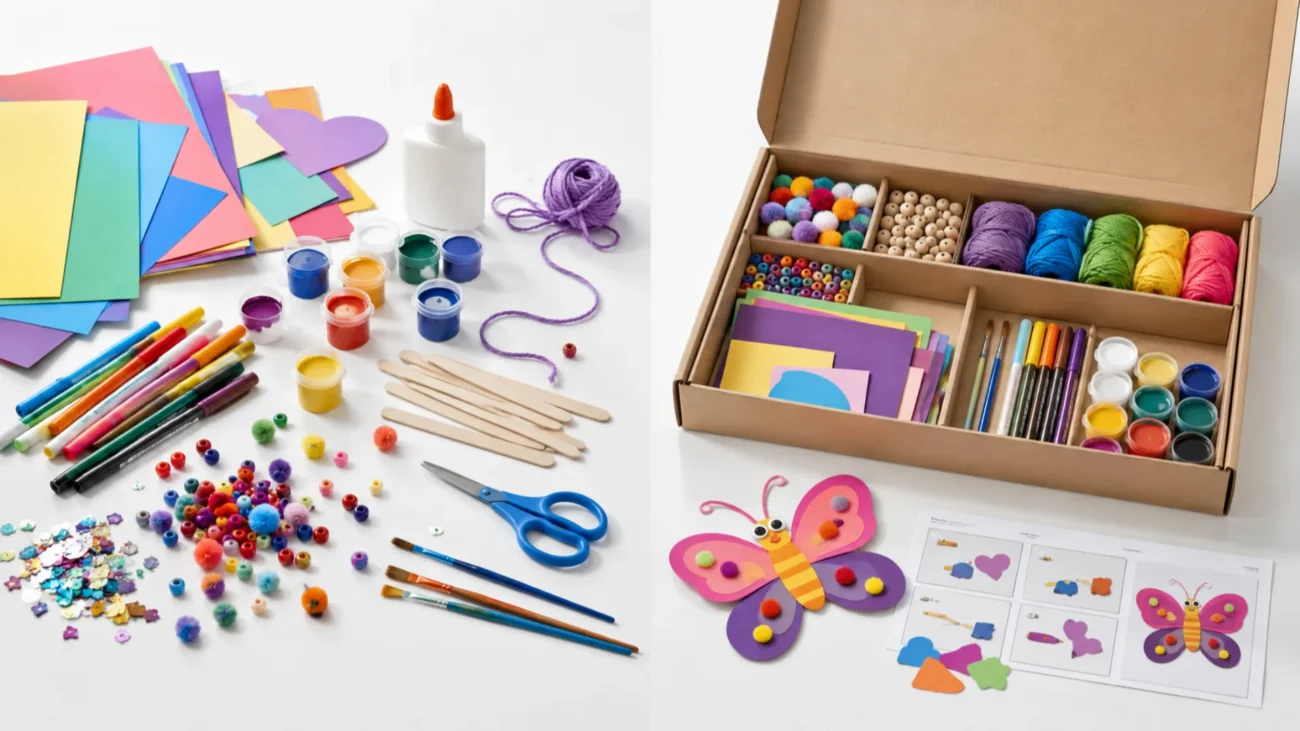
They are flexible because they can be used for many different projects.
A craft kit for kids, by contrast, normally combines selected materials around a defined outcome.
For example, a bracelet kit might contain beads, elastic cord, decorative pieces, clasps, a storage tray, and instructions. A painting kit might include a pre-printed object, several paint colors, brushes, and a visual guide.
This leads to one of the most useful product-evaluation questions in this entire guide:
Can the customer complete the project shown or described on the package using the supplied components plus only those household items that were clearly disclosed before purchase?
If the answer is no, the kit is incomplete regardless of how impressive its component count looks.
Single-Project Craft Kits
Single-project kits focus on one clear activity.
Examples include:
- Making one bracelet
- Painting one decorative object
- Sewing one felt figure
- Creating one paper decoration
- Assembling one small craft item
These products can work well at entry-level or impulse-buy price positions because shoppers understand the result quickly.
They also simplify quality control. Buyers can compare the materials directly against one finished project.
When reviewing a single-project kit, check whether:
- Every required component is present
- The materials match the instruction sheet
- The supplied tools work
- The finished result can realistically resemble the packaging image
- Required household items are disclosed
Multi-Project Craft Kits
Multi-project kits promise several finished items or several activity sessions from one box.
This can create stronger perceived value, but it also introduces more ways for the kit to fail.
A box that advertises several projects should contain enough shared materials to complete them.
For example, a kit may contain enough decorative pieces for several activities but insufficient glue, thread, paint, or cord to finish all of them.
Do not evaluate a multi-project kit only by counting project ideas in the instruction booklet. Complete enough of the activities to verify that common consumables and shared tools support the advertised use.
What Buyers Should Define Before Choosing Craft Kits for Kids
Before comparing suppliers, define the intended customer and use case.
Age range, difficulty, activity setting, packaging, and price positioning all affect which product structure makes sense.
Target Age Range
Age positioning affects:
- Component size
- Tool design
- Reading requirements
- Number of steps
- Fine-motor demands
- Small components
- Required supervision
- Packaging and warnings
Avoid choosing the age range only after the product is complete.
Instead, begin with the intended user and ask whether the components, tools, instructions, and activity support that positioning.
A project based on large pre-cut shapes and simple placement has different requirements from a detailed bead or sewing project. Buyers planning age-based assortments beyond craft products can also use our school supplies list by grade to compare product needs across different school stages.
Activity Difficulty
Difficulty is not determined by the number of parts.
A kit with many stickers may be simple to complete, while a small sewing kit with only a few fabric pieces may require considerably more coordination.
A practical retail classification can distinguish between:
Simple activities, which use straightforward placement, coloring, decorating, or basic assembly.
Intermediate activities, which involve more materials, pattern following, several assembly stages, or waiting for paint or adhesive.
More advanced activities, which may involve sewing, detailed painting, precise threading, or multi-stage construction.
These are retail-planning descriptions rather than fixed age standards.
Activity Duration
Craft activities may be designed as:
- Quick creative sessions
- One-session projects
- Longer projects
- Multi-session activities
- Multi-project sets
If the packaging makes a specific completion-time claim, sample testing should support it.
An experienced adult completing the sample faster than the intended child is not a reliable basis for a time claim.
Intended Setting
Different settings require different product structures.
Home Use
Home kits can provide several components and shared tools because storage and adult assistance may be available.
Classroom Use
Classroom craft kits may need:
- Easier component counting
- Student sub-packs
- Shared-tool planning
- Multiple instruction copies
- Faster distribution and cleanup
Travel Use
Travel products benefit from:
- Secure closures
- Fewer loose pieces
- Compact packaging
- Internal storage
- Low-mess materials
Gifts and Parties
Gift presentation may justify stronger packaging, while party activities may benefit from simpler projects that can be distributed to several users.
Main Types of Craft Kits for Kids
A strong retail range usually contains clearly different activities rather than many products that perform the same task.
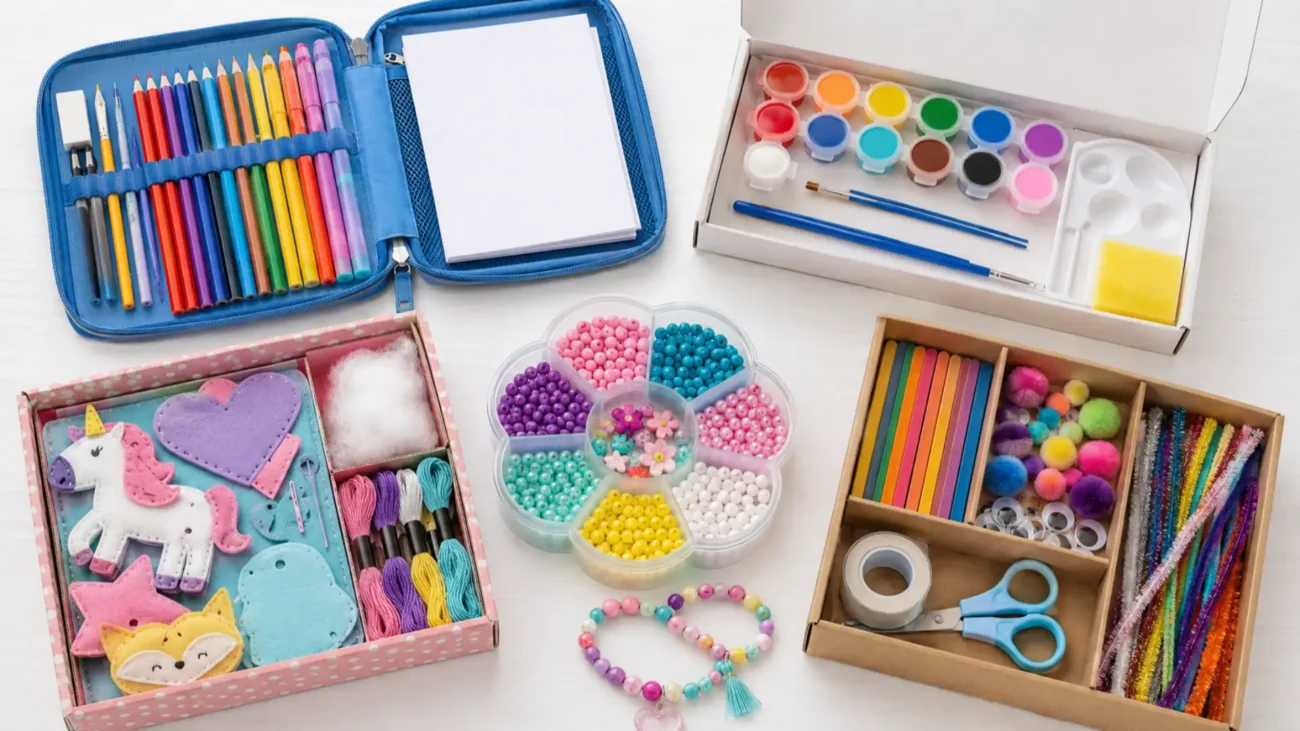
Art Kits for Kids
Art kits for kids typically focus on drawing, coloring, painting, or mixed-media activities.
They may contain:
- Colored pencils
- Markers
- Crayons
- Paint
- Brushes
- Paper
- Printed activity sheets
- Decorative materials
An art kit should still provide more structure than simply placing unrelated supplies in a box.
Buyers should check:
- Whether the included media work with the supplied paper or surface
- Whether enough colors are provided for the projects shown
- Whether brushes and applicators suit the project size
- Whether the activity is guided or genuinely open-ended
This distinction helps prevent a craft-kit assortment from becoming a duplicate of a broader art-supplies range.
Art kits for kids belong here as one important craft-kit format, while general art supplies serve a wider, open-ended purpose. For a ready-to-use coloring format, buyers can also review our Cat Die-Cut Shaped Coloring Book Set, which combines a shaped drawing pad with colored pencils and sticker sheets.
Painting Kits for Kids
Painting kits for kids may include:
- Pre-printed canvases
- Wooden objects
- Plaster or molded shapes
- Decorative boards
- Paint pots
- Brushes
The sample test should check the complete painting process.
Important questions include:
- Is there enough paint?
- Does the paint remain usable when the package is opened?
- Is the brush suitable for both large and small areas?
- Does the paint work on the supplied surface?
- Are drying or waiting steps explained?
- Can partially used materials be stored?
Do not assume that a paint marketed as washable, quick-drying, or suitable for children supports those claims without relevant evidence.
Sewing Kits for Kids
Sewing kits for kids can be an important supporting product type within a broader craft assortment.
Typical products may include:
- Pre-cut felt or fabric
- Thread or yarn
- Stuffing
- Decorative pieces
- Pre-punched holes
- Sewing tools
- Instructions
When evaluating a sewing kit, inspect:
- Tool type
- Tool tip and surface finish
- Hole placement
- Thread length
- Thread compatibility
- Fabric edges
- Assembly order
- Finished-project size
- Required adult involvement
A beginner-oriented product should make the first stitching steps understandable rather than expecting users to already know how to begin, finish, or secure the thread.
Bead and Bracelet Kits
Bead kits for kids may combine:
- Beads
- Elastic
- Cord
- Charms
- Letter pieces
- Clasps
- Storage compartments
- Instructions
This format needs especially careful component control.
Check:
- Bead quantity
- Color distribution
- Hole consistency
- Cord length
- Cord performance
- Component storage
- Small-part considerations
- Whether the number of finished items shown can actually be made
Packaging matters because a divided bead box has little value if all colors mix together during transport.
Other Activity Kit Formats
Retail assortments may also include:
- Sticker activities
- Coloring sets
- Scratch art
- Clay or modeling activities
- Paper crafts
- Foam decoration
- Jewelry making
- Mixed creative activities
These products can add useful variety even when they are not strong enough to justify their own major SEO target.
The retail decision should still depend on the quality of the activity, packaging, price position, and actual inventory strategy. For a scratch-art example, buyers can compare our Hello Kitty Rainbow Scratch Art Book as a compact creative activity format for gift and retail assortments. Sticker-led assortments can also include products such as our Disney Princess sticker roll, which provides a compact character-themed option for craft, reward, and impulse-buy programs.
DIY, Activity, and Classroom Kit Formats
Not every creative search has exactly the same intent.
Understanding the difference helps retailers describe products accurately.
DIY Crafts for Kids
People searching for DIY crafts for kids may be looking for activities they can make using materials already available at home.
A commercial DIY kit solves a different problem: it reduces preparation.
Instead of asking the customer to find several separate materials, the kit provides most or all project-specific components together.
The packaging should clearly communicate:
- What is included
- What the child creates
- What creative choices remain open
- Which household items are still required
This preserves the do-it-yourself experience while adding the convenience of a packaged product.
Activity Kits for Kids
Activity kits for kids can cover a wider range than traditional crafts.
They may combine:
- Drawing
- Decoration
- Building
- Puzzles
- Story elements
- Creative play
Retailers should identify the primary experience.
Is the customer buying a product to make something, solve something, play with something, or learn something?
Clear positioning reduces category overlap.
Classroom Craft Kits
A classroom format may need to support several users simultaneously.
Retail buyers should check:
- Number of intended users
- Individual material packs
- Shared tools
- Component allocation
- Setup time
- Cleanup
- Instructions for the teacher
- Instructions for students
A large family craft set is not automatically an effective classroom product.
How to Match a Kids Craft Kit to Age and Skill Level
An age label is only one part of product evaluation.
Buyers should examine the actual actions required.
Number and Type of Steps
Rather than counting steps alone, ask what happens during them.
Does the user need to:
- Read instructions?
- Measure?
- Tie a knot?
- Thread a small opening?
- Wait for glue to set?
- Match several components?
- Correct mistakes?
- Use a tool precisely?
A short project can still be difficult.
Small Components
Craft kits frequently contain small decorative components.
Examples include:
- Beads
- Buttons
- Sequins
- Charms
- Small foam pieces
- Fasteners
The intended age, component dimensions, product classification, and destination-market rules all need to be considered.
Do not use one blanket statement for every craft kit containing small parts.
Tools
Tools may include:
- Scissors
- Brushes
- Applicators
- Tweezers
- Modeling tools
- Threading tools
- Needle-like tools
Check:
- Size
- Grip
- Points
- Edges
- Surface finish
- Strength
- Compatibility with the supplied material
A tool that is physically present but cannot perform the activity makes the kit incomplete.
Adult Assistance
The product should make the expected level of adult involvement understandable.
Possible positions include:
- Independent activity
- Adult setup recommended
- Supervision required for particular steps
- Adult assistance needed during the activity
Do not describe an activity as independent if an adult has to complete critical steps that are not disclosed before purchase.
What Should Be Included in a Complete Kids Craft Kit?
A kids craft kit should function as one complete activity system.
Main Project Materials
The production specification should identify:
- Component
- Material
- Dimensions
- Color
- Quantity
Avoid vague descriptions such as “assorted felt pieces” when production depends on specific shapes, colors, and counts.
Clear specifications make it easier to compare the pre-production sample with the final batch.
Tools
Test every tool using the supplied materials.
For example:
- Does the brush cover the intended surface?
- Does a threading tool pass through the supplied openings?
- Does a cutting tool work with the supplied material?
- Can the applicator reach the intended area?
Do not increase the advertised component count by including tools that are too weak or poorly matched to the activity.
Adhesives and Consumables
Consumables may include:
- Paint
- Glue
- Adhesive dots
- Thread
- Yarn
- Elastic
- Cord
- Ink
Check:
- Quantity
- Closure
- Packaging
- Application method
- Storage
- Drying or setting behavior
There is no universal percentage of extra material that every kit must contain.
Instead, complete the project under realistic conditions and determine whether the supplied quantity provides a reasonable margin for normal use.
Decorative Components
Check:
- Quantity
- Color
- Size
- Pattern
- Attachment method
- Packaging position
A product with exactly the minimum number of tiny decorative pieces may be more vulnerable to user error or component loss than one with a small practical allowance.
Whether spare pieces are appropriate depends on the product.
Instructions
Instructions should cover:
- Component identification
- Tool identification
- Step sequence
- Important orientation
- Assembly
- Drying or waiting
- Adult assistance where relevant
- Finished result
The instruction sheet is not an accessory. It is part of the functionality of the kit.
Spare Components
Spare components can be useful for:
- Beads
- Stickers
- Thread
- Fasteners
- Small decorative pieces
They are not mandatory, and there is no universal percentage that should be added.
Use the sample-completion test to determine whether a small allowance would materially improve the product.
Instructions and Project Usability
Instruction quality can determine whether the activity is completed successfully or abandoned halfway through.
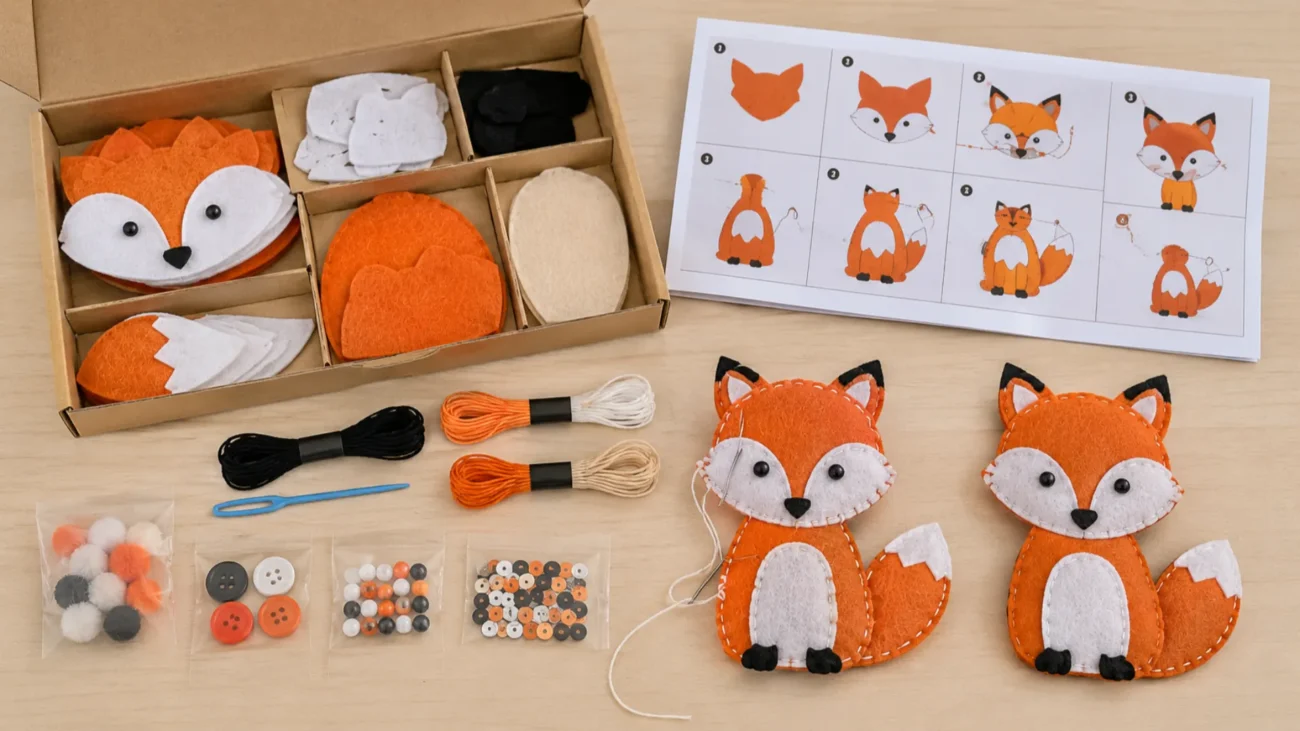
Can Someone Complete the Project Using Only the Instructions?
Give the sample to someone who has not seen the product development process.
Ask them to follow the printed steps.
Do not allow them to rely on factory explanations or missing instructions supplied verbally by the sales representative.
Record where they:
- Pause
- Misidentify a part
- Use the wrong color
- Assemble something backward
- Skip a step
- Need outside help
Those friction points indicate where the instructions need revision.
Illustrations vs. Text
Visual guidance can be particularly useful for activities involving:
- Folding
- Threading
- Positioning
- Layering
- Sewing
- Assembly
However, illustrations only help when they match the actual production components.
If the shape or color changes during manufacturing, the instruction artwork should be updated too.
Finished Project Example
The packaging should show a result that is reasonably achievable using the contents.
Avoid images that materially exaggerate:
- Size
- Number of finished items
- Surface quality
- Color range
- Decoration
- Included accessories
One useful sample-review step is to photograph the finished sample and compare it directly with the packaging artwork.
Required Household Items
If the project still requires items such as:
- Water
- Pencil
- Tape
- Scissors
- Ruler
- Protective table covering
state this clearly before the user starts.
The customer should not discover halfway through the project that an essential item was never included or disclosed.
Materials and Safety Checks for Retail Buyers
Safety and compliance should be evaluated product by product.
A children’s craft kit can contain paper, fabric, plastics, small components, art materials, tools, adhesives, and coatings, and different elements can trigger different requirements.
Review the Complete Kit
Do not review only the main material.
The complete package may contain:
- Paper
- Card
- Fabric
- Foam
- Plastic
- Wood
- Beads
- Paint
- Ink
- Glue
- Thread
- Tools
- Decorative components
A document covering one paper, fabric, or plastic component does not automatically establish the status of every other part packed inside the kit.
Buyers should therefore determine the actual product classification and applicable safety requirements for the complete finished product. For products marketed primarily to children in the United States, buyers can review CPSC guidance on children’s products to determine which federal safety rules may apply to the complete kit.
Small Parts
When a kit contains beads, charms, buttons, small decorative pieces, or fasteners, buyers should review:
- Intended age
- Product classification
- Component dimensions
- Required warnings
- Applicable testing
- Destination market
Avoid simplifying the assessment into statements such as “all bead kits are unsuitable for young children.”
The correct decision depends on the actual product and market. Buyers sourcing products for the U.S. market can review CPSC’s Small Parts Ban and Choking Hazard Labeling guidance when evaluating component size, intended age, and applicable warning requirements.
Paints, Inks, and Art Materials
Kits containing paints, markers, inks, modeling materials, adhesives, or similar art materials need additional material and labeling review.
Broad supplier statements such as “non-toxic” are not sufficient on their own. For art materials sold in the United States, buyers can review CPSC’s Art Materials guidance for current requirements covering toxicological assessment, labeling, and ASTM D-4236 conformance statements.
Buyers should ask:
- Which formulation does the documentation cover?
- Does it match the current supplier?
- Does it match the current product version?
- Does it apply to the intended market?
- Does it support the claim printed on the packaging?
Tools
Tools also need product-specific inspection.
Check:
- Points
- Edges
- Burrs
- Surface finish
- Handle size
- Strength
- Intended user
- Compatibility with the activity
A smooth-looking plastic tool can still contain molding defects, and a tool that is too weak may encourage users to apply excessive force.
Product Claims
Avoid unsupported packaging claims such as:
- Non-toxic
- Chemical-free
- Eco-friendly
- Biodegradable
- Washable
- Child-safe
- Hypoallergenic
The correct wording depends on what has actually been assessed or tested.
If the formulation, component supplier, material, coating, or product construction changes, confirm whether existing evidence still applies.
How Retail Buyers Should Test a Craft Kit Sample
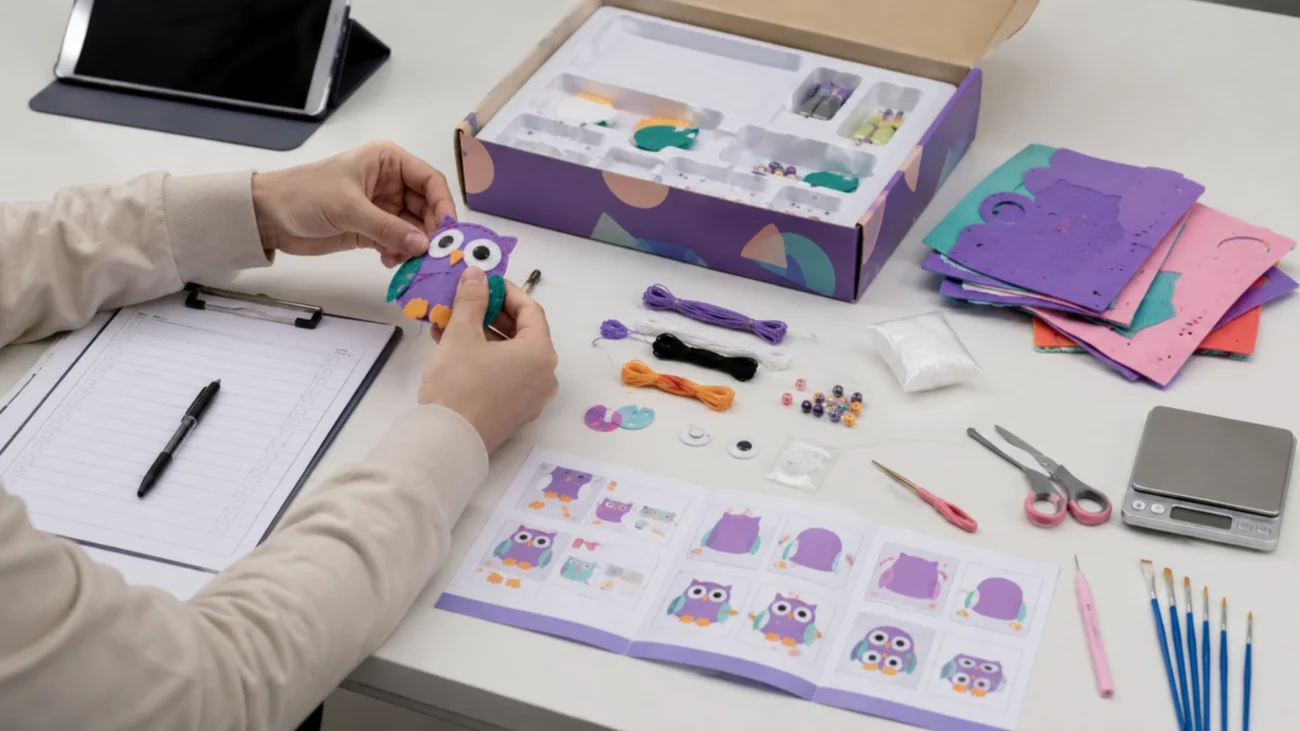
This is one of the most important operational steps in selecting kids craft kits.
A sealed sample can show packaging, colors, apparent component count, and initial presentation. It cannot show whether the project actually works.
Use a repeatable sample-completion test.
Step 1: Open the Retail Package
Open it as a customer would.
Check:
- Opening difficulty
- Component spillage
- Damage to the packaging
- Whether the package can be used for later storage
Step 2: Record Every Component
Lay out the contents and compare them against:
- Packaging
- Instruction sheet
- Supplier specification
- Bill of Materials
Record:
- Missing parts
- Extra parts
- Wrong colors
- Wrong sizes
Step 3: Compare Components with the Instructions
Every component mentioned in the instructions should exist.
Every important component supplied should also have a clear role.
Step 4: Complete the Project Exactly as Instructed
Do not improve the activity using personal craft experience.
If the buyer has to invent a step, the instructions need work.
Step 5: Record Missing Materials
Identify anything that should have been included or disclosed.
Examples may include:
- Adhesive
- Cutting tool
- Water
- Tape
- Pencil
Step 6: Test Every Supplied Tool
Use the actual brush, needle-like tool, scissors, applicator, or threading tool through the relevant steps.
Step 7: Record Consumable Usage
Track:
- Paint
- Glue
- Thread
- Cord
- Beads
- Stickers
- Other limited materials
Determine whether the claimed project count can realistically be completed.
Step 8: Inspect the Finished Result
Compare it with the box image.
Check:
- Size
- Color
- Structure
- Decoration
- Number of finished items
Handmade results naturally vary, but the packaging should not promise something the components cannot produce.
Step 9: Review Leftovers, Storage, and Cleanup
Consider:
- Remaining materials
- Waste
- Paint or glue cleanup
- Storage
- Loose small components
Step 10: Record the User Experience
| Test Area | What to Record |
|---|---|
| Components | Missing, extra, wrong, or damaged pieces |
| Instructions | Unclear steps or mismatched illustrations |
| Tools | Functional or unsuitable |
| Consumables | Sufficient or insufficient |
| Project Result | How closely it matches the stated outcome |
| Difficulty | Easier or harder than expected |
| Completion Time | Actual sample result |
| Cleanup | Mess, storage, and leftover materials |
The results can become part of the production approval standard.
Packaging, Gift Sets, and Display Planning
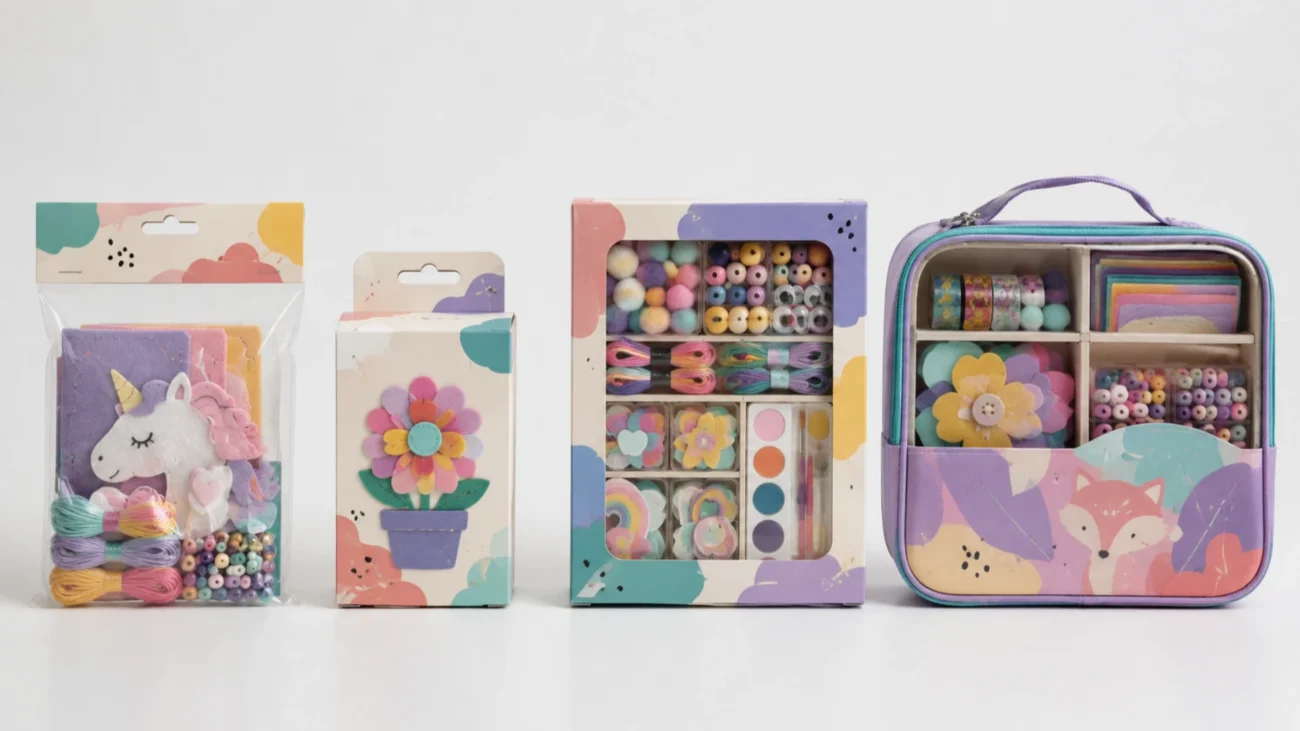
Packaging has four core jobs:
- Protect the components
- Keep them organized
- Explain the project
- Present the product at retail
Header Card and Bag
This format can work for:
- Flat activities
- Simple projects
- Low component counts
- Peg displays
Advantages include low packaging weight and visible contents.
Limitations can include:
- Lower crush protection
- Less surface area for instructions and warnings
- Loose components collecting at the bottom
Folding Carton
A folding carton offers more room for:
- Instructions
- Product images
- Component information
- Barcodes
- Warnings
- Multiple inner bags
Its regular shape can also improve shelf stacking and carton packing.
Check whether internal parts move excessively inside the box.
Window Box
A window allows customers to see:
- Real colors
- Materials
- Components
- Tools
This can improve product understanding, especially for gift-oriented kits.
However, the visible sample should represent the actual contents rather than placing only the best-looking components in front of the window.
Reusable Carry Case
Carry cases can work for:
- Multi-project kits
- Art kits
- Travel products
- Large component assortments
Inspect:
- Closure
- Handle
- Internal compartments
- Storage after use
- Added shipping volume
The case should have practical value after purchase rather than simply increasing packaging size.
Component Organization
Packaging should reduce:
- Missing parts
- Mixed components
- Damaged tools
- Paint leakage
- Scratched materials
A useful packaging test is to close the sample, orient it in several directions, handle it as it might be handled during transport, and then reopen it to see whether the internal arrangement still works.
Seasonal Planning for Kids Craft Kits
Seasonal products can give retailers reasons to refresh displays, but they also increase inventory risk because the selling period is shorter.
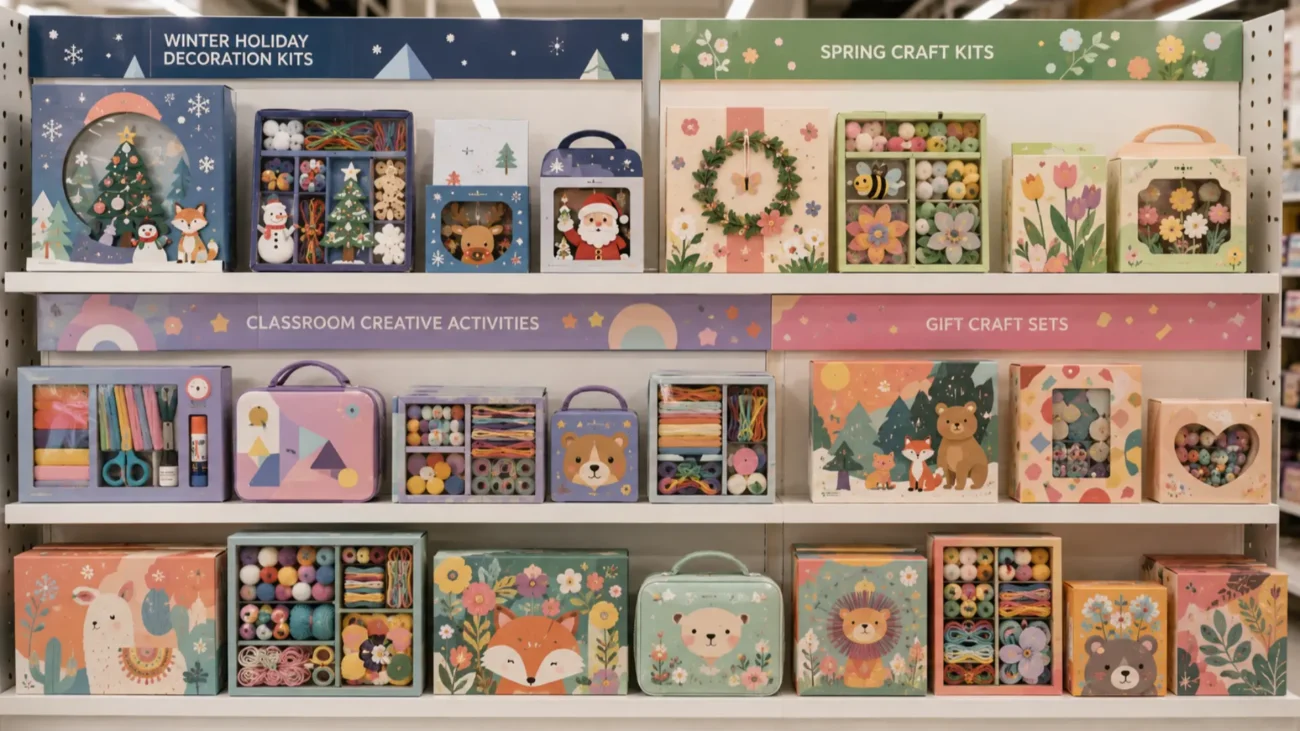
Christmas Craft Kits for Kids
Christmas craft kits for kids can include:
- Ornament decorating
- Seasonal cards
- Felt decorations
- Painting activities
- Gift-making crafts
The seasonal theme should exist in the actual project, not only in red and green packaging.
A strong Christmas kit might allow the child to create a decoration, card, ornament, or other clearly defined seasonal result.
Retailers should work backward from the required shelf date rather than rely on one universal lead-time rule.
Actual timing depends on:
- Sample revisions
- Materials
- Packaging
- Production capacity
- Inspection
- Freight method
- Destination
Easter Craft Kits for Kids
Easter craft kits for kids may include:
- Egg decoration
- Bunny-themed crafts
- Spring decorations
- Small gift activities
Because the sales window is narrow, mixed-design flexibility and realistic MOQ can be particularly important.
Late delivery can quickly turn seasonal inventory into slow-moving stock.
Holiday Craft Kits
Broader holiday themes can sometimes extend the selling period.
A project can use seasonal colors and decoration while remaining flexible enough to serve several occasions.
Back-to-School and Classroom Programs
Creative kits can also fit:
- Back-to-school promotions
- Classroom activity sections
- After-school programs
- Gift displays
The project should suit the intended setting rather than simply adding school-themed packaging to a normal home craft kit. Retailers planning a broader seasonal range can use our back-to-school essentials guide to coordinate craft products with stationery, bags, storage, lunch products, and other school categories.
How to Build a Kids Craft Kit Retail Assortment
A balanced assortment should give customers clear reasons to choose different products.
Entry-Level Kits
These can focus on:
- One clear project
- Fewer components
- Straightforward instructions
- Compact packaging
Their role is accessibility and easy product understanding.
Mid-Range Kits
Mid-range products may add:
- More materials
- Multiple projects
- Better component organization
- Additional tools
- More detailed activities
This level often works well as the core of a retail assortment because it balances price and project depth.
Gift-Oriented Kits
Gift products can justify:
- Stronger presentation
- Storage cases
- Multiple activities
- Larger assortments
- More organized internal packaging
Do not distinguish them only by calling them “premium.”
Explain the actual structural differences.
Avoid Too Many Similar SKUs
Eight kits with the same project and only different packaging graphics can increase inventory complexity without giving customers meaningful choice.
Instead, differentiate by:
- Activity
- Difficulty
- Number of projects
- Packaging
- User setting
- Price position
For example, a range could combine:
- One painting kit
- One sewing activity
- One bead set
- One simple entry-level craft
- One gift-oriented multi-project kit
This creates clearer product segmentation.
Wholesale Buying Checklist for Kids Craft Kits
Once a product passes the retail-use test, wholesale buyers need a production-control framework.
Create a Complete Bill of Materials
The BOM should identify each component clearly.
| Field | Example of What to Record |
|---|---|
| Component | Felt panel, cord, paint pot, brush |
| Material | Supplier-confirmed material |
| Size | Dimensions or length |
| Color | Approved reference or code |
| Quantity | Exact number per kit |
| Function | Main material, tool, decoration |
| Packaging Position | Inner bag, tray section, outer box |
Avoid descriptions such as “one bag of beads” when the production result depends on bead count, size, color, and assortment.
Use the Sample Completion Test as the Approval Standard
The approved sample should not only look correct.
It should have passed the actual project-completion test.
Keep:
- Sample photographs
- BOM version
- Instruction version
- Consumable usage
- Finished project
- Approved packaging
These records help buyers compare production with the agreed sample.
Confirm MOQ and Mixed Designs
MOQ can apply separately to:
- Main product structure
- Custom components
- Packaging
- Printing
- Instructions
- Colors
- Individual designs
Ask:
- Can several designs share one structure?
- Can colors be mixed?
- Does each custom print have its own minimum?
- Are component minimums different from final-kit minimums?
There is no universal MOQ that applies to all craft kits.
Review Customization Before Final Artwork
Potential options may include:
- Outer packaging
- Printed instructions
- Colors
- Printed activity sheets
- Decorative parts
- Labels
- Barcodes
- Inner trays
- Original graphics
Confirm actual manufacturing capability, printing method, minimums, and sampling requirements before approving artwork.
Check Batch Completeness
Craft kits have an unusual quality-control risk:
One inexpensive missing component can prevent the entire advertised project from being completed.
Final QC should therefore inspect more than outer appearance.
Check:
- Component counts
- Correct components
- Colors
- Tools
- Instructions
- Consumable packs
- Barcodes
- Inner packaging
- Outer packaging
Check Packaging Consistency
Production review should also compare:
- Artwork version
- Product name
- Instruction language
- Age information
- Required warnings
- Barcode
- Country or market information where applicable
- Inner component arrangement
A kit with correct materials but the wrong instruction sheet can still become unusable.
Plan Seasonal Lead Times Backward
Start with the required in-store deadline and work backward through:
- Freight
- Inspection
- Assembly
- Packaging production
- Component sourcing
- Sample revisions
- Initial sampling
Add an appropriate buffer based on the actual supplier, production complexity, destination, and shipping route. Buyers evaluating manufacturers across several school-product categories can also use our school-supplies supplier guide to compare sampling, communication, production control, documentation, and reorder support.
Wholesale and Bulk Product Range
Commercial terms such as wholesale craft kits and bulk craft kits represent stronger product-browsing and volume-purchasing intent.
A buying guide should explain how to evaluate the products, while the main Craft category should handle the stronger transactional product search.
This separation helps retailers move naturally from research into product selection without forcing every commercial keyword into the same article. Buyers ready to compare commercial product options can browse Wandefu’s Craft collection for kids craft kits, creative products, and wholesale sourcing options.
Common Mistakes When Sourcing Kids Craft Kits
1. Counting Components Instead of Completing the Project
A high piece count does not prove that the activity works. Complete the project.
2. Choosing Difficulty from Packaging Artwork
Cute graphics do not establish activity difficulty. Review the actual steps and tools.
3. Approving Instructions Without Testing Them
Instructions written from the factory’s perspective may not work for the intended user.
4. Ignoring Small Components
Assess age, classification, component size, and destination-market requirements.
5. Accepting Tools That Do Not Work
Test every supplied tool with the actual project material.
6. Providing Too Little Consumable Material
The project must be finishable using realistic material usage.
7. Hiding Required Household Items
Disclose required external items before purchase.
8. Skipping the Full Sample Completion Test
A sealed box cannot demonstrate project usability.
9. Allowing Components to Mix During Transport
Internal organization is part of product quality.
10. Starting Customization Before Confirming MOQ
Finalize the commercial structure before investing in artwork revisions.
11. Ordering Seasonal Products Too Late
Plan from the required retail date backward.
12. Inspecting Packaging but Not Component Completeness
A perfect outer box cannot compensate for a missing project component.
Frequently Asked Questions About Kids Craft Kits
What Are Kids Craft Kits?
Kids craft kits are packaged activity products that combine materials, tools, components, and instructions around one or more creative projects.
They differ from loose craft supplies because the contents are organized around a defined activity or result.
How Do You Choose Craft Kits for Kids by Age?
Evaluate:
- Component size
- Tools
- Number and type of steps
- Reading requirements
- Fine-motor demands
- Small components
- Required adult involvement
Do not rely on packaging graphics or one generic age rule.
What Should Be Included in a Kids Craft Kit?
A complete kids craft kit should normally include:
- Main project materials
- Required project-specific tools
- Sufficient consumables
- Decorative parts where relevant
- Clear instructions
Any required household items should be disclosed.
Are Art Kits for Kids the Same as Craft Kits?
They overlap, but they are not necessarily identical.
Art kits for kids normally center on drawing, painting, coloring, or mixed-media activities.
Other craft kits may focus on:
- Sewing
- Jewelry making
- Construction
- Decoration
- Assembly
The distinction depends on the actual product structure.
What Are DIY Kits for Kids?
DIY kits package the project-specific materials needed for a do-it-yourself activity.
They differ from many online DIY crafts for kids tutorials because the customer does not need to source each material separately.
Are Sewing Kits for Kids Suitable for Beginners?
Some are.
A beginner sewing kit should have a project structure, tool type, prepared materials, and instructions appropriate to the intended user.
Do not assume that every product called a children’s sewing kit is automatically suitable for a first-time user.
What Should Retailers Check in Christmas Craft Kits for Kids?
Check:
- Whether the project is genuinely seasonal
- Component completeness
- Packaging
- Instructions
- Safety and age positioning
- Supplier lead time
- Required shelf date
Seasonal designs should be ordered with enough time for testing and revisions.
Are Classroom Craft Kits Different from Individual Kits?
They can be.
A classroom product may need:
- User-specific component packs
- Shared tools
- Easier component distribution
- Multiple instructions
- Faster setup and cleanup
What Should Wholesale Buyers Check Before Ordering Craft Kits?
Wholesale buyers should confirm:
- Complete BOM
- Physical sample
- Completed project
- Materials
- Applicable compliance documentation
- MOQ
- Customization
- Packaging
- Batch component counts
- Seasonal timing
The product should be evaluated as a complete system rather than as separate raw materials.
Conclusion
Choosing effective kids craft kits requires more than selecting an attractive box or a high component count. The project needs to be achievable, the materials sufficient, the tools functional, the instructions understandable, and the packaging capable of keeping everything organized through transport and normal use.
Different craft kits for kids also create different sourcing requirements. Art kits for kids depend on compatible media and consumable quantities. Sewing and bead products add more detailed tool and component considerations. DIY and classroom products change the expectations around preparation, independence, storage, and distribution.
For retailers, a strong assortment should offer clear differences in activity type, difficulty, packaging, and price position instead of many nearly identical SKUs.
For wholesale buyers, approval should include a documented BOM, full sample-completion test, relevant safety documentation, MOQ confirmation, packaging review, and batch-completeness checks.
Buyers ready to compare products can browse Wandefu’s Craft collection for available creative products and wholesale options.
Retailers and distributors can contact the Wandefu team to discuss kids craft kits, packaging, custom designs, seasonal assortments, and sourcing requirements.