
Kids Stationery Set Buying Guide for School, Gifts, and Retail Displays

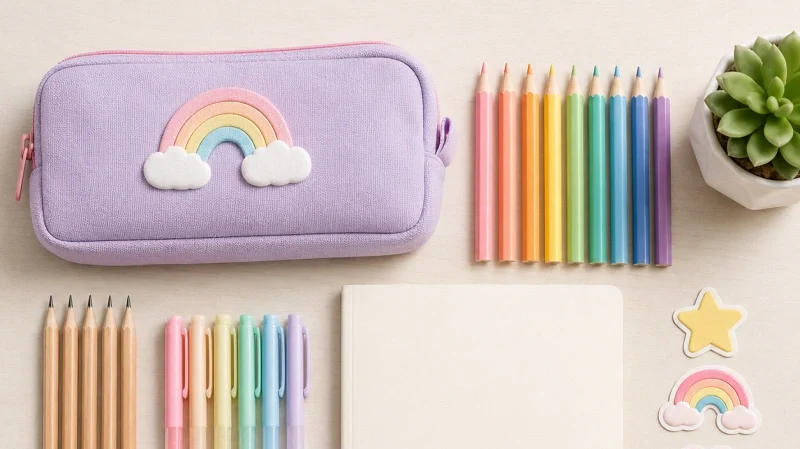
A well-planned kids stationery set gives children the writing, drawing, measuring, and organizing tools they need in one practical package. It can simplify back-to-school shopping, create a useful birthday gift, or help a retailer present several coordinated products as one clear offer. For buyers, the main advantage is convenience. For children, matching colors, patterns, and storage cases can make everyday supplies easier to recognize, carry, and keep organized.
A good set, however, is not made by placing random pencils, erasers, rulers, and stickers into a bag. The products must suit the child’s age and intended activity. Pens should write smoothly, pencil leads should not break after light handling, rulers should have clear markings, and small parts must be reviewed for the target age group. The outer package must also protect every item during shipping and look neat when it reaches a store shelf or customer.
Retailers and distributors have additional questions to answer. Which items should be included? Should the range contain basic, themed, and premium options? Can several colors be mixed under one minimum order quantity? Does the supplier provide clear specifications, samples, test reports, barcode space, and stable packaging?
This guide explains how to choose a kids stationery set for school, gifts, creative activities, and retail displays. It also covers age selection, product quality, packaging formats, wholesale samples, MOQ planning, private-label options, and common sourcing mistakes.
What Is a Kids Stationery Set?
A kids stationery set is a coordinated collection of writing, drawing, classroom, or storage products sold as one unit. A simple set may contain two pencils, an eraser, a sharpener, a ruler, and a small pouch. A larger set may add pens, colored pencils, stickers, a notebook, scissors, glue, or a reusable storage case.
The main difference between a set and a group of loose products is planning. The items should work together in three ways:
- Functional fit: The products support the same activity or user need.
- Visual fit: Colors, graphics, and materials look consistent.
- Packaging fit: Every item sits securely inside the pouch, tray, or box.
Some kids stationery sets are designed for daily classroom use. Others focus on gifts, creative projects, travel activities, or retail promotions. A retailer may also use one common package structure across several themes, such as animals, space, sports, flowers, dinosaurs, or pastel designs.
A well-designed stationery set for kids should make its intended use clear within a few seconds. A parent should be able to see whether the set is suitable for school. A gift buyer should understand why it feels special. A retail buyer should know how it will hang, stack, or stand on a shelf.
Individual Items vs. Complete Sets
Loose stationery and complete sets both have useful roles.
| Buying factor | Individual items | Complete stationery set |
|---|---|---|
| Product choice | Customers choose every item separately | Products are selected in advance |
| Shopping time | Several decisions may be required | One purchase covers several needs |
| Visual consistency | Colors and themes may not match | Products can follow one design system |
| Replacement | Easy to replace one used item | Replacement may require a separate purchase |
| Gift presentation | Usually needs extra wrapping | Can arrive ready to give |
| Retail display | Often spread across several hooks or bins | Creates one clear shelf-facing product |
Individual products are best when the customer needs a specific refill or has a detailed school list. A complete kids stationery set works well when convenience, coordinated design, or gift presentation matters more.
What Should a Good Kids Stationery Set Include?
The best product mix for a kids stationery set depends on the target age, retail price, package size, and main use. A basic school pack should not be crowded with low-use novelty items. A gift set should not look empty or unfinished. A creative kit needs enough materials to support a real activity. Buyers who need a broader product overview can also read our complete guide to choosing kids stationery for school before deciding which items belong in a coordinated set.
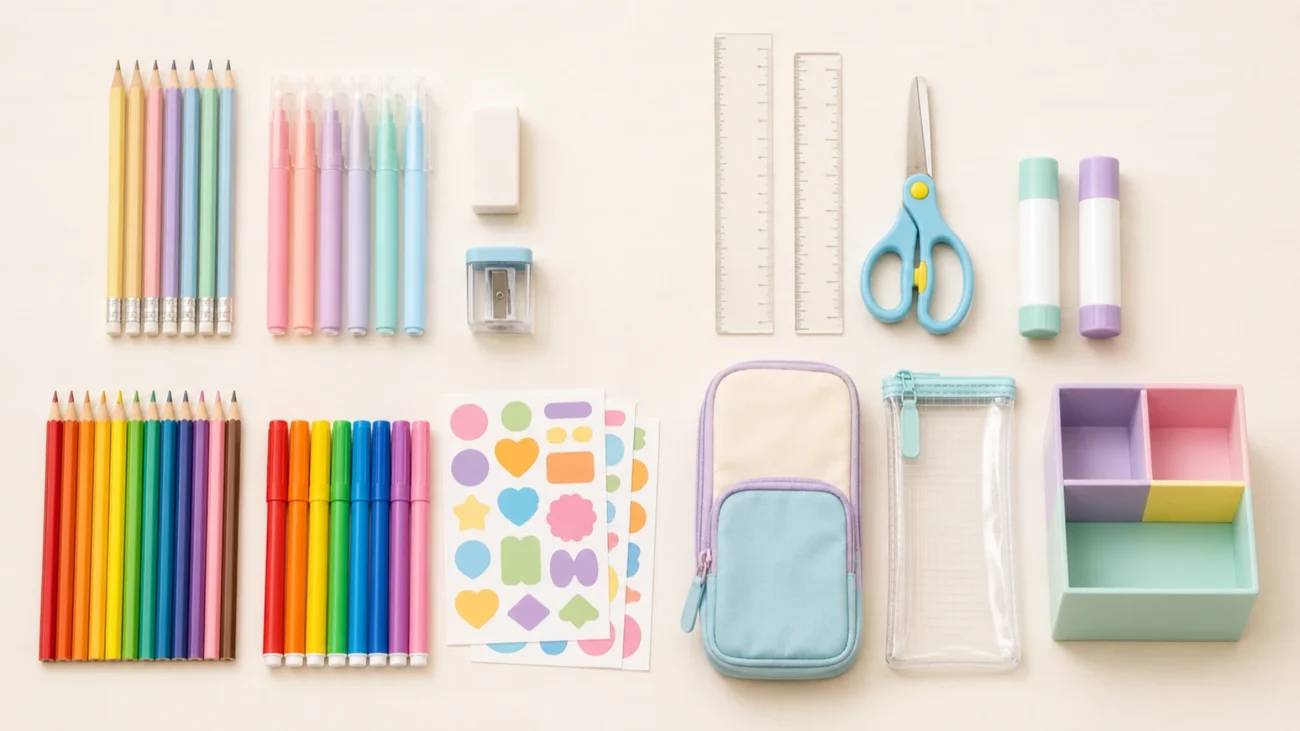
Most sets combine products from four practical groups.
Writing Essentials
Writing products form the core of most sets. Common choices include:
- HB or No. 2 graphite pencils
- Ballpoint pens
- Gel pens
- Mechanical pencils
- Erasers
- Pencil sharpeners
For younger children, thicker pencils or triangular barrels can be easier to hold. For older students, 0.5 mm or 0.7 mm gel pens and mechanical pencils may suit note-taking and detailed work.
The exact specifications matter. Pencil cores should remain centered and resist breaking during normal sharpening. Pens should start writing without repeated scribbling. Erasers should remove graphite without tearing the paper or leaving heavy smears. Sharpeners should hold the blade firmly, while enclosed sharpeners can keep pencil shavings off desks and inside backpacks.
A strong school stationery set usually includes only the writing tools that a child will use regularly. Two dependable pencils and one good eraser provide more value than several weak products added only to increase the item count.
Measuring and Classroom Tools
Rulers, scissors, and glue can turn a simple writing pack into a more complete classroom kit.
Useful options include:
- 15 cm or 30 cm rulers
- Protractors and set squares
- Rounded-tip scissors
- Glue sticks
- Simple document clips or page markers
A ruler should have straight edges, readable markings, and a material that will not easily crack into sharp pieces. Geometry tools are more suitable for older students who need them for classwork. For younger age groups, scissors should have rounded tips and handles that fit small hands.
Glue sticks should open and twist smoothly, stay closed during transport, and match the product requirements of the destination market. Buyers should test whether the glue spreads evenly and whether the cap remains secure after repeated use.
Coloring and Creative Supplies
Creative items can make a kids stationery set more attractive and useful for home activities, art lessons, and travel.
Common additions include:
- Colored pencils
- Crayons
- Washable markers
- Highlighters
- Sticker sheets
- Decorative tape
- Small activity books
The creative section should remain focused. A basic classroom pack may need only colored pencils and stickers. An activity kit can include markers, scissors, glue, and a booklet that gives children something specific to make or complete.
Coloring tools should provide even color without breaking or drying out too quickly. Marker caps should close properly. Sticker sheets should peel cleanly. Activity books should use paper that suits the included pens or pencils.
Storage and Organization Products
A pouch, pencil case, or box often determines how customers judge the complete set.
Popular storage options include:
- Transparent zipper pouches
- Printed fabric pencil cases
- Molded EVA cases
- Tin boxes
- Small plastic organizers
- Document pouches
The storage item should fit every product without forcing the zipper or bending the contents. It should also leave enough space for the child to repack the set after use. A case that looks neat only when factory-packed but cannot be closed by a child will create frustration.
Reusable storage can raise the perceived value of kids stationery sets because the package remains useful after the pens, pencils, or stickers are used. It can also reduce loose movement during delivery and improve the product’s appearance in photographs and retail displays.
Five Common Types of Kids Stationery Sets
Retailers should organize their range around clear customer needs. The following five types cover most school, gift, activity, and mass-retail uses.
| Set type | Typical contents | Main customer | Common price position | Suitable channels |
|---|---|---|---|---|
| Basic school set | Pencils, eraser, sharpener, ruler, pen, pouch | Parents, schools, bulk buyers | Entry level | Supermarkets and school stores |
| Cute themed set | Gel pens, themed eraser, stickers, matching case | Children and gift shoppers | Mid range | Gift shops, boutiques, e-commerce |
| Gift set | Notebook, pen set, stickers, case, display box | Birthday and holiday shoppers | Mid to premium | Gift stores and department stores |
| Art and activity set | Colored pencils, markers, glue, scissors, booklet | Parents, teachers, activity buyers | Mid range | Toy stores, bookshops, education stores |
| Retail-ready boxed set | Coordinated items in a window or hanging pack | Chain buyers and distributors | Variable | Supermarkets and mass retail |
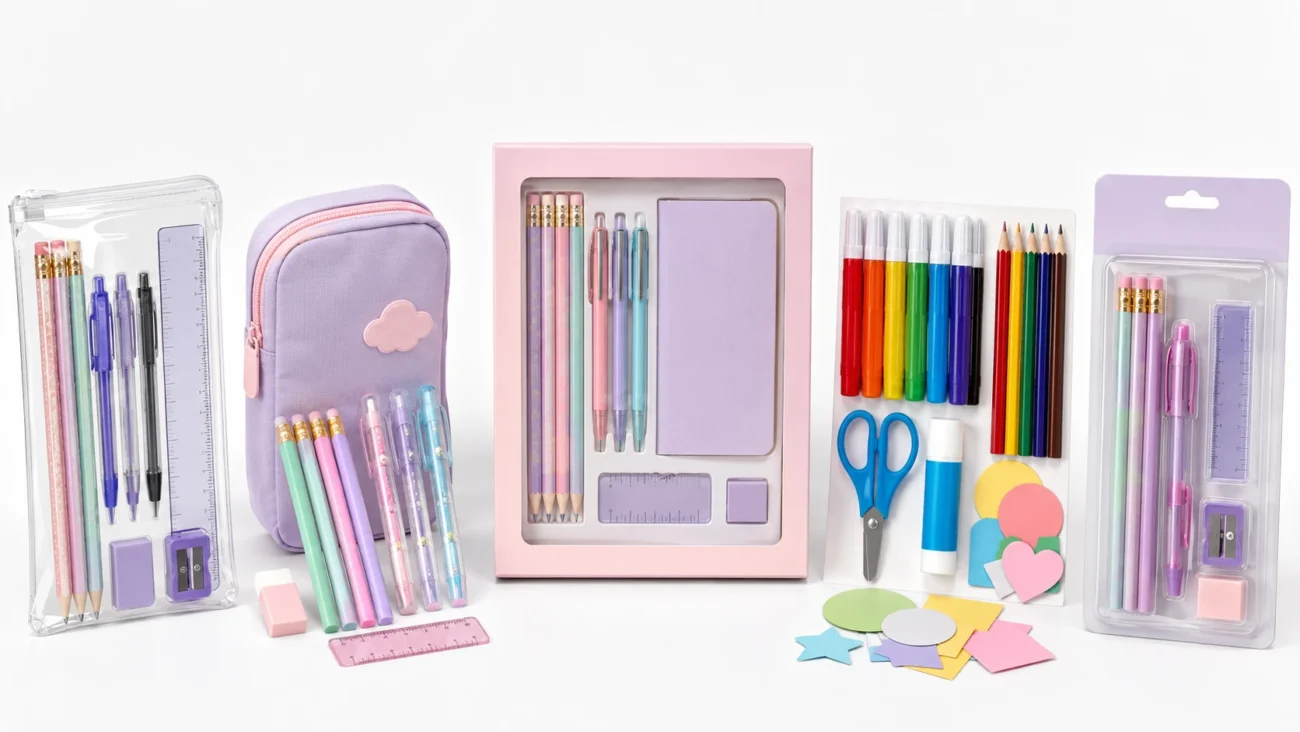
Basic School Stationery Sets
A basic set focuses on products that children use during normal school days. A common combination is:
- Two HB pencils
- One eraser
- One sharpener
- One 15 cm ruler
- One blue or black ballpoint pen
- One simple pencil pouch
This type of school stationery set works well for back-to-school promotions, classroom supply programs, and entry-level retail offers. The products should be easy to replace, compact enough for a backpack, and durable enough for repeated use.
Retailers should resist adding unnecessary items to make the package look larger. The purpose of a basic set is to solve a simple need at a clear price.
Cute and Themed Stationery Sets
Cute stationery sets rely on coordinated design as well as function. Common themes include animals, food, space, flowers, sports, dinosaurs, fantasy graphics, and pastel patterns.
A typical themed set may contain:
- Two gel pens
- One mechanical pencil
- One shaped eraser
- One mini ruler
- One sticker sheet
- One matching pencil case
The graphics should remain consistent across all products. A cat theme, for example, should not combine unrelated dinosaurs, stars, and sports artwork in the same package. Matching colors and repeated design details make the set look planned rather than assembled from leftover stock.
These sets often perform well as gifts and impulse purchases because customers can understand the theme quickly. Cute stationery sets also support series-based merchandising: retailers can place several designs together while keeping the same package size and price. For a character-led example, buyers can review our Minecraft 13-piece stationery set, which applies one coordinated theme across multiple school and journal items.
Stationery Gift Sets
A stationery gift set should look ready to present without extra work. The set may contain a notebook, pens, stickers, a pencil case, and a small desk accessory inside a window box or reusable case.
Gift value comes from the complete presentation, not only the number of pieces. A moderate selection of useful items can feel premium when:
- The products follow one theme
- The box keeps each item in position
- The front window shows the main contents
- The interior does not look empty
- The package opens cleanly
- The graphics suit the intended age group
Birthday, holiday, first-day-of-school, and classroom reward programs are common sales occasions. Retailers can offer several gift prices by changing the storage case, notebook quality, accessory count, and outer package. A themed K-POP stationery set can also illustrate how coordinated contents and packaging create a more gift-ready product than unrelated individual items.
Art and Activity Stationery Sets
An activity set gives children tools for a defined creative task. A typical combination may include colored pencils, washable markers, stickers, glue, rounded-tip scissors, and a small activity book.
The activity should be easy to understand from the package. Examples include:
- Drawing and coloring
- Paper craft
- Sticker scenes
- Travel activities
- Classroom project work
- Simple card making
A useful kit provides enough materials to complete the activity. For example, a paper craft set should not include scissors and glue without any paper components or instructions. Clear product planning helps parents understand what children can do with the set after opening it.
Retail-Ready Boxed Stationery Sets
Retail-ready sets are designed for efficient stocking, stable presentation, and easy customer comparison.
Useful packaging features include:
- A clear viewing window
- A reinforced hanging slot
- A flat base for shelf display
- Space for a barcode and product information
- Standardized outer dimensions
- Internal bands or trays that prevent movement
- A clear list of included products
This format can reduce shelf handling and make several designs look consistent in a chain store. The package must still survive normal transport. A perfect front display is not useful if the products shift into a pile before the box reaches the store.
How to Choose a Kids Stationery Set for Different Uses
The same kids stationery set will not work equally well for school, gifts, classroom rewards, and retail displays. Start with the use case, then select the contents and package.
For Everyday School Use
A daily-use kids stationery set should be simple, strong, and easy to manage.
Check the following:
- Does it include the products required most often?
- Can the child open and close the case without help?
- Do the items fit into a standard school bag?
- Are the pencils, pens, and erasers easy to replace?
- Will the package survive repeated movement between home and school?
- Are the products suitable for the child’s grade?
A fabric pencil case or durable zipper pouch usually works better for daily use than a decorative box that may crush inside a backpack. Standard sizes are also useful because parents can replace individual products without purchasing a new set. Parents preparing for a new term can compare the set with our complete back-to-school essentials checklist for kids to make sure no important classroom supplies are missing.
For Birthday and Holiday Gifts
Gift buyers look for a product that feels complete when opened.
A good gift set should have:
- A theme that matches the child’s interests
- A balanced mix of practical and fun items
- Clean, organized packaging
- A strong color story
- One or two items that feel special
- Enough visible contents to justify the price
A small notebook, decorative pen, sticker sheet, and reusable case can create a better gift than a large pack of repetitive items. The opening experience matters, but the products should still be useful after the excitement has passed.
For Classroom Rewards
Teachers and schools often need small sets that are easy to store and hand out.
Suitable products include:
- Mini notebooks
- Pencils
- Erasers
- Stickers
- Small highlighters
- Short rulers
The package should be light, flat, and individually packed. Avoid loose pieces that may fall out during distribution. A small stationery set for kids can work as a reading reward, event gift, competition prize, or welcome pack.
Unit cost matters in this channel, but low cost should not mean poor function. One pen that writes properly and one cleanly printed sticker sheet will leave a better impression than several items that do not work.
For Retail Displays
Retail products must communicate their contents quickly. Customers should not need to turn the package over several times to understand what is included.
Check whether:
- The front shows the main items
- The theme is easy to identify
- The package can hang or stand securely
- The item count is clear
- Several designs align on the shelf
- The price level matches the presentation
- The barcode and required labels have enough space
A three-level assortment often works well: a low-cost basic set, a mid-range themed set, and a premium gift option. This gives customers a clear reason to compare and trade up.
Choosing Stationery Sets by Age
Age affects grip size, product complexity, small-part risk, school requirements, and design preferences. Retailers should define the intended age group before approving the contents. For a more detailed comparison of requirements at each learning stage, use this school supplies list covering preschool, kindergarten, elementary school, and middle school.
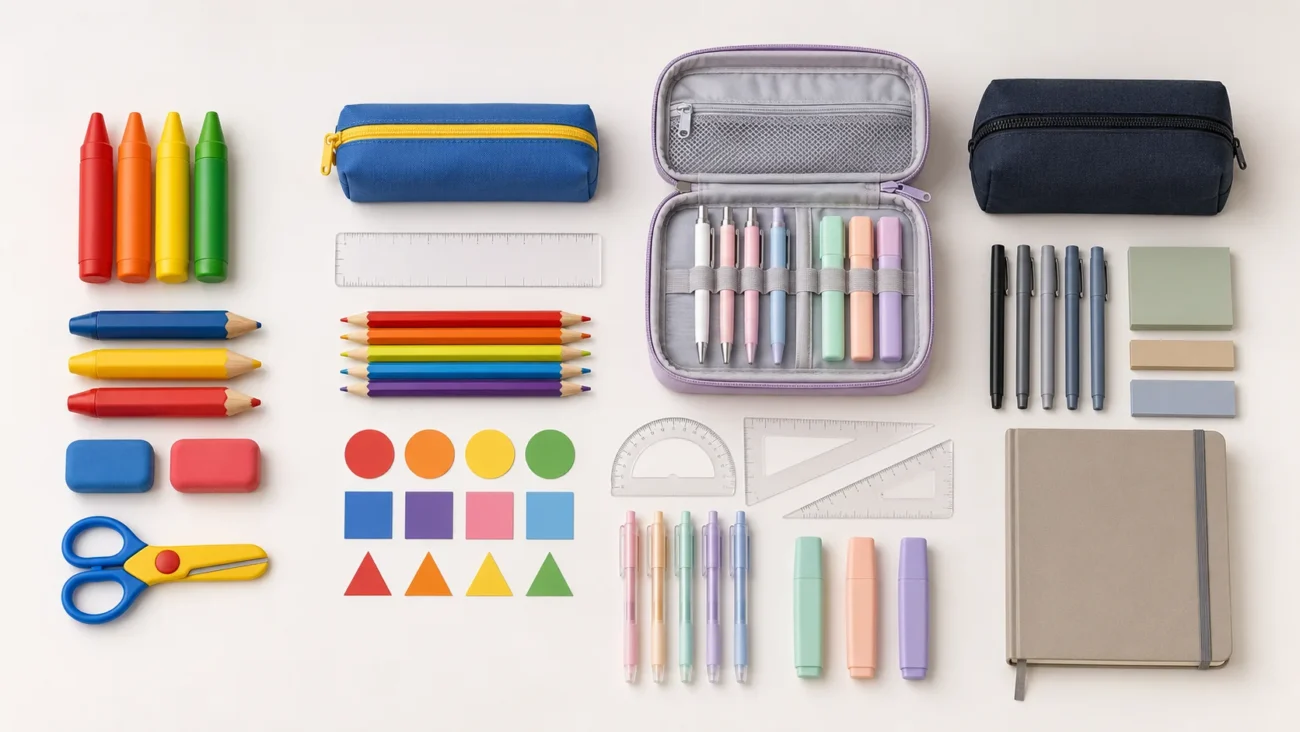
Ages 3–5
For preschool and kindergarten users, choose products that are simple to hold and easy to recognize.
Suitable options include:
- Thick or triangular pencils
- Large crayons
- Washable broad-tip markers
- Large erasers
- Rounded-tip scissors
- Easy-twist glue sticks
- A simple transparent pouch
Avoid small detachable decorations and products that are difficult to open. The set should contain a limited number of clear, useful items rather than many tiny accessories.
Ages 6–8
Early elementary students can use standard school tools with simple creative additions.
A suitable school stationery set may include:
- HB pencils
- A clear ruler
- A block eraser
- A sharpener
- Colored pencils
- Stickers
- A zipper pencil case
Bright themes and familiar characters often appeal to this age group, but function should remain easy to understand. The child should be able to return every item to the case without following a complicated layout.
Ages 9–12
Older elementary and middle-school students often need more organization and a wider choice of writing tools.
Suitable products may include:
- Mechanical pencils
- Gel pens
- Highlighters
- Protractors or set squares
- Page markers
- A notepad or simple planner
- A multi-compartment pencil case
Designs can shift toward softer colors, graphic patterns, sports, space, or more restrained themes. The set can still be fun without looking designed for a much younger child.
Teen and Student Sets
Teenagers generally place more value on writing quality, organization, and a cleaner appearance.
Useful products include:
- Fine-point gel pens
- Quick-drying pens
- Mechanical pencils
- Muted highlighters
- Sticky notes and index tabs
- A durable ruler
- A simple fabric case
Neutral, navy, gray, black, or muted pastel colors often suit this group. The package should look organized rather than crowded.
Safety and Quality Features to Check
Children use stationery frequently, so buyers should review materials, age suitability, product function, and batch consistency. Safety requirements vary according to the product, intended use, age group, and destination market. A pencil set, art kit, and toy-like activity product may not follow the same regulatory path.
Confirm Which Rules Apply to the Product
Do not place every children’s stationery item under one standard automatically.
For products sold as crayons, markers, paints, or other art materials in the United States, buyers should review the CPSC’s official guidance on ASTM D-4236 labeling and toxicological review requirements before approving packaging.
Suppliers and importers selling in the European Union should confirm product classification by reviewing the European Commission’s official guidance for products covered by EU toy safety rules.
The practical step is to provide the supplier or testing laboratory with the complete product, age grading, packaging, intended use, and target country. Ask for a written testing plan instead of assuming that one report covers every component.
Review Materials and Chemical Information
Depending on the set contents, buyers may need information for:
- Pencil coatings
- Pen and marker inks
- Glue formulations
- Erasers
- Plastic cases
- Printed packaging
- Decorative parts
Request current reports that match the actual product materials, colors, and production version. A report for a different ink color, plastic formula, or older product should not be accepted without review.
Avoid broad statements such as “all materials are certified” unless the supplier can show which product, standard, test date, and laboratory the statement refers to.
Check Age-Appropriate Components
Physical risks often come from the smallest details.
Inspect:
- Removable eraser toppers
- Small caps
- Decorative charms
- Magnets
- Sharp compass points
- Scissor tips
- Rough plastic edges
- Loose sharpener blades
- Fragile parts that may break
For products containing detachable caps, charms, magnets, or small accessories, buyers should compare the design against the CPSC’s guidance on small parts and choking-hazard labeling for children’s products.
Perform Functional Testing
Every sample should be used, not only photographed.
Test whether:
- Pens start immediately and write without skipping
- Ink leaks after storage
- Pencil leads remain centered
- Pencils sharpen without splitting
- Erasers remove marks cleanly
- Ruler markings are straight and readable
- Scissors cut paper without sticking
- Glue twists up and closes properly
- Sticker sheets peel without tearing
- Zippers open and close repeatedly
- Cases remain shaped after normal handling
A kids stationery set is judged as one product. One weak component can reduce the customer’s opinion of the whole package.
Check Set and Batch Consistency
The approved sample should become the production reference.
Confirm:
- Exact item quantities
- Product dimensions
- Material specifications
- Print positions
- Color references
- Packaging dimensions
- Internal layout
- Barcode placement
- Required warnings and labels
Create an itemized specification sheet with photographs. During inspection, compare production cartons against the approved sample and written requirements.
Packaging Options for Kids Stationery Sets
Packaging protects the products, supports the selling price, and determines how a kids stationery set can be displayed. It also affects carton size, shipping cost, storage, and waste.
Transparent Zipper Pouches
A clear PVC, EVA, or other suitable transparent pouch gives customers a direct view of the contents.
Advantages include:
- Good product visibility
- Low to moderate cost
- Reusable storage
- Compact size
- Easy backpack use
Check the zipper, seams, material smell, print quality, and header strength. If the pouch will hang in stores, the reinforced area must support the complete product weight.
Transparent pouches are practical for basic kids stationery sets, school promotions, and classroom packs.
Window Boxes
A cardboard box with a clear window creates a more structured presentation.
Advantages include:
- Strong shelf appearance
- More space for brand graphics
- Better gift positioning
- Easier product organization
- Improved protection from crushing
The internal tray should hold every product without making removal difficult. The window should remain clear and securely attached. The box should stand straight when placed on a shelf.
Window boxes suit themed sets, gift collections, and mid-range retail offers.
Hanging Cards and Blister Packs
Hanging formats use vertical retail space efficiently and keep products in fixed positions.
Advantages include:
- Clear peg-hook display
- Strong front visibility
- Compact shelf use
- Easy comparison between designs
Check the hanging slot, card thickness, blister seal, and product weight. Also review local packaging and recycling requirements before choosing materials.
This format is common for supermarkets, chain stores, and promotional aisles.
Reusable Pencil Cases and Storage Boxes
A reusable case works as both the package and a long-term product.
Options include:
- Fabric zipper cases
- Molded EVA cases
- Tin boxes
- Plastic compartment boxes
- Small desktop organizers
These formats can support a higher selling price because customers keep the storage item. They also work well for cute stationery sets and premium gifts.
The case should not be packed so tightly that the child cannot close it later. Test the empty and fully loaded case, the zipper path, handles, hinges, and any internal elastic loops.
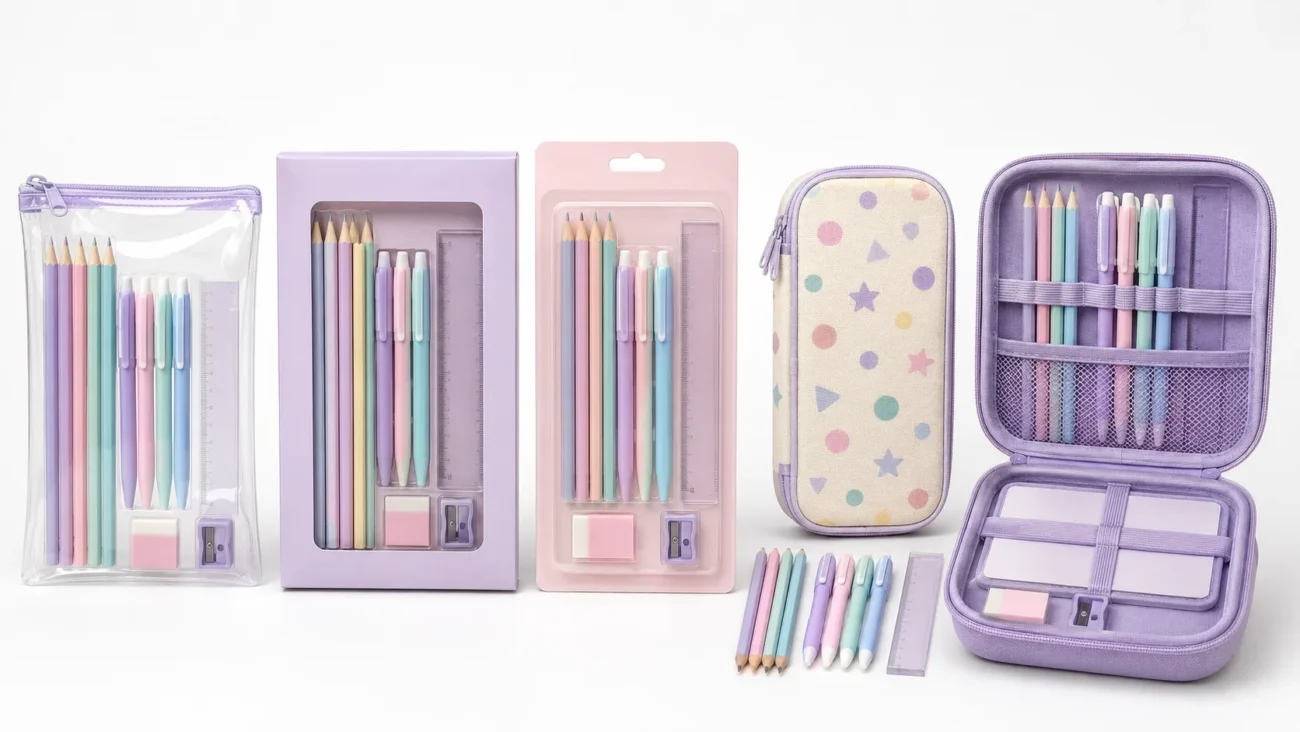
Packaging Comparison
| Packaging type | Product visibility | Relative cost | Gift appeal | Best use |
|---|---|---|---|---|
| Transparent pouch | High | Low to medium | Medium | Daily school and promotional sets |
| Window box | High | Medium | High | Themed and gift sets |
| Hanging card or blister | High | Low to medium | Low to medium | Supermarkets and chain retail |
| Fabric pencil case | Medium | Medium | High | School, e-commerce, and gift ranges |
| EVA or rigid storage case | Medium to high | Medium to high | Very high | Premium gift and specialty retail |
What Retailers Should Check Before Ordering Wholesale Stationery Sets
Bulk purchasing requires clear written specifications, physical samples, realistic pricing, and enough time for production and delivery.
Confirm the Exact Set Composition
A title such as “12-piece set” is not enough.
Ask for a list that includes:
- Product name
- Quantity
- Size
- Material
- Color
- Print design
- Packaging position
- Accessories
- Replacement or substitution rules
Clarify how the piece count is calculated. Twelve colored pencils may be counted as twelve pieces by one supplier and one box by another. Use an itemized list rather than comparing only the number printed on the front.
Confirm whether the supplier may replace components during production. Any permitted substitute should require written approval.
Order and Test Physical Samples
Do not approve a bulk kids stationery set order from renderings alone.
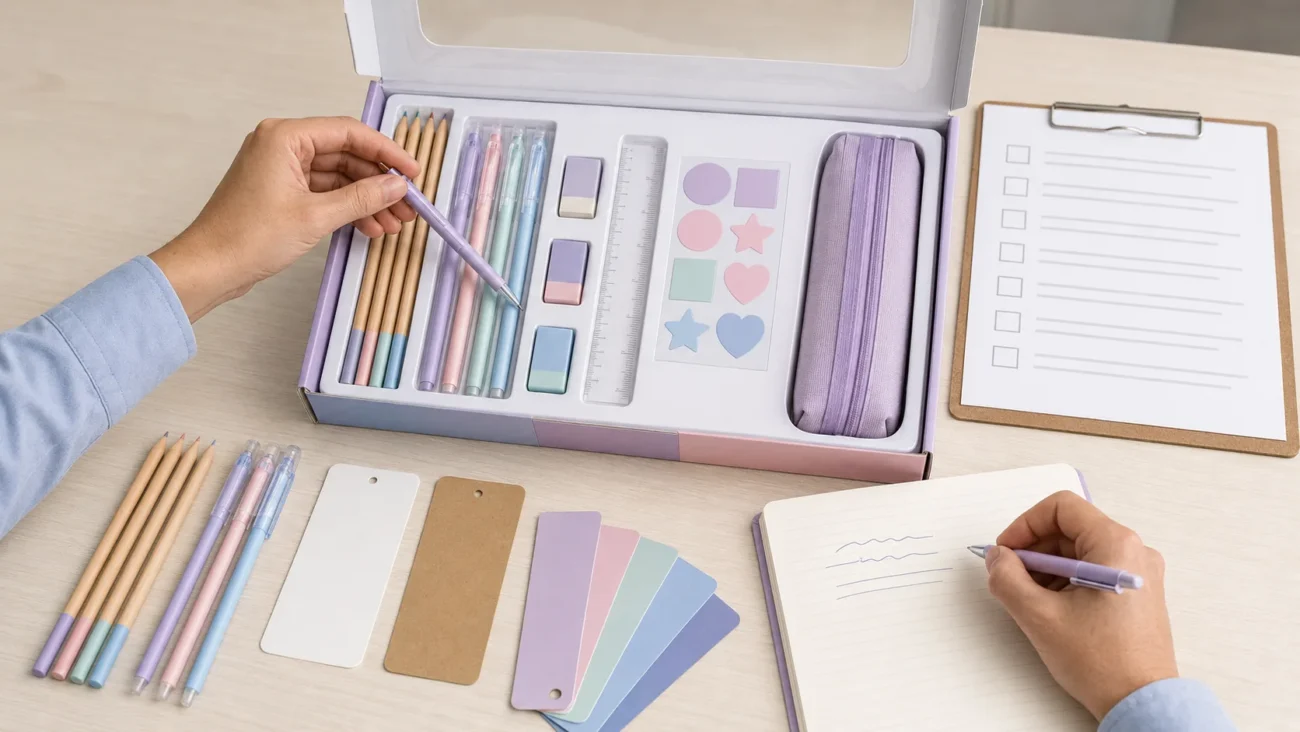
Evaluate:
- The complete visual appearance
- Writing and coloring performance
- Color match across components
- Printing and graphic alignment
- Product fit inside the package
- Zipper or closure quality
- Window clarity
- Barcode and label space
- Odor
- Drop and shake stability
Close the package and shake it in several directions. Place it flat, upright, and hanging if those display methods are planned. Check whether the products move, overlap, or damage the front window. Buyers planning a larger order should follow our detailed wholesale stationery supplies buying guide for retailers and distributors before approving samples or production.
Keep one approved sample sealed and signed for production comparison.
Clarify MOQ and Mixed-Design Rules
Minimum order quantity can apply by:
- Product combination
- Artwork
- Color
- Package type
- Individual SKU
- Total purchase order
- Master carton
Ask whether the total can be divided across several themes. For example, a 3,000-set order may allow three designs at 1,000 sets each, or it may require 3,000 sets per design.
Using the same product structure and box dimensions across several graphics can make mixed designs easier and reduce tooling or setup changes. It also gives retailers more shelf variety without creating completely different products.
Build Clear Price Tiers
A useful assortment normally includes more than one price point.
Entry-Level Basic Set
Focus on:
- Essential products
- Simple packaging
- High-volume sales
- Easy replenishment
Mid-Range Themed Set
Focus on:
- Coordinated graphics
- Better storage
- Added stickers or decorative items
- Stronger retail margins
Premium Gift Set
Focus on:
- Reusable or rigid packaging
- A notebook or desk accessory
- More detailed presentation
- Gift-ready structure
Do not compare quotations only by the lowest unit price. Consider which products, packaging, carton quantity, testing, and customization are included.
Review Private-Label and Custom Packaging Options
Customization may include:
- Logo printing
- Custom colors
- Printed pencil cases
- Header cards
- Window boxes
- Hangtags
- Barcode labels
- Product inserts
- Multilingual packaging
- Custom product combinations
Ask which changes affect MOQ, sampling cost, plate charges, tooling, and production time. A simple artwork change may be easier than changing product molds or the complete package structure.
Provide the supplier with the final barcode, warnings, age grade, country information, and artwork before mass production. Late changes can delay approval and create packaging waste.
Plan the Seasonal Timeline Backward
Back-to-school and holiday sales require early planning.
A basic schedule may include:
- Product and supplier selection
- Quotation comparison
- Sample development
- Product testing
- Artwork approval
- Pre-production sample
- Mass production
- Quality inspection
- Packing
- Freight and customs
- Warehouse receiving
- Retail distribution
Build a buffer for sample revisions, packaging corrections, and transport delays. The correct starting date depends on product complexity, destination, shipping method, and supplier capacity.
Evaluate the Supplier, Not Only the Sample
A good sample is important, but buyers should also check whether the supplier can repeat the same result.
Review:
- Experience with multi-item sets
- Quality control process
- Product traceability
- Communication speed
- Packaging engineering ability
- Ability to source replacement components
- Order and carton accuracy
- Export documentation
- On-time delivery record
When the order contains many components, coordination becomes as important as the quality of any single pencil or ruler. Supplier capability can be reviewed in more detail through our practical guide to choosing the right school supplies supplier for wholesale orders.
Four Practical Stationery Set Ideas for Retailers
Each kids stationery set example below can be adjusted to match the target age, retail price, and sales channel.
1. Basic Everyday School Set
Contents
- Two HB pencils
- One block eraser
- One enclosed sharpener
- One 15 cm ruler
- One ballpoint pen
- One transparent zipper pouch
Best for
- Supermarkets
- School stores
- Back-to-school promotions
- Classroom supply programs
This school stationery set keeps the contents simple and replaceable. It works best when every item performs reliably and the front price remains easy to understand.
2. Cute Themed Set
Contents
- Two pastel gel pens
- One mechanical pencil
- One themed eraser
- One mini ruler
- One sticker sheet
- One matching fabric case
Best for
- Gift shops
- Children’s boutiques
- Online stores
- Counter displays
This option uses design consistency to create value. The colors, illustrations, and case should feel like one collection.
3. Creative Activity Set
Contents
- Twelve colored pencils
- Six washable markers
- One sticker sheet
- One glue stick
- One pair of rounded-tip scissors
- One small activity book
Best for
- Toy shops
- Bookshops
- Travel ranges
- Holiday activity promotions
The booklet should match the included tools so children can begin the activity without needing many extra materials.
4. Premium Gift Set
Contents
- One A5 notebook
- Two quality pens
- One reusable pencil case
- One sticker pack
- One small desk organizer
- One window gift box
Best for
- Department stores
- Birthday collections
- Holiday gift displays
- Premium e-commerce offers
The notebook, case, and outer box should use the same color system and artwork. A clean layout is more important than filling every empty space.
Common Mistakes When Selecting Kids Stationery Sets
1. Increasing the Piece Count With Low-Use Items
Customers may notice a large number on the package, but they will judge the set by what they can actually use. Remove repetitive or weak products and invest in better core items.
2. Mixing Unrelated Colors and Graphics
A mismatched set looks cheaper even when the individual products are acceptable. Use a defined palette, consistent illustration style, and matching print quality.
3. Ignoring Product Movement During Shipping
Products can leave their trays, scratch the window, or arrive in a pile. Test the complete package, not only the products on a table.
4. Skipping Functional Tests
Pens, pencils, sharpeners, scissors, glue, and zippers all need hands-on testing. A product that looks good in a photograph may fail during normal use.
5. Using Components That Do Not Suit the Age Group
Small parts, sharp tools, and difficult closures can make a set unsuitable for younger children. Review the real product and intended age together.
6. Offering Only One Product and Price Level
A basic set cannot replace a gift set, and a premium box may be too expensive for school promotions. Create clear entry, themed, and premium options.
7. Leaving Compliance Checks Until the End
Testing after packaging has been printed can cause expensive corrections. Define the product classification, destination requirements, and test plan before mass production.
Frequently Asked Questions About Kids Stationery Sets
What is usually included in a kids stationery set?
A typical kids stationery set contains writing tools such as pencils or pens, an eraser, a sharpener, a ruler, and a storage item. Larger sets may add colored pencils, markers, stickers, scissors, glue, notebooks, or desk accessories.
The right contents depend on the age group and use. A daily school pack should focus on essentials. A gift or activity set can include more creative products.
What is the best stationery set for school?
The best set is one that matches the student’s grade, school supply list, and daily routine. For many elementary students, reliable pencils, a clean eraser, a ruler, a sharpener, and a durable pencil case provide a practical starting point.
Avoid choosing only by the number of pieces. Product function and easy storage matter more during normal school use.
How many items should a stationery set for kids include?
A basic stationery set for kids may contain five to eight useful items. A gift or activity set may contain ten to twenty pieces.
There is no ideal number for every product. The set should contain enough tools for its intended purpose without using repetitive filler items.
Are cute stationery sets suitable only for younger children?
No. Cute stationery sets can be designed for different age groups. Younger children may prefer bright colors and simple characters. Older students may prefer pastel colors, small illustrations, food themes, animals, or clean kawaii-style graphics.
The design should match the customer’s age and taste while keeping the products practical.
What should retailers check before ordering wholesale stationery sets?
Retailers should confirm the itemized composition, materials, dimensions, sample quality, package stability, MOQ, mixed-design rules, test requirements, lead time, carton packing, and customization details.
A signed physical sample and clear written specification reduce confusion during production.
Can a kids stationery set be customized?
Yes. Depending on the supplier, product type, and order quantity, customization can include colors, graphics, logos, pencil cases, package structure, item combinations, barcodes, labels, and inserts.
Buyers should confirm which changes require a new sample, higher MOQ, tooling, or extra production time.
Which packaging is best for retail?
The best packaging depends on the channel. Transparent pouches work well for practical school sets. Window boxes suit gifts and themed ranges. Hanging packs use peg space efficiently. Reusable cases support higher perceived value and online presentation.
The package should protect the contents, communicate the set clearly, and fit the retailer’s shelf or hook system.
How early should retailers order for back-to-school sales?
Start by working backward from the warehouse arrival date. Include time for supplier selection, sampling, testing, artwork, production, inspection, freight, customs, and distribution.
Complex custom sets usually require more time than standard products. Buyers should also include a buffer for sample or packaging revisions.
Conclusion
A successful kids stationery set combines practical products, age-appropriate design, dependable function, consistent graphics, and packaging that protects every item. The correct combination changes with the purpose. Daily school sets need simple, replaceable tools. Gift sets need stronger presentation. Activity sets need a clear creative task. Retail-ready sets need stable dimensions, visible contents, and efficient shelf placement. Buyers can browse our wholesale stationery supplies and coordinated children’s products to compare possible items for future sets.
For retailers and distributors, the best results come from clear product specifications, physical sample testing, realistic MOQ planning, and a product range with more than one price level. Buyers should also confirm which safety and labeling requirements apply to the exact product and destination market before production begins.
Wandefu offers a broad selection of stationery and related kids products for retail and wholesale buyers. Contact our team to discuss product combinations, themed designs, packaging formats, private-label options, and sourcing requirements for your next stationery collection. Retailers can also contact the Wandefu team to discuss custom stationery set sourcing and packaging requirements.