
Wholesale Stationery Supplies Buying Guide for Retailers and Distributors


Buying wholesale stationery supplies can be a strong growth opportunity for retailers, distributors, gift shops, school supply stores, and online sellers. Stationery products are practical, easy to display, easy to bundle, and suitable for both year-round sales and seasonal promotions.
However, buying stationery in bulk is not only about finding the lowest price. A smart wholesale buyer needs to consider product categories, target customers, MOQ, total landed cost, packaging, quality control, customization options, delivery timing, and supplier reliability.
This wholesale stationery supplies buying guide is written for retailers and distributors who want to make better sourcing decisions. Whether you are buying basic school stationery, notebooks, pencil cases, coloring books, stickers, kids stationery sets, or private label stationery products, this guide will help you plan your product range, compare suppliers, control costs, and build a stronger stationery business. Wholesale stationery supplies
Why Wholesale Stationery Supplies Are a Strong Category for Retailers
Stationery is one of the most stable product categories for retail and distribution businesses. It has broad demand across schools, families, offices, gift shops, bookstores, supermarkets, and online stores.
For many buyers, wholesale stationery supplies are attractive because the products are usually small, practical, repeatable, and easy to combine with other children’s products.
Stationery products have repeat purchase demand
Stationery products are used every day. Pens run out of ink. Notebooks are filled. Stickers are used. Erasers wear down. Coloring books are completed. Pencil cases may be replaced when children start a new school year.
This repeat-use pattern creates steady demand for products such as:
- Pencils
- Pens
- Erasers
- Rulers
- Notebooks
- Pencil cases
- Markers
- Sticky notes
- Coloring books
- Sticker books
- Stationery sets
For retailers, this means stationery can bring customers back again and again. For distributors, bulk stationery supplies can serve different customer groups, including school supply shops, supermarkets, bookstores, online sellers, and regional wholesalers.
Stationery works well for seasonal promotions
Stationery sells throughout the year, but some seasons create stronger demand. The most important period is usually back-to-school season. Parents, schools, and retailers prepare notebooks, pencil cases, writing tools, folders, coloring supplies, backpacks, lunch products, and storage items before the new school year starts.
Other useful sales periods include:
- Christmas gift season
- New semester promotions
- Children’s Day
- Birthday gifts
- Holiday craft activities
- Classroom reward programs
- School opening campaigns
Retailers who prepare early can build stronger displays and avoid missing peak sales windows. For wholesale buyers, this means planning orders several months before the season begins.
Stationery is easy to bundle with other kids products
Stationery is easy to combine with related products. This makes it useful for increasing average order value.
Common product bundles include:
- Pencil case + pencils + eraser + ruler
- Notebook + pen set + sticky notes
- Coloring book + markers + stickers
- Kids stationery set + pencil pouch
- Backpack + pencil case + stationery set
- Lunch box + notebook + small accessory
- DIY craft kit + coloring supplies
For retailers, bundles make shopping easier for parents and gift buyers. For distributors, bundles create higher-value product sets for stores and seasonal promotions.
Define Your Target Buyers Before Purchasing
Before buying wholesale stationery supplies, define who your customers are. Different buyers need different product styles, price ranges, packaging formats, and order quantities.
Retail stores
Retail stores need products that look attractive on shelves. Customers often make quick buying decisions based on design, packaging, and price.
Retail stores usually need:
- Colorful stationery sets
- Cute pencil cases
- Decorative notebooks
- Sticker books
- Small impulse-buy products
- Retail-ready packaging
- Barcode labels
- Easy-to-display products
For physical stores, packaging matters. A product should clearly show what is inside and why it is worth buying. A pencil case should look neat and practical. A stationery set should clearly show the included items. A notebook should have an attractive cover and clean finishing.
Online stores
Online stores need products that photograph well, ship safely, and are easy to describe. Customers cannot touch the product before buying, so product images, size details, set contents, and packaging quality are very important.
Online sellers usually prefer:
- Lightweight products
- Giftable stationery sets
- Cute stationery designs
- Small bundles
- Clear SKU options
- Strong packaging for shipping
- Products suitable for lifestyle photos
Pencil cases, stationery sets, notebooks, stickers, and coloring products can work well online because they are visual and easy to package.
Distributors and wholesalers
Distributors and wholesalers focus on volume, price, consistency, and reorder support. Their customers may include local retail shops, school supply stores, supermarkets, online sellers, and smaller wholesalers.
They usually need:
- Competitive tiered pricing
- Stable product quality
- Multi-SKU order support
- Clear carton information
- Bulk packaging
- Repeat supply
- Export-ready documents
For distributors, consistency is often more important than having too many random designs. A smaller number of reliable, high-demand products can be better than a very large catalog with slow-moving items.
School and educational buyers
School and educational buyers focus on practicality, durability, safety, and price stability.
Common products for educational buyers include:
- Pencils
- Erasers
- Rulers
- Glue sticks
- Scissors
- Notebooks
- Folders
- Markers
- Coloring books
- Bulk classroom stationery
For these buyers, products do not always need premium retail packaging. Safe materials, stable supply, and practical product design are more important.
Choose the Right Product Categories for Wholesale Stationery
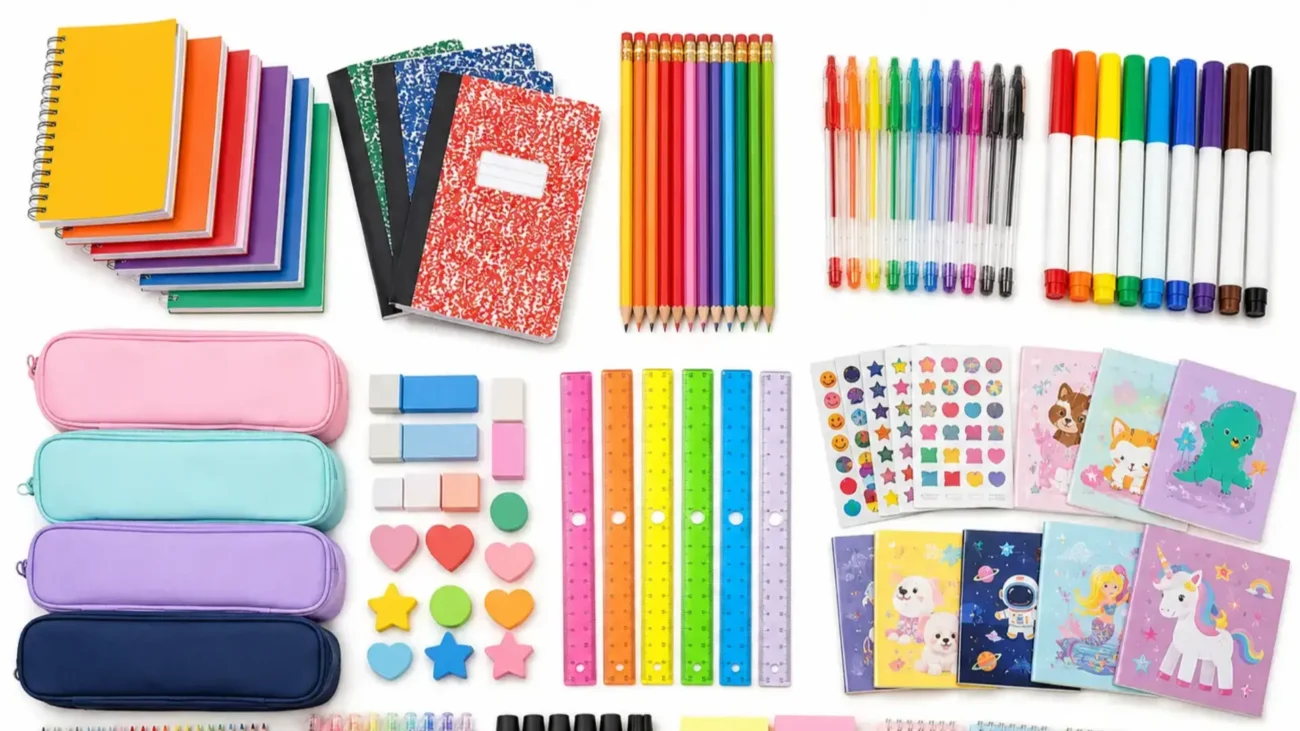
A good stationery assortment should balance basic items, high-margin products, creative products, and giftable sets. Buyers should avoid choosing products randomly. Instead, product categories should be planned based on customer demand, sales channel, season, and price range.
Basic stationery supplies
Basic stationery supplies are the foundation of most wholesale orders. They have broad demand and are suitable for schools, stores, offices, and everyday use.
Common basic products include:
- Pencils
- Pens
- Erasers
- Rulers
- Sharpeners
- Glue sticks
- Scissors
- Markers
- Highlighters
These products are practical and easy to sell, but competition can be strong. To improve retail appeal, buyers should consider packaging, colors, product quality, and bundle options.
Paper products
Paper products are another important stationery category. They are useful for back-to-school, office, journaling, drawing, and study-related sales.
Examples include:
- Notebooks
- Spiral notebooks
- Composition books
- Memo pads
- Sticky notes
- Folders
- Sketch books
- Activity books
- Drawing paper
When sourcing paper products, check paper thickness, binding quality, cover printing, and whether the paper works well with common pens or markers. For notebooks and journals, paper quality can strongly affect customer satisfaction. For buyers comparing compact and gift-oriented paper products, our K-POP mini keyring notebook provides an example of how notebook functionality can be combined with a small collectible format.
Important details to check include:
- Paper weight
- Binding style
- Cover material
- Printing quality
- Page alignment
- Ink bleed-through
- Packaging protection
For school notebooks, buyers may choose cost-effective paper. For journals, sketchbooks, or premium stationery sets, thicker paper is usually better.
Pencil cases and stationery storage
Pencil cases are practical, visual, and suitable for both daily use and gifting. They are also strong add-on products for school supply displays.
Common types include:
- Fabric pencil pouches
- Hard-shell pencil cases
- Transparent pencil boxes
- Large-capacity pencil cases
- Multi-compartment pencil cases
- Desk organizers
- Small storage pouches
When buying pencil cases wholesale, check zipper smoothness, stitching, fabric thickness, printing quality, inner lining, and storage capacity. A pencil case may look attractive in photos but fail in daily use if the zipper is weak or the fabric is too thin.
Creative stationery products
Creative stationery products are popular with kids, students, hobby users, gift shops, and online stores. For a small character-led stationery SKU, buyers can also review our Hello Kitty holographic sticker sheet as an example of an add-on product suited to gift and impulse displays.
Examples include:
- Coloring books
- Sticker books
- Washable markers
- Colored pencils
- Crayons
- Activity books
- DIY paper craft sets
- Drawing pads
These products can support school projects, after-school activities, gifts, and seasonal craft promotions. For products used by children, safety and material quality should be checked carefully. Art material safety labeling
Giftable stationery sets
Stationery sets are useful because they create higher perceived value. Instead of selling single items, retailers can offer ready-made sets for school, gifts, and seasonal promotions. Kids stationery sets
Popular set types include:
- Kids stationery sets
- Cute stationery sets
- Back-to-school stationery kits
- Pencil case sets
- Notebook and pen sets
- Coloring sets
- Cartoon-style stationery sets
A good stationery set should have a clear theme, useful product combination, attractive packaging, and age-appropriate design. For retailers and online sellers, kids stationery sets wholesale can be a strong product line because they are easy to display, easy to photograph, and easy to promote as gifts. A coordinated example is our Stitch 13-piece stationery set, which combines school and journal items in one themed retail assortment.
Product category planning table
| Product Category | Example Products | Best For | Main Buying Focus |
|---|---|---|---|
| Basic Stationery | pencils, pens, erasers, rulers | schools, stores, bulk buyers | price, quality, supply stability |
| Paper Products | notebooks, folders, memo pads | students, offices, school shops | paper quality, binding, cover design |
| Pencil Cases | pouches, hard cases, fabric cases | retailers, back-to-school displays | zipper, stitching, capacity |
| Creative Supplies | coloring books, markers, stickers | kids stores, gift shops | safety, design, packaging |
| Stationery Sets | pencil case sets, notebook sets | online stores, gift sellers | theme, packaging, perceived value |
Understand MOQ When Buying Bulk Stationery Supplies
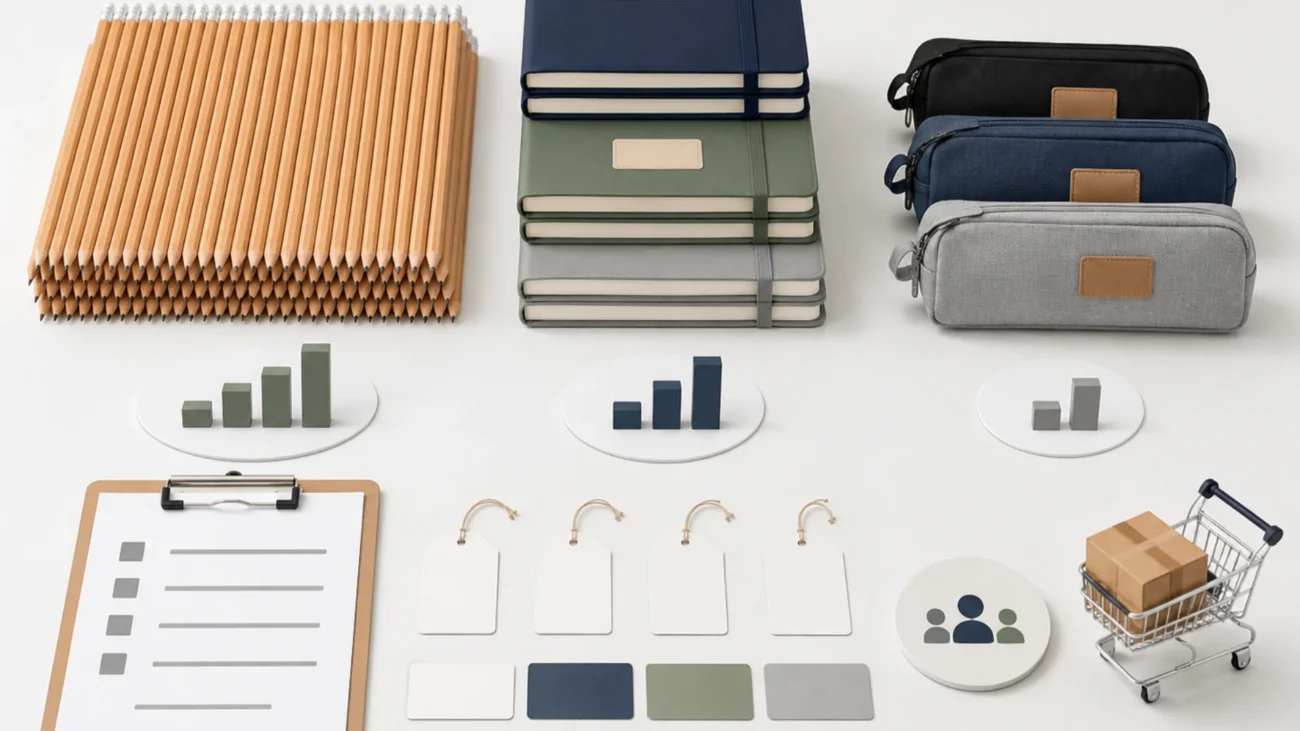
MOQ means Minimum Order Quantity. It is one of the first issues buyers face when sourcing bulk stationery supplies. MOQ affects budget, inventory risk, supplier choice, and product testing.
MOQ depends on product type
Different stationery products have different MOQ requirements.
In general:
- Ready-made items usually have lower MOQ.
- Custom items usually have higher MOQ.
- Printed products may require higher MOQ.
- Products with custom packaging may require separate packaging MOQ.
- Molded plastic products often require higher quantities.
- Stationery sets may depend on the MOQ of each item inside the set.
For example, a ready-made pencil case may have a lower MOQ than a fully custom printed notebook. A private label stationery set may require higher quantities because it involves product selection, packaging design, logo printing, and assembly.
MOQ by SKU, design, and packaging
Do not only ask, “What is the MOQ?”
Ask more specific questions:
- What is the MOQ per SKU?
- What is the MOQ per design?
- What is the MOQ per color?
- What is the MOQ per packaging type?
- Can different colors be mixed?
- Can different products be shipped together?
- Is there a minimum total order value?
This is important because some suppliers calculate MOQ by total order value, while others calculate MOQ by each design or each color.
For example, a supplier may say the MOQ is 500 pieces for a notebook. But if you want four cover designs, the real order may become 2,000 pieces because each design requires 500 pieces.
How smaller retailers can manage MOQ
Smaller retailers may not want to buy too much inventory at the beginning. They can manage MOQ through careful product selection and supplier communication.
Practical methods include:
- Start with ready-made products.
- Choose fewer designs but stronger styles.
- Test small quantities first.
- Ask for mixed-SKU order options.
- Select products with broad demand.
- Avoid too many slow-moving designs.
- Reorder bestsellers after sales data is clear.
For new stores, it is better to test a focused product range than to buy too many styles at once.
Compare Wholesale Pricing and Total Cost
Wholesale pricing is important, but the lowest unit price is not always the best deal. Retailers and distributors should calculate the total cost before confirming an order. Total landed cost
Unit price is not the full cost
A supplier’s quoted unit price is only one part of the final cost. The actual cost to receive and sell the product includes several other items.
These may include:
- Unit price
- Packaging cost
- Custom logo cost
- Sample cost
- Testing cost
- Shipping cost
- Customs duties
- Local delivery cost
- Storage cost
- Platform fees
- Possible product loss or damage
A simple formula can help buyers understand the real cost:
Total Landed Cost per Unit = Unit Price + (Shipping + Duties + Local Costs) ÷ Total Quantity
In this formula:
- Unit Price is the supplier’s product price.
- Shipping includes ocean, air, or express shipping.
- Duties include import taxes and tariffs.
- Local Costs include customs clearance, local trucking, and handling.
- Total Quantity is the number of units in the order.

This formula shows why very small orders often have a high real cost per unit. Shipping and local costs are spread across fewer units. When the order quantity increases, those fixed costs are spread across more units, and the landed cost per unit usually becomes lower.
Tiered pricing for larger orders
Most stationery suppliers offer tiered pricing. The more you order, the lower the unit price may become.
Example:
| Quantity | Example Price Level |
|---|---|
| 500 pieces | Higher unit price |
| 1,000 pieces | Standard wholesale price |
| 3,000 pieces | Better volume price |
| 5,000 pieces | Distributor price |
Buyers should ask suppliers for price breaks at different quantities. Even if you do not plan to buy the largest quantity now, this helps you understand future reorder costs.
How to protect your profit margin
To protect your profit margin, do not only compare factory prices. Work backward from your expected selling price.
Ask:
- What is the landed cost per unit?
- What retail price can the market accept?
- What discount may be needed during promotions?
- How much storage time is expected?
- What is the return or defect risk?
- How fast can the product sell?
For online sellers, also include marketplace fees and shipping-to-customer costs. For retailers, include display costs, markdowns, and possible slow-moving inventory.
Cost planning table
| Cost Item | Why It Matters |
|---|---|
| Unit Price | Base product cost |
| Packaging | Affects display and protection |
| Customization | Logo, artwork, private label |
| Shipping | Strongly affects landed cost |
| Duties and Taxes | Required for import planning |
| Testing | Important for kids products |
| Storage | Important for slow-moving products |
| Promotion | Affects final margin |
Check Quality Before Placing a Wholesale Order
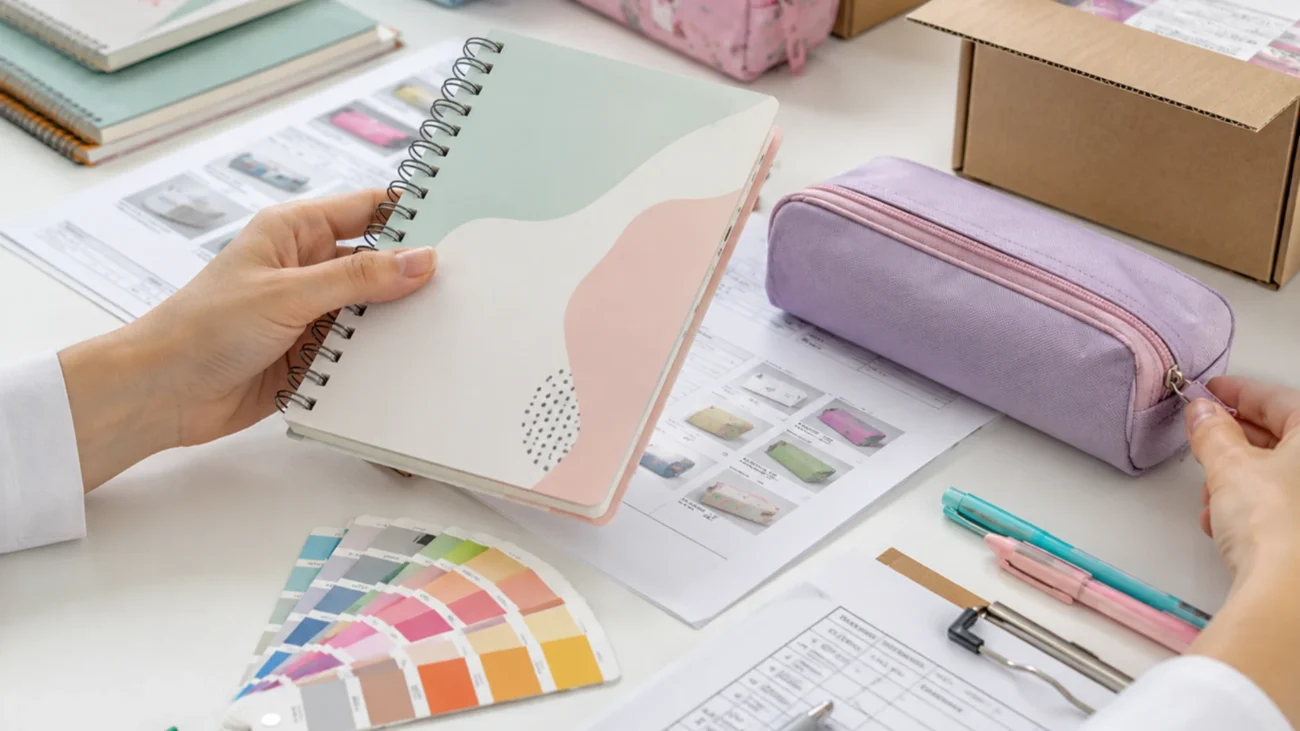
Quality problems can damage customer trust and create returns. A good sample and a clear quality control process are essential before bulk production. Importing products
Request samples before bulk production
Always request physical samples before placing a bulk order.
For ready-made products, ask for a sample from current production or stock. For custom products, ask for a pre-production sample that matches your final design, material, color, and packaging.
When checking samples, review:
- Product size
- Material quality
- Color accuracy
- Printing quality
- Function
- Packaging
- Weight
- Safety details
- Ease of use
For notebooks, check paper thickness, cover quality, binding, and printing. For pencil cases, check zipper smoothness, fabric, stitching, lining, and storage capacity. For markers, check ink flow, color quality, cap fit, and drying speed.
Inspect printing, materials, and packaging
When reviewing samples, look at them from the customer’s point of view.
Check:
- Are notebook pages smooth and well aligned?
- Does ink bleed through the paper?
- Is the pencil case zipper smooth?
- Are colors consistent?
- Is the logo or pattern printed clearly?
- Is the packaging strong enough?
- Does the product look suitable for retail display?
- Are labels and barcodes correct?
A product with good design but poor packaging may still fail in retail.
Ask about the quality control process
A professional stationery supplier should be able to explain their quality control process clearly.
Ask whether they check:
- Raw materials
- Printing
- Assembly
- Packaging
- Carton quantity
- Final product appearance
- Function
- Shipment condition
For large orders, buyers can also consider third-party inspection before final payment.
Decide Between Ready-Made, OEM, ODM, and Private Label Stationery
Different sourcing models fit different business goals. Buyers should choose based on budget, timeline, brand needs, and product differentiation.
Ready-made stationery supplies
Ready-made products are existing products from the supplier’s catalog. They are usually faster to ship and easier to test.
Best for:
- New retailers
- Small stores
- Fast seasonal restocking
- Product testing
- Basic product lines
- Lower-risk purchasing
The main advantage is speed. The main limitation is that competitors may sell similar products.
OEM stationery
OEM is suitable when you already have your own design, logo, artwork, or product specification. The supplier produces the product according to your requirements.
OEM can include:
- Custom logo printing
- Custom notebook covers
- Custom pencil case patterns
- Custom colors
- Custom stationery sets
- Buyer-provided artwork
- Brand-specific packaging
OEM is useful for brand owners, distributors, and retailers who want differentiated products.
ODM stationery
ODM is suitable when the supplier already has product designs, and you want to modify them for your market.
ODM can help when:
- You do not have a full design team.
- You want faster product development.
- You want to use proven product styles.
- You need new collections quickly.
- You want to test a market before full custom development.
For example, you may choose an existing pencil case shape and ask the supplier to change the color, pattern, or packaging.
Private label stationery
Private label stationery allows retailers to sell products under their own brand. It usually involves logo, packaging, barcode, and retail presentation.
Private label options may include:
- Logo on product
- Custom hang tags
- Color cards
- Gift boxes
- Barcode labels
- Display boxes
- Custom SKU labels
- Retail packaging
Private label is useful for long-term brand building, especially for online stores and retail chains.
Sourcing model comparison
| Sourcing Model | Customization Level | Typical Use | Time to Market |
|---|---|---|---|
| Ready-made | None or very low | Fast stock and testing | Fastest |
| Private Label | Logo and packaging | Retail brand building | Moderate |
| ODM | Color, print, material changes | Faster product development | Moderate |
| OEM | Full buyer design | Unique product development | Longest |
Build Product Bundles to Increase Retail Value
Product bundling is one of the most useful strategies for stationery retailers. It helps increase average order value and makes products easier to sell.
Back-to-school stationery bundles
Back-to-school bundles save time for parents and help retailers sell multiple items together. Back-to-school essentials checklist
Useful bundle ideas include:
- Pencil case + pencils + eraser + ruler
- Notebook + pen set + sticky notes
- Backpack + pencil case + stationery set
- Folder + notebook + writing tools
- Coloring book + markers + stickers
Bundles can be designed by age group, grade level, color theme, or product function.
Giftable stationery sets
Stationery also works well as a gift category. Cute stationery, themed notebooks, stickers, markers, and pencil pouches are easy to combine into giftable sets. Licensed character products
Giftable combinations include:
- Coloring book + markers
- Sticker book + notebook
- Cute stationery set
- Pencil pouch + gel pens
- Notebook + keychain
- Activity book + crayons
Giftable stationery sets are suitable for birthdays, holidays, classroom rewards, and back-to-school motivation gifts.
Retail display and impulse-buy products
Small stationery items can work well near checkout areas or in display boxes.
Examples include:
- Mini notebooks
- Gel pens
- Erasers
- Stickers
- Keychains
- Small pencil cases
- Sticky notes
- Decorative clips
These products may have low unit prices, but they can increase total basket value when displayed well.
Choose Packaging That Fits Your Sales Channel
Packaging protects the product, but it also affects how customers see its value. Buyers should choose packaging based on the sales channel.
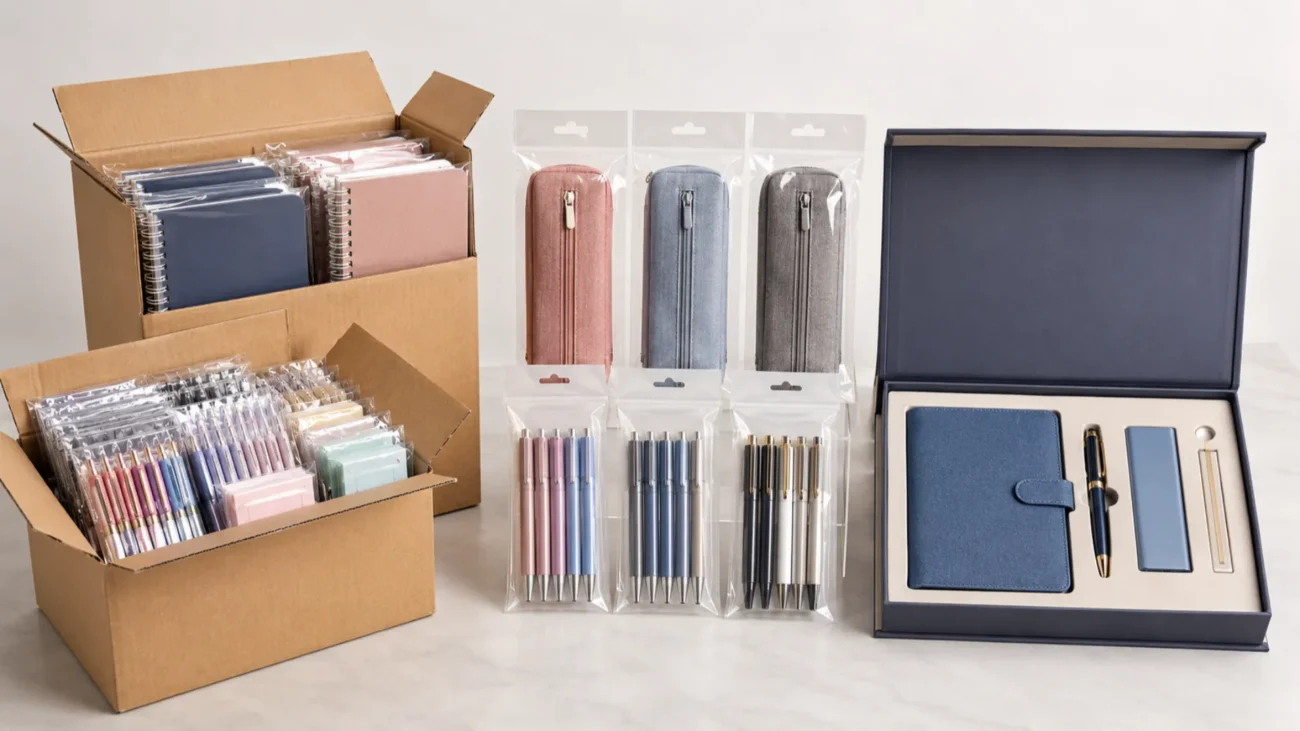
Simple bulk packaging
Simple bulk packaging is suitable for distributors, schools, and low-cost product lines.
Examples include:
- Poly bags
- Inner boxes
- Plain labels
- Bulk cartons
- Kraft paper wraps
This type of packaging helps reduce cost and shipping volume.
Retail-ready packaging
Retail-ready packaging is important for stores and gift sellers. It helps customers understand the product quickly and makes the product easier to display.
Examples include:
- Hang tags
- Header cards
- Display boxes
- Blister cards
- Gift boxes
- Window boxes
- Barcode labels
For kids stationery sets wholesale, packaging is especially important because the set should look attractive as a gift or seasonal display item.
Packaging for online selling
Online selling requires packaging that is strong enough for delivery and attractive enough for product photos.
Good online packaging should be:
- Clear
- Compact
- Strong
- Easy to label
- Good for photography
- Not too heavy
- Suitable for parcel shipping
For e-commerce sellers, packaging affects customer reviews, shipping cost, and product return rates.
Work with a Reliable Stationery Supplier
A reliable stationery supplier can support product selection, pricing, quality control, packaging, customization, shipping, and repeat orders.
How to choose the right school supplies supplier
Product range and category depth
A good stationery supplier should offer more than one product type. Buyers often need a mix of notebooks, pencil cases, writing tools, creative supplies, and stationery sets.
Check whether the supplier can provide:
- Basic stationery
- Paper products
- Pencil cases
- Creative stationery
- Stationery sets
- Packaging options
- Customization support
- Reorder support
A supplier with category depth helps buyers build stronger collections and reduce the need to manage many different factories.
Wholesale and export experience
For international buyers, export experience is important. A supplier should understand shipping terms, carton packing, product labeling, and export documents.
Ask whether the supplier can provide:
- Clear quotations
- Product specifications
- Carton size and weight
- Packing lists
- Commercial invoices
- Barcode support
- Shipping marks
- Freight forwarder coordination
This reduces communication problems and helps orders move more smoothly.
Communication and reorder support
Good communication is essential for wholesale buying.
A reliable supplier should:
- Respond clearly
- Provide complete product details
- Keep artwork and packaging records
- Support repeat orders
- Update stock information
- Suggest new product options
- Help with seasonal planning
For retailers and distributors, a supplier should not only complete one order. The better goal is long-term cooperation.
Common Mistakes When Buying Wholesale Stationery Supplies
Wholesale buying mistakes can lead to excess inventory, lower margins, quality complaints, and missed sales windows.
Buying too many styles without testing
Many new buyers choose too many designs at once. This spreads the budget too thin and increases inventory risk.
A better method is to start with a focused selection:
- Basic bestsellers
- Strong visual designs
- Practical stationery sets
- Seasonal products
- Items with clear target customers
After testing, reorder the best-performing products in larger quantities.
Ignoring packaging quality
Packaging affects both product protection and retail value. Weak packaging can cause damage during shipping and make a good product look cheap.
Check:
- Box strength
- Hang tag quality
- Label accuracy
- Barcode position
- Inner packing
- Carton packing
- Product presentation
Packaging should be part of the quality review, not an afterthought.
Choosing only by the lowest price
The lowest price may hide problems. A very cheap product may use thin paper, weak plastic, poor printing, low-quality ink, or weak packaging.
This can lead to:
- Product returns
- Bad reviews
- Damaged goods
- Poor retail display
- Lower customer trust
- Higher long-term cost
Choose the supplier that offers the best total value, not only the lowest quote.
Not planning for seasonal demand
Stationery sales are strongly affected by timing. Back-to-school, Christmas, and holiday gifting periods require early planning.
If buyers order too late, they may face:
- Limited stock
- Rushed production
- Higher shipping cost
- Delayed delivery
- Missed sales windows
- Lower product selection
Retailers and distributors should plan seasonal orders several months in advance, especially for customized products.
Wholesale Stationery Supplies Checklist for Buyers
Use this checklist before confirming a wholesale stationery order.
| Checklist Item | What to Check |
|---|---|
| Target Customer | Retail stores, online stores, distributors, school buyers |
| Product Mix | Balance basics, creative products, sets, and seasonal items |
| MOQ | Check by SKU, design, color, and packaging |
| Sample | Receive and approve physical samples |
| Price | Compare unit price and tiered pricing |
| Total Cost | Calculate landed cost, not just factory price |
| Quality | Check materials, printing, function, and packaging |
| Packaging | Choose bulk, retail-ready, or e-commerce packaging |
| Customization | Confirm logo, artwork, color, barcode, and private label options |
| Supplier Capability | Check product range, export experience, and reorder support |
| Delivery | Confirm production lead time and shipping schedule |
| Margin | Review landed cost, retail price, and promotion plan |
Frequently Asked Questions
What are wholesale stationery supplies?
Wholesale stationery supplies are stationery products purchased in bulk for resale, distribution, school supply programs, office use, or retail sales. They include items such as pencils, pens, notebooks, pencil cases, folders, coloring books, stickers, and stationery sets.
What stationery products are best for retailers?
Strong stationery products for retailers include stationery sets, pencil cases, notebooks, stickers, coloring books, markers, memo pads, erasers, and gel pens. Retailers should choose products that are practical, easy to display, and suitable for their target customers.
What is a good MOQ for small retail stores?
For ready-made products, small retailers should look for mixed-SKU orders or low-minimum assortments. For custom products, MOQ will usually be higher because of printing, packaging, and setup costs.
Can retailers buy mixed bulk stationery supplies?
Yes, many suppliers support mixed bulk orders, but buyers must confirm how MOQ is calculated. MOQ may apply by total quantity, SKU, color, design, or packaging type.
What is the difference between ready-made and custom stationery?
Ready-made stationery refers to existing products that can be ordered quickly. Custom stationery may include logo printing, custom colors, artwork, packaging, or product design changes. Custom products require more time and usually higher MOQ.
Can stationery products be customized with a logo?
Yes. Many stationery products can be customized through OEM, ODM, private label, or custom packaging options. Common customization includes logo printing, barcode labels, hang tags, display boxes, and branded gift packaging.
How can stationery retailers improve profit margins?
Retailers can improve margins by building bundles, choosing fast-moving SKUs, using attractive packaging, calculating landed cost carefully, and avoiding too much slow-moving inventory.
When should retailers buy back-to-school stationery?
Retailers should prepare back-to-school stationery several months before the sales season. Customized products need more time for sampling, packaging confirmation, production, inspection, and shipping.
How do I choose a reliable stationery supplier?
Check product range, sample quality, MOQ clarity, quotation details, export experience, communication speed, packaging options, and reorder support. A reliable supplier should provide clear information before you place a bulk order.
Conclusion
Wholesale stationery supplies are a strong category for retailers and distributors because they have repeat demand, seasonal sales potential, and strong bundling opportunities. Products such as notebooks, pencil cases, coloring books, stickers, writing tools, and kids stationery sets can support both daily sales and seasonal promotions.
Successful stationery buying requires more than comparing low prices. Buyers should define their target customers, choose the right product categories, understand MOQ, calculate total landed cost, review samples, check packaging, and work with a reliable stationery supplier.
For retailers, stationery can support back-to-school displays, gift sets, checkout impulse products, and online bundles. For distributors, bulk stationery supplies can serve many customers, from school supply stores to regional wholesalers and online sellers.
If you are looking for wholesale stationery supplies, kids stationery sets, pencil cases, notebooks, coloring books, stickers, or custom stationery products, working with a multi-category supplier can help you build stronger product collections and prepare for future sales seasons more efficiently.
Contact our team to discuss wholesale stationery options, MOQ, packaging, customization, and OEM/ODM solutions for your next product collection.
Contact our team